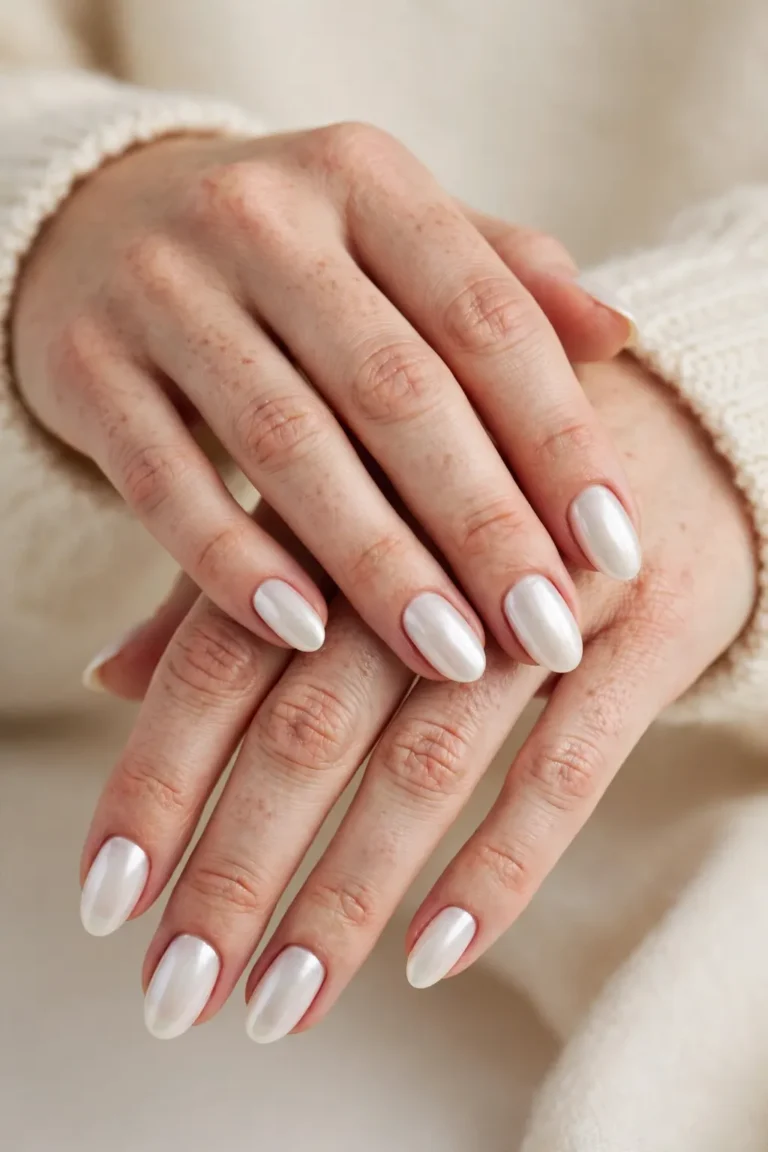
Velvet Nails: The Magnetic Cat-Eye Finish in Olive, Bronze & Wine
Velvet nails are the quiet-luxury version of the cat-eye manicure: the same magnetic polish, held under the magnet a fraction longer and a fraction further away, so the shimmer spreads into a soft, plush glow instead of a sharp line. Salon experts name velvet or cat-eye finishes the luxe autumn/winter 2026 finish (Stylist, A/W26), and the demand behind it is the same magnetic technology as ‘cat eye nails’ at 5,000,000 searches a month (Pinsearch, Nov 2026) — the velvet version is simply the softer, more wearable reading of that trend. This guide covers how velvet differs from a classic cat eye, the three shades that carry the look — olive, bronze and wine — plus soft milky and blush velvet, velvet on short nails, velvet by occasion, the exact wording for your nail tech, and how to do magnetic polish at home. For more beauty inspiration, start at AboutSuperstars.
Quick answer: Velvet nails are magnetic cat-eye polish held in a soft, diffused pattern: olive, bronze and wine shades suit most skin tones, last two to three weeks in gel, and need one magnet pass per nail — ask for two thin layers and a velvet, not sharp, cat-eye line.
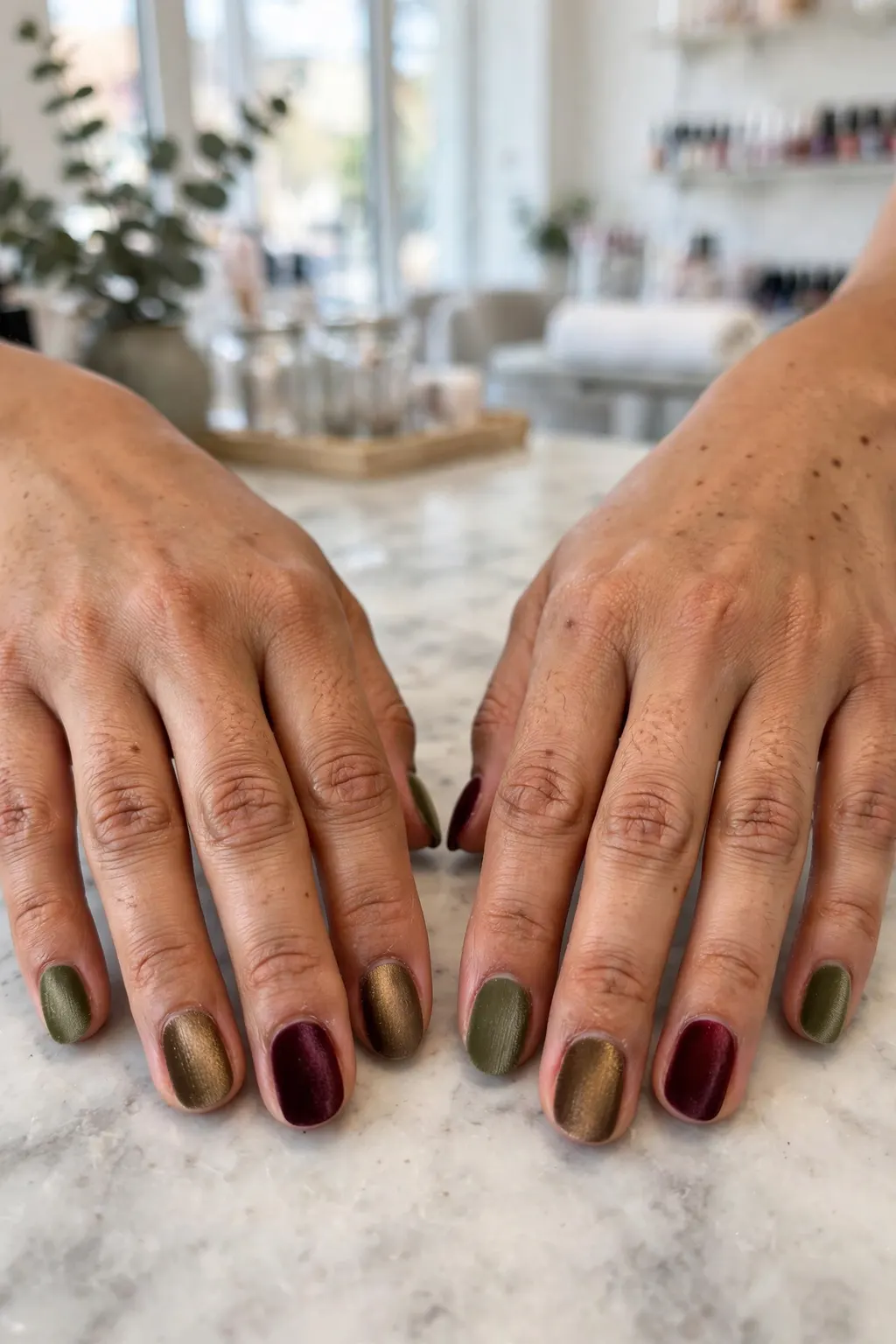
Velvet vs Cat Eye: Same Magnet, Different Light

Velvet nails and cat-eye nails use the same magnetic polish, and the difference between them is entirely in how the magnet is held: a cat eye is made by holding the magnet close and still, so the metallic particles gather into one sharp, bright line across the nail, while a velvet finish is made by holding the magnet further away and moving it slowly, so the same particles spread into a soft, diffused glow that looks like brushed fabric. The polish is identical — iron-oxide particles suspended in a dark gel base — and the velvet effect is a technique, not a product, which is why a good tech can give you either finish from the same bottle. The velvet version suits everyday wear better, because the glow shifts gently as the hand moves instead of flashing a hard line, and it photographs softer, which is why it reads as luxe rather than dramatic. A cat eye suits a party nail, where the sharp line is the point; velvet suits the nail you will live with for three weeks, because it never looks harsh in daylight and never fights with the rest of your outfit.
Best for: nail shapes, lengths and skin tones
Velvet suits every nail shape, because the glow is spread across the whole nail rather than drawn as a line, so there is no line to follow a curve or fight a corner: almond, oval, square and squoval all take it the same way. It suits medium and long lengths best, because a longer nail gives the glow more surface to move across, but it suits short nails too — the velvet section later in this guide covers exactly how — because the softness of the finish does not need length to read. It suits every skin tone, because the shade is the match, not the technique: olive flatters warm and neutral undertones, bronze flatters warm skin, wine flatters cool and deep skin, and the milky and blush versions flatter fair skin that finds dark shades too heavy. The rule is to match the base colour to the hand and let the magnet do the rest.
The exact wording to show your nail tech
Say: “Velvet nails, not a sharp cat eye — magnetic polish held soft and diffused, like brushed velvet, no hard line.” The three phrases that matter are the finish name, the softness and the line: if your tech hears only “cat eye”, you may get a sharp line when you wanted a glow; if they hear only “velvet”, you may get a matte texture coat instead of magnetic polish. Add the shade and the layer count — “two thin layers of the olive, magnet held high and slow” — and show a photo, because the difference between velvet and cat eye is a matter of millimetres of magnet distance, and a photo shows exactly how soft the glow should be.
How long it lasts and what it costs
A regular-polish velvet manicure lasts three to five days; a gel version lasts two to three weeks. The magnetic effect itself does not change the schedule — the particles are sealed under the top coat like any other gel colour — but a velvet finish shows wear at the free edge sooner than a plain colour, because the glow thins where the top coat wears, so a top coat wrapped over the edge matters more here than with a solid shade. Cost is a standard manicure or gel set plus a small add-on for the magnetic polish and the magnet work, because the polish costs more than a plain gel and each nail needs its own magnet pass; two thin layers are normally included in that add-on, and a third layer for extra depth is the only thing that should cost more.
Olive Velvet Nails: The Understated Luxe Shade

Olive velvet nails are the understated luxe shade of the velvet family: a deep, muted green base with a soft magnetic glow that reads as expensive precisely because it does not shout. Olive works as a velvet shade because the green is dark enough for the metallic particles to show against it, and muted enough that the glow reads as fabric rather than glitter — the nail looks like a piece of dark green velvet, not like a party nail that happens to be green. It suits autumn and winter best, because it sits naturally beside knitwear, camel coats and dark denim, and it suits work best of all the velvet shades, because it reads as a neutral at arm’s length and only reveals its shimmer up close. Olive is also the shade that flatters the widest range of skin tones in this family: warm undertones find it rich, neutral undertones find it calm, and cool undertones find it softened by the velvet diffusion, which takes the edge off a green that might otherwise read as harsh.
Step by step
Prep the nails — file to an even length, push back the cuticles, wipe with remover so the base grips — then paint a dark base coat, usually black or very dark green, and cure it, because the velvet glow needs a dark ground to show against. Then paint the first thin layer of magnetic olive polish and hold the magnet high above the nail, about a centimetre away, moving it slowly from side to side for ten seconds, so the particles spread into a soft cloud rather than a line. Cure, then repeat with a second thin layer and the same slow magnet pass, because two thin layers give the glow its depth — one layer reads as flat green, two layers read as velvet. Then seal with a glossy top coat, wrapped over the free edge, because gloss is what makes the velvet read as fabric rather than matte: a matte olive velvet looks dusty, while the same shade under gloss looks like brushed silk.
Common mistakes to avoid
The most common mistake is holding the magnet too close, which turns the velvet back into a sharp cat eye — a bright line across a dark green nail that looks dramatic rather than plush. The second is one thick layer instead of two thin ones: a thick layer of magnetic polish cures unevenly, the particles sink, and the glow comes out patchy, with bright spots beside dull ones. And the third is skipping the dark base coat, or using a light one: on a light base the olive reads as a pale, muddy green and the magnetic particles barely show, because there is no dark ground for the glow to stand out against. If any of these happen, the fix is the same — remove, re-base dark, and redo with two thin layers and the magnet held high.
Products and tools that help
A magnetic olive gel polish, a dark base coat in black or very dark green, a bar or round magnet (the bar gives a wider, softer glow than a small round one, which is why it suits velvet), and a glossy non-yellowing top coat, because gloss is the finish that makes the velvet read as fabric. A clean-up brush with remover keeps the dark base off the skin, which matters more with olive than with a nude, because a dark smudge on the skin shows instantly. Keep the magnet clean and dry between nails: a magnet with polish on it gives a weaker, uneven pull, and the glow comes out patchy from one nail to the next.
Bronze & Copper Velvet for Warm Skin Tones

Bronze and copper velvet nails are the warmest shades in the velvet family, and they are the ones that flatter warm skin tones most directly: a deep bronze or copper base with a soft magnetic glow that reads as molten metal softened by fabric, warm without being brassy. Bronze works as a velvet shade because its particles are naturally warm-toned, so the glow reads as part of the colour rather than sitting on top of it — the nail looks lit from within, not decorated. Copper is the brighter of the two, closer to a penny than to a coin, and it suits the reader who wants the velvet glow to be visible: on copper the shimmer is the point, while on bronze it is a secret the nail keeps until the light catches it. Both shades suit autumn best, because they sit naturally beside rust, camel, cream and dark green, and both suit evening well, because warm metallics catch candlelight and low light in a way cool shades never do.
Who should skip this version
Skip bronze and copper velvet if your skin is very cool-toned and you want the manicure to look soft rather than warm — on cool skin a copper glow can read as orange, and the warmth fights the hand instead of flattering it, so olive or wine will suit you better. Skip it too if you want a nail that reads as a neutral at work: bronze and copper are the most visible velvet shades, and even in their softest form they read as a statement, not a background. In both cases the honest fix is a quieter velvet — olive for a warm neutral, or soft milky velvet for a shade that disappears into the hand — and the bronze or copper saved for an evening or a weekend, where being noticed is the point.
Works best on: shapes and lengths
Bronze and copper velvet suit almond and oval nails best, because the longer, tapered shape gives the warm glow a long surface to travel across, and the movement of the glow is what makes the shade look molten rather than flat. They suit medium to long lengths well, because the warmth needs room to show its depth — on a very short nail the same shade can read as a single warm block, and the velvet softness is lost. They suit warm and neutral skin tones best, because the base is matched to the hand: warm skin takes a true copper, neutral skin takes a deeper bronze, and deep skin takes either, because both shades sit richly against it. Fair skin can wear bronze too, as long as the shade is deep rather than bright — a deep bronze on fair skin reads as luxe, while a bright copper on fair skin can read as orange.
Maintenance schedule
A regular-polish bronze or copper velvet manicure lasts three to five days; a gel version lasts two to three weeks. The weak point is the free edge, where the metallic glow wears first and the nail starts to look dull at the tip while the rest still shines — refresh the top coat at day three, wrapped over the edge, and the glow stays even. Keep cuticle oil on daily, because warm metallics draw the eye to the skin around the nail, and neat skin is what makes a bronze manicure look expensive rather than brassy. Avoid long soaks in hot water in the first day after the manicure, because heat and water lift a metallic gel faster than a plain colour, and the glow is the first thing to go.
Wine & Burgundy Velvet for Evening
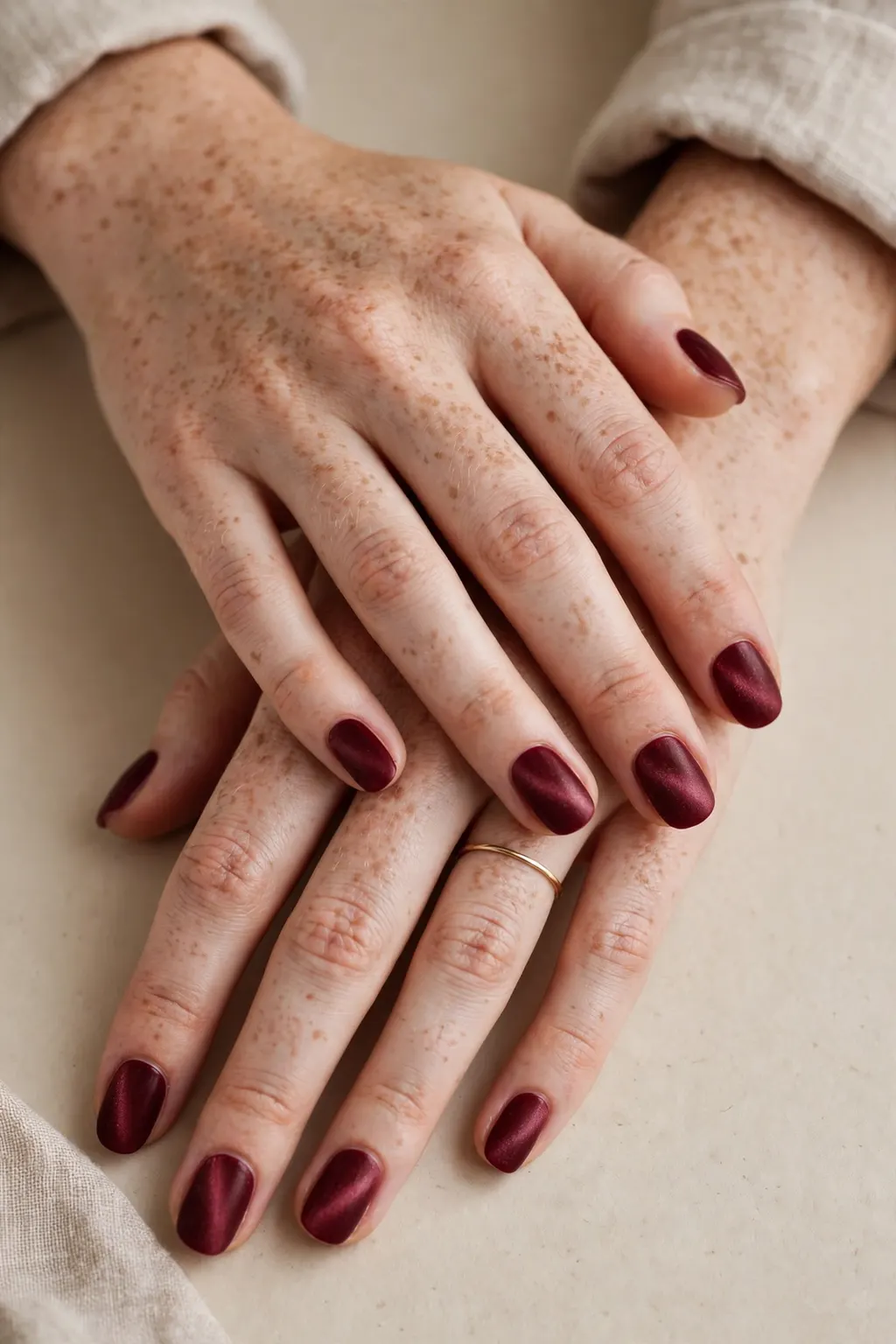
Wine and burgundy velvet nails are the evening shades of the velvet family: a deep red-wine base with a soft magnetic glow that reads as the most glamorous version of a colour most readers already own. Wine works as a velvet shade because it is dark enough for the particles to show, and red enough that the glow reads as warm rather than cold — the nail looks like a glass of red wine held up to the light, deep at the edges and glowing at the centre. Burgundy is the darker, browner cousin, closer to a dried rose than to a fresh one, and it suits the reader who finds wine a fraction too bright: on burgundy the velvet glow is subtler, and the nail reads as almost-black in low light, then reveals its red depth when the light catches it. Both shades suit evening best, because they were made for low light, and both suit the Christmas and New Year season, because a deep wine velvet sits naturally beside velvet dresses, gold jewellery and dark lipstick.
Best for: nail shapes, lengths and skin tones
Wine and burgundy velvet suit almond and square nails best, because the longer shape gives the deep colour room to show its glow, and the straight edge of a square frames the wine shade the way a frame suits a dark painting. They suit medium and long lengths well, because a deep shade needs surface to show its depth — on a very short nail the same wine can read as a single dark block, and the velvet softness is the thing that saves it, so short nails should ask for the softest magnet pass. They suit cool and deep skin tones best, because the red in the wine flatters cool undertones and the depth flatters deep skin, while warm skin takes wine too, as long as the shade leans burgundy rather than cherry — a blue-red wine on warm skin reads as rich, while a cherry-red wine on warm skin can read as pink.
The exact wording to show your nail tech
Say: “Wine velvet for evening — deep wine magnetic polish, soft diffused glow, no sharp cat-eye line, two thin layers.” The three phrases that matter are the shade, the softness and the layer count: if your tech hears only “wine”, you may get a plain wine gel with no magnetic glow at all; if they hear only “velvet”, you may get the wrong shade family entirely. Add the depth — “burgundy, darker than wine, almost black in low light” — if that is what you want, because wine and burgundy are close enough that a tech will guess wrong without the extra word, and show a photo, because the difference between wine velvet and a plain dark-red manicure is the glow, and a photo shows exactly how much glow you expect to see.
How long it lasts and what it costs
A regular-polish wine or burgundy velvet manicure lasts three to five days; a gel version lasts two to three weeks. Dark shades show chips and tip wear more clearly than light ones, so the top coat matters more here than with a pale velvet: refresh it at day three, wrapped over the free edge, and the wine stays sealed. Cost is a standard manicure or gel set plus a small add-on for the magnetic polish and the magnet work, because the polish costs more than a plain gel and each nail needs its own magnet pass; a third layer for extra depth on a dark shade is the only thing that should cost more, and it is worth asking for on burgundy, where the depth is the whole point.
Soft Velvet: Milky & Blush Magnetic Finishes

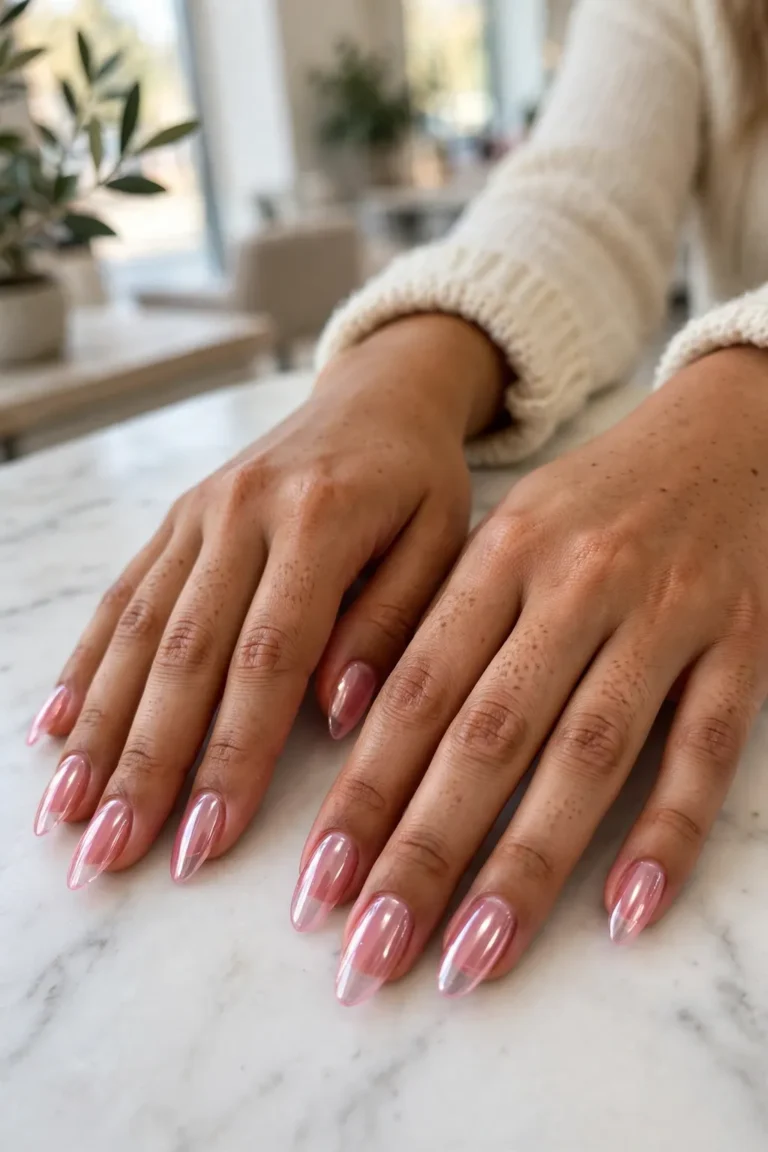
Soft velvet nails are the milky and blush versions of the magnetic finish: a sheer, pale base with a faint magnetic glow that reads as a whisper of the velvet trend rather than the full statement. Milky velvet is a sheer white base with a soft pearl glow, and blush velvet is the same idea in a sheer pink — both suit the reader who loves the velvet idea but finds olive, bronze and wine too dark for everyday wear. The soft versions work because the magnetic particles are finer and the base is lighter, so the glow reads as a sheen rather than a shimmer: the nail looks like polished stone, not like a decorated nail. They suit fair skin best, because a pale base flatters a pale hand without washing it out, and they suit work best of all the velvet shades, because they read as a clean, glossy manicure at arm’s length and only reveal their magnetic glow up close. The chrome family sits beside them — the sheer chrome pairing is Jelly Pink Chrome Nails, the glassy pink finish that shares the same sheer, light-catching idea in a chrome rather than a velvet form.
Step by step
Prep the nails — file to an even length, push back the cuticles, wipe with remover so the base grips — then paint a sheer milky or blush base coat and cure it, because the soft glow needs a pale ground to show against. Then paint the first thin layer of magnetic milky or blush polish and hold the magnet high above the nail, further away than you would for a dark velvet, moving it very slowly for ten seconds, so the fine particles spread into a faint sheen rather than a visible line. Cure, then repeat with a second thin layer and the same slow, high magnet pass, because two thin layers give the sheen its depth — one layer reads as a plain sheer manicure, two layers read as soft velvet. Then seal with a glossy top coat, wrapped over the free edge, because gloss is what makes a milky base read as clean rather than chalky: a matte milky velvet looks flat and almost grey, while the same base under a glossy top coat reads as fresh and deliberate.
Common mistakes to avoid
The most common mistake is holding the magnet too close, which turns the soft sheen into a visible line across a pale nail — a sharp cat eye on a milky base looks like a mistake rather than a design, because the contrast is wrong. The second is a base that is too opaque: a thick milky coat on any nail looks like white-out rather than a sheer base, and the magnetic glow cannot show through it at all. And the third is using a dark velvet polish instead of a soft one: a dark magnetic polish under a sheer top coat reads as a muddy grey, not as soft velvet, because the particles are too coarse for a pale finish. If any of these happen, the fix is the same — remove, re-base sheer, and redo with a soft magnetic polish, two thin layers and the magnet held high.
Products and tools that help
A magnetic milky or blush gel polish made for soft finishes (the particles are finer than in a dark velvet polish), a sheer milky or blush base coat, a bar magnet for the widest, softest glow, and a glossy non-yellowing top coat, because gloss is the finish that makes a milky base look clean and yellowing is the enemy of every pale manicure. A clean-up brush with remover keeps the pale base off the skin, which matters more with milky white than with colour, because a white smudge on the skin shows instantly. Keep the magnet pass slow and high: on a pale nail, speed makes the sheen patchy, and closeness makes it a line.
Velvet Nails on Short Nails: Plush Without Length

Velvet on short nails works because the velvet finish does not need length to read: the glow is spread across the whole nail, not drawn as a line, so a short nail carries the full effect in miniature. A short velvet nail reads as plush rather than cramped, because the softness of the finish flatters a small surface — where a sharp cat-eye line on a short nail can look like a scratch across a tiny canvas, a velvet glow on the same nail looks like a small piece of fabric. The shades that suit short nails best are the mid-depth ones — olive and wine — because a very dark velvet on a very short nail can read as a single dark block, while a mid-depth shade keeps the glow visible. Soft milky velvet suits short nails too, because a pale base elongates the nail, and the faint sheen is the detail that keeps it from reading as a plain manicure. The rule for short velvet is the same as for every short manicure: keep the shape neat, keep the cuticles tidy, and let the finish do the talking, because there is no length to distract the eye.
Who should skip this version
Skip velvet on short nails if your nails are very short — bitten to the quick or filed below the fingertip — because even a soft glow needs a millimetre of nail bed to sit on, and at that length a plain colour with a glossy top coat reads better than a magnetic finish squeezed onto skin. Skip it too if you want the velvet glow to be the star of the manicure: on a short nail the glow is a detail, not a display, and if you love the full drama of a long velvet nail, a short version will feel like a compromise. In both cases the honest fix is a simpler festive manicure — one deep colour, glossy and neat — and the velvet saved for when the nails have a week’s growth, when the glow has room to move.
Works best on: shapes and lengths
Velvet on short nails suits short square and squoval shapes best, because the straight edge gives the glow a clean frame to sit against, and it suits short round nails too, as long as the magnet pass is centred rather than pulled to one side. It suits short to very short lengths well, because the finish was made for a small surface — a nail that ends at the fingertip still has room for a full velvet glow, unlike a cat-eye line, which needs length to draw. It suits every skin tone, because the shade is the match, not the length: fair skin takes soft milky or olive velvet, medium skin takes olive or bronze, deep skin takes wine or burgundy, and the glow reads the same over all of them.
Maintenance schedule
A regular-polish short velvet manicure lasts three to five days; a gel version lasts two to three weeks. The weak point is the free edge, where the glow wears first and the short nail starts to look dull at the tip while the rest still shines — refresh the top coat at day three, wrapped over the edge, and the glow stays even. Keep cuticle oil on daily, because a short nail shows the skin around it more than a long one does: there is no length to distract the eye, and neat skin is what makes a short velvet manicure look expensive rather than improvised. Short nails also grow out faster in appearance, because the regrowth shows sooner on a small nail — book the infill or the redo at two weeks rather than three if you wear velvet on short nails.
Velvet Nails by Occasion: Work, Weddings, Parties

Velvet by occasion is a matter of choosing the shade, not the technique: the same soft magnetic glow works for work, for a wedding and for a party, and only the colour changes. For work, choose olive or soft milky velvet, because both read as neutrals at arm’s length and only reveal their shimmer up close — the manicure looks professional in a meeting and interesting in the lift afterwards. For a wedding, choose soft blush velvet or a pale wine, because both sit naturally beside a pale dress and gold jewellery, and the glow photographs as a sheen rather than a sparkle, which is what wedding photographs reward. For a party, choose bronze, copper or deep wine, because warm metallics and deep reds catch low light and candlelight, and the velvet glow is at its most dramatic when the room is dark. The same two thin layers and the same slow magnet pass make all three versions; the occasion is decided at the colour wall, not at the magnet.
Best for: nail shapes, lengths and skin tones
Velvet by occasion suits every shape, because the glow is spread across the whole nail rather than drawn as a line, so there is no line to follow a curve or fight a corner: almond for a party, oval for work, square for a wedding — the shape follows the event, not the finish. It suits medium and long lengths best for parties and weddings, because a longer nail gives the glow more surface to move across, and short lengths best for work, because a short velvet nail reads as tidy and deliberate. It suits every skin tone, because the shade is the match: fair skin takes soft milky or blush velvet for work and pale wine for a wedding, medium skin takes olive for work and bronze for a party, deep skin takes wine or burgundy for any occasion, because both shades sit richly against it.
The exact wording to show your nail tech
Say: “Velvet nails for [the occasion] — [the shade], soft diffused glow, no sharp cat-eye line, two thin layers.” The three phrases that matter are the occasion, the shade and the softness: if your tech hears only the occasion, you may get a party nail for a work meeting; if they hear only the shade, you may get a sharp cat eye when you wanted velvet. Add the depth — “olive for work, the understated one” or “wine for the party, the deep one” — and show a photo of the shade on a hand like yours, because the difference between a work velvet and a party velvet is a matter of shade depth, and a photo shows exactly how visible you want the glow to be.
How long it lasts and what it costs
A regular-polish velvet manicure lasts three to five days; a gel version lasts two to three weeks, whatever the occasion. The schedule does not change with the event — the particles are sealed under the top coat like any other gel colour — but a party velvet shows wear at the free edge sooner than a work velvet, because the glow thins where the top coat wears, so a top coat wrapped over the edge matters more before a party than before a work week. Cost is a standard manicure or gel set plus a small add-on for the magnetic polish and the magnet work, because the polish costs more than a plain gel and each nail needs its own magnet pass; the occasion changes the shade, not the price, and a third layer for extra depth on a dark party shade is the only thing that should cost more.
What to Ask Your Nail Tech: Magnet Technique & Layer Count
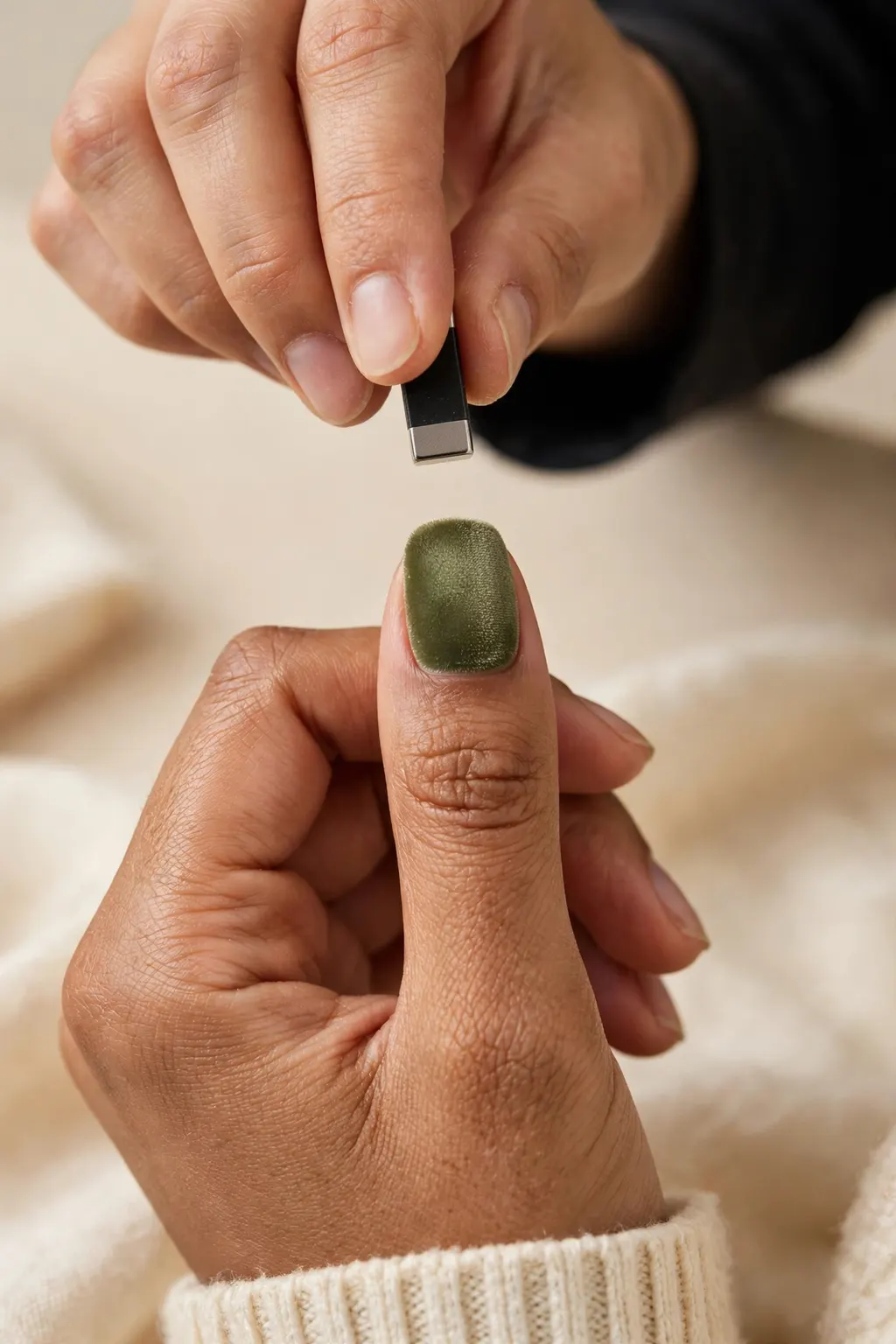
What to ask your nail tech about velvet nails comes down to two things — the magnet technique and the layer count — because those are the two decisions that decide whether you get velvet or a sharp cat eye. The magnet technique is the distance and the speed: the magnet held high and moved slowly makes velvet, the magnet held close and still makes a cat eye, and the difference is a matter of millimetres, so it needs to be said out loud rather than assumed. The layer count is the depth: one thin layer reads as flat colour, two thin layers read as velvet, and three thin layers read as deep velvet on a dark shade, so the count needs to be agreed before the work starts. Ask both questions before the polish comes out, not after the first layer is on, because a magnet pass cannot be undone once the layer is cured — the only fix is to remove the layer and start again, and that costs time and patience on both sides.
Your velvet nails salon brief: “Velvet, not cat eye — magnetic [olive / bronze / wine] polish, two thin layers over a dark base, magnet held high and moved slowly so the glow is soft and diffused, no hard line. Glossy top coat, wrapped over the free edge.” Bring a photo of the shade on a hand like yours, and one photo of the glow at the softness you want.
Step by step
Prep the nails — file to an even length, push back the cuticles, wipe with remover so the base grips — then paint the dark base coat and cure it, because the velvet glow needs a dark ground to show against. Then paint the first thin layer of magnetic polish and hold the magnet high above the nail, about a centimetre away, moving it slowly from side to side for ten seconds, so the particles spread into a soft cloud. Cure, then repeat with a second thin layer and the same slow magnet pass, because two thin layers give the glow its depth. Then ask your tech to show you one nail before sealing the hand: if the glow reads as a soft cloud, seal it with a glossy top coat, wrapped over the free edge; if it reads as a line, the layer comes off and the pass is redone high and slow, because a sealed line cannot be softened afterwards.
Common mistakes to avoid
The most common mistake is a tech who holds the magnet too close out of habit, because most magnetic work is cat-eye work and the hand remembers the close hold — watch the first nail, and say the words “higher and slower” before the second one if you see a line forming. The second is one thick layer instead of two thin ones: a thick layer cures unevenly, the particles sink, and the glow comes out patchy, with bright spots beside dull ones. And the third is sealing before checking: once the top coat is on and cured, a sharp line is locked in, and the only fix is a full removal. The check takes ten seconds and saves a redo — ask for it on the first nail, not the tenth.
Products and tools that help
A magnetic polish in your chosen shade, a dark base coat in black or very dark green, a bar magnet for the widest, softest glow, and a glossy non-yellowing top coat, because gloss is the finish that makes the velvet read as fabric. A clean-up brush with remover keeps the dark base off the skin, which matters more with velvet shades than with a nude, because a dark smudge on the skin shows instantly. Keep the magnet clean and dry between nails: a magnet with polish on it gives a weaker, uneven pull, and the glow comes out patchy from one nail to the next. If your tech uses a small round magnet, ask for the bar instead — the bar gives the wide, soft glow that velvet needs, while the round one gives the narrow line that cat eye needs.
Velvet at Home: Magnetic Polish Without the Salon
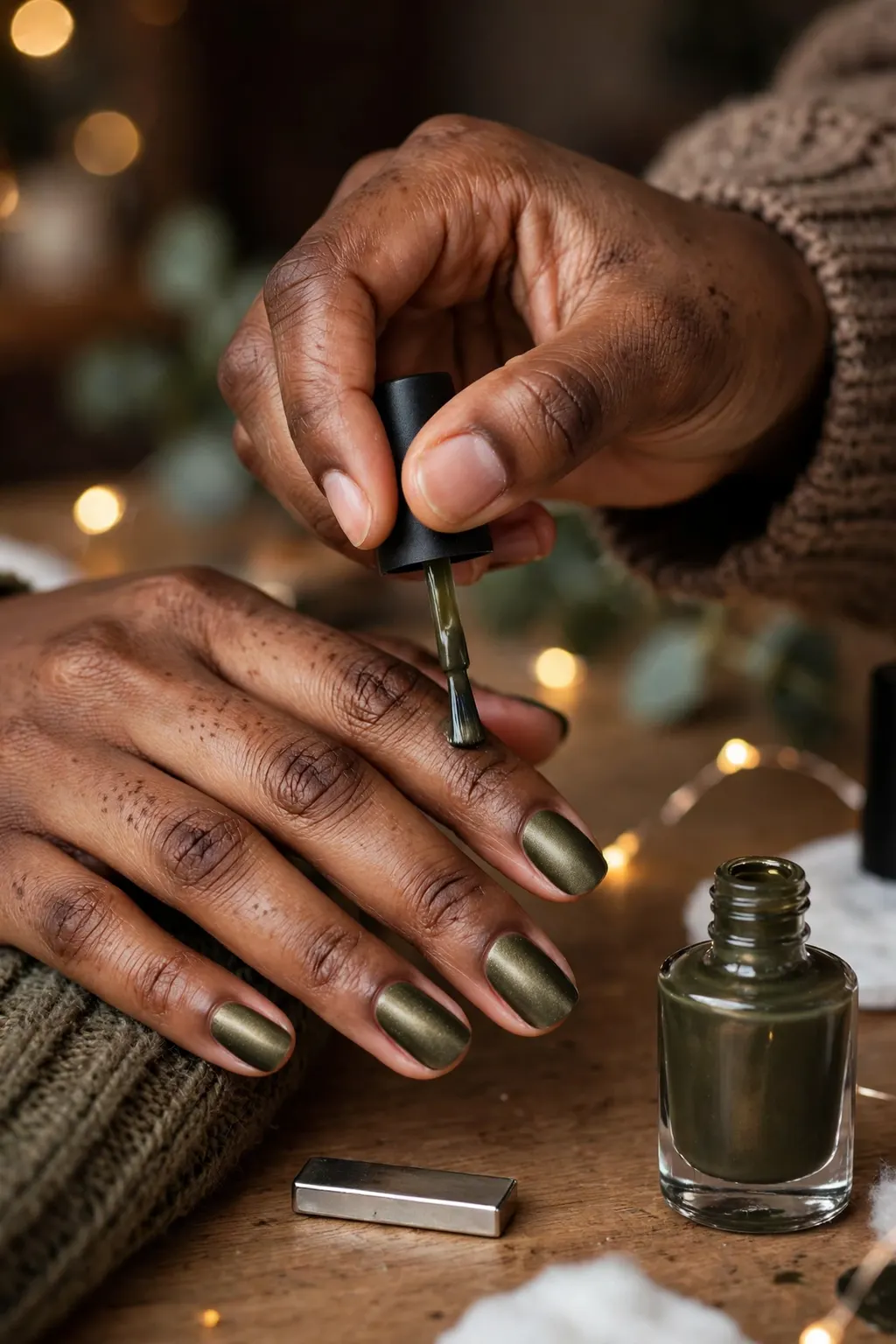
Velvet at home is possible with magnetic polish and a little patience, because the technique is the same one the salon uses — the difference is practice, not equipment. A home velvet manicure needs a magnetic gel polish, a magnet, a dark base coat and a UV or LED lamp if you choose gel, or a magnetic regular polish and no lamp if you choose the regular-polish version, which is the easier place to start. The home version suits a first try, because a regular magnetic polish can be removed with ordinary remover if the glow comes out wrong, while a gel version needs a soak-off and a redo. It suits a quiet evening, because each nail needs its own slow magnet pass and the whole hand takes half an hour of unhurried work — this is not a manicure to rush before leaving the house. And it suits the reader who already owns a lamp and a few gel colours, because the only new purchase is the magnetic polish and the magnet itself.
Who should skip this version
Skip velvet at home if you have never used gel polish before, because the lamp, the curing times and the soak-off removal are a learning curve of their own, and adding a magnet technique on top of it is two new skills at once — start with a magnetic regular polish instead, which needs no lamp and removes like any other polish. Skip it too if you want the velvet glow to be perfect on the first try: a home velvet takes two or three attempts before the magnet distance feels natural, and the first set will likely have one nail with a line and one with a patch. In both cases the honest fix is a salon visit for the first velvet, so you can see the technique done well, and the home kit for the second set, when you know what the glow is supposed to look like.
Works best on: shapes and lengths
Velvet at home suits short and medium nails best, because a smaller surface is easier to hold the magnet over evenly, and the glow is more forgiving on a short nail — a patch on a short nail reads as a detail, while the same patch on a long nail reads as a mistake. It suits oval and squoval shapes best, because the magnet pass is easiest over a gentle curve, and it suits every skin tone, because the shade is the match: fair skin takes soft milky or olive velvet at home, medium skin takes olive or bronze, deep skin takes wine or burgundy, and the glow reads the same over all of them. Start with olive, because it is the most forgiving shade at home — its muted green hides a patchy magnet pass better than any other velvet colour.
Maintenance schedule
A regular-polish home velvet manicure lasts three to five days; a gel version lasts two to three weeks. The weak point at home is the same as in the salon — the free edge, where the glow wears first — so wrap the top coat over the edge and refresh it at day three. Keep cuticle oil on daily, because a home manicure shows the skin around the nail more than a salon one does: there is no professional cuticle work to hide behind, and neat skin is what makes a home velvet look deliberate rather than improvised. Store the magnetic polish upright and away from magnets, including the fridge door: a polish that has sat beside a magnet loses its particles to one side of the bottle, and the glow comes out uneven from the first nail.
Frequently Asked Questions
Are velvet nails the same as cat eye nails?
No — velvet nails and cat eye nails use the same magnetic polish, but they are different finishes. A cat eye holds the magnet close and still, so the particles gather into one sharp, bright line. Velvet holds the magnet further away and moves it slowly, so the same particles spread into a soft, diffused glow that looks like brushed fabric. The polish is identical; the technique is what changes, and a good tech can give you either finish from the same bottle.
Can velvet nails be done with regular nail polish?
Yes, with a magnetic regular polish — several brands make one, and it needs no lamp and removes with ordinary remover. The glow is softer and shorter-lived than the gel version, lasting three to five days instead of two to three weeks, and the magnet pass works the same way: hold the magnet high and move it slowly while the polish is still wet. Regular magnetic polish is the best place to start if you have never tried velvet before, because a mistake removes easily and the second attempt costs nothing but time.
How long do velvet nails last?
A regular-polish velvet manicure lasts three to five days; a gel version lasts two to three weeks. The magnetic effect itself does not change the schedule, because the particles are sealed under the top coat like any other gel colour. The glow thins first at the free edge, so a top coat wrapped over the edge and refreshed at day three keeps the velvet even for the full wear, and daily cuticle oil keeps the skin around the nail neat enough for the finish to read as expensive.
Conclusion & Bottom Line
Velvet nails are the soft reading of the magnetic trend: the same polish as a cat eye, held further away and moved more slowly, so the shimmer spreads into a plush glow instead of a sharp line. Olive is the understated luxe shade, bronze and copper are the warm ones, wine and burgundy are the evening ones, and milky and blush are the soft ones that suit work and fair skin. Two thin layers over a dark base, a magnet held high and slow, and a glossy top coat wrapped over the edge are the whole technique — and the words “velvet, not cat eye” are the whole brief. Pick the shade that flatters your skin tone, show your tech a photo of the softness you want, and check the first nail before the hand is sealed.
Bottom line: velvet nails are magnetic polish, held soft — two thin layers, a high slow magnet pass, and the shade that suits your skin tone.