Coffee Nails: Espresso, Iced Latte & Mocha Shades for Every Skin Tone
Brown is having its moment on nails, and coffee nails are the reason. The idea is simple: take the browns you already know from a coffee menu — the near-black depth of espresso, the mid-brown sweetness of mocha, the milky softness of an iced latte — and wear them as a manicure, matched to your skin tone the way you would match a foundation. Searches for “coffee nails ideas” are climbing fast: Pinterest’s Beauty Trend Report (6 Oct 2026) puts coffee nails ideas up 922%, iced latte nails up 295% and latte brown nails up 293%. This guide covers the whole coffee menu from flat white to double espresso, the deepest espresso shade, the mocha sweet spot, milky iced latte, caramel latte swirls, coffee French and ombré fades, matching browns to your skin tone, the exact wording for your nail tech, and the care that keeps browns glossy instead of dull. For more beauty inspiration, start at AboutSuperstars.
Quick answer: Coffee nails are brown manicures ordered like a coffee menu — deep espresso, mid-brown mocha, milky iced latte — matched to your skin’s undertone. Ask for the depth by name, keep the finish glossy, and seal with a top coat wrapped over the tip, and the colour stays rich for two to three weeks in gel.
The Coffee Menu: From Flat White to Double Espresso
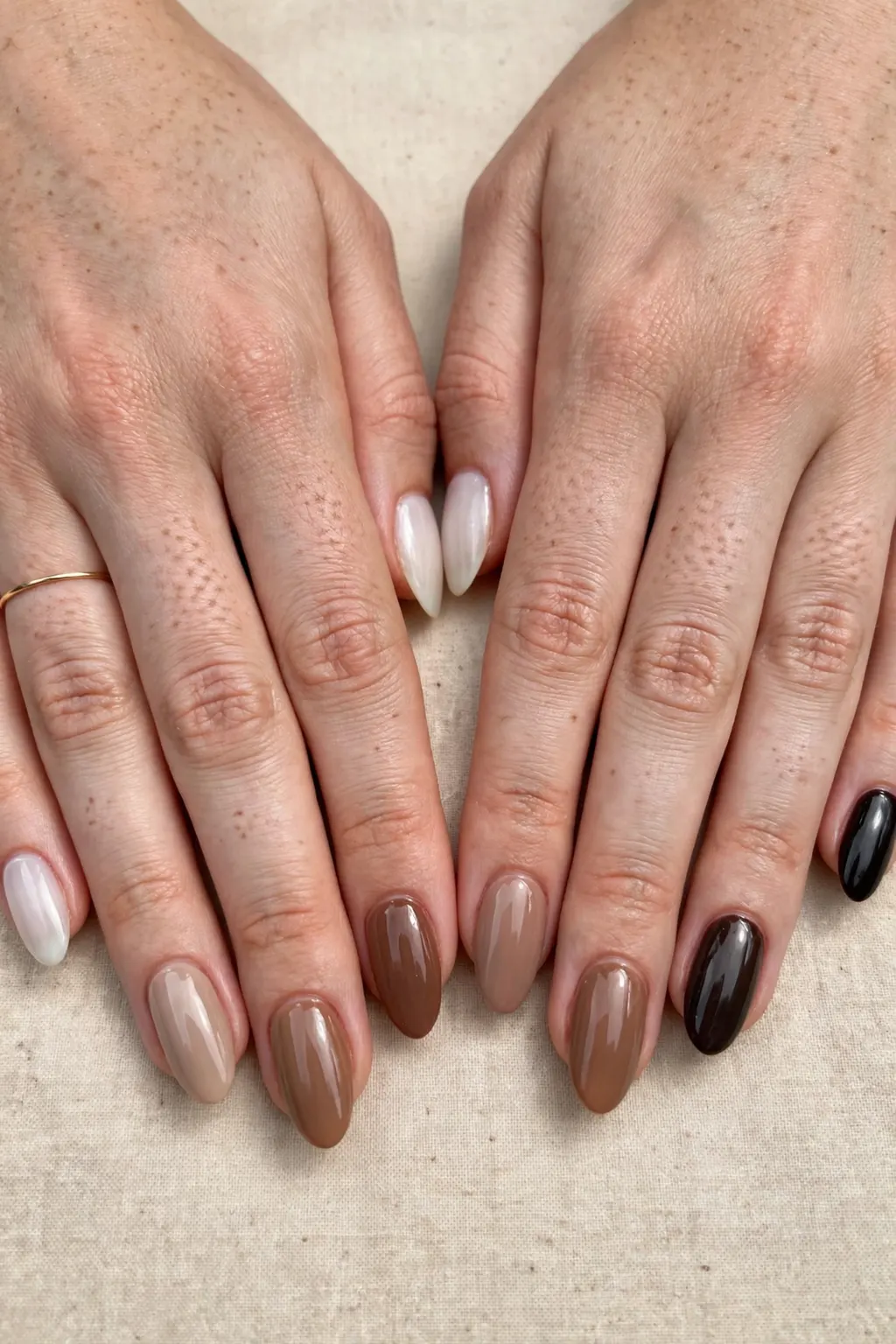
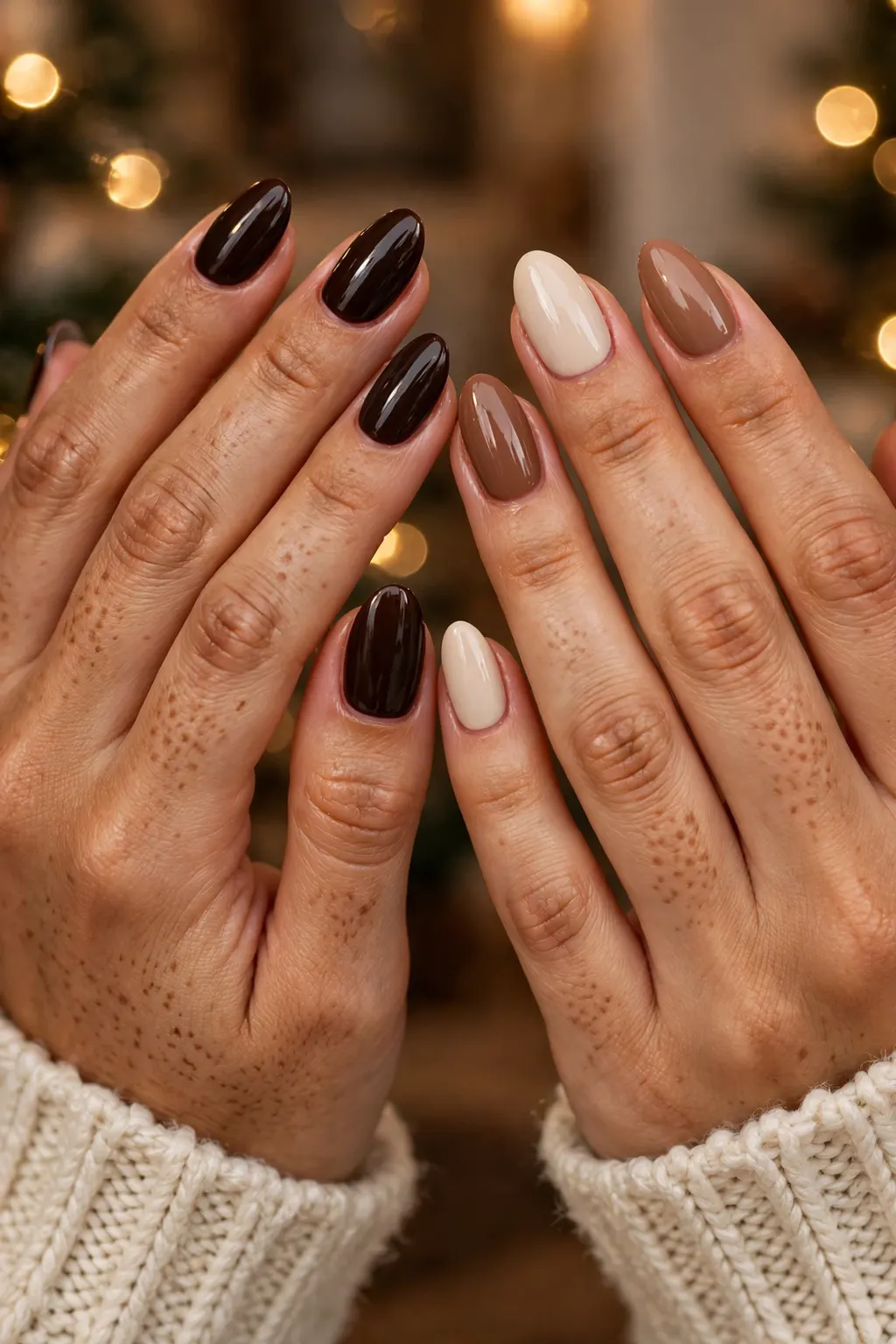
Coffee nails work because the menu gives you a shared language for depth. A flat white is a milky, sheer brown that barely covers the nail. A latte is a soft mid-brown with milk in it. A mocha is a warmer mid-brown with a hint of chocolate. An espresso is a deep, near-black brown that reads as almost black in dim light and richly brown in daylight. When you order by the menu, your nail tech knows exactly how dark to go, and you know exactly what to expect — there is no guessing at a colour chart, no “a bit darker than that” that means different things to different people. The menu also explains why coffee nails suit so many people: there is a depth for every skin tone, from a sheer flat white on very fair skin to a double espresso on deep skin, and the same family of browns flatters all of them because brown is a warm neutral that sits naturally against skin. If you want the wider story of brown neutrals this winter, our Caramel, Coffee & Latte Nails guide covers caramel nudes and latte shades by skin tone — this guide is the coffee half of that palette, taken shade by shade.
Best for: nail shapes, lengths and skin tones
The coffee menu suits every shape and length, because the choice is about depth, not about a pattern that needs room. It suits short nails best of all: a single deep colour on a short nail looks deliberate and polished, and it needs no length to read clearly. It suits almond and square nails equally — the colour sits on the whole nail, so the shape does not fight it. It suits every skin tone, because the menu runs from sheer to near-black: fair skin takes the milky end, medium skin takes the mocha middle, deep skin takes the espresso end, and everyone in between finds their depth somewhere on the menu.
The exact wording to show your nail tech
Say: “Coffee nails — I want an espresso depth” — or mocha, or iced latte — “in a glossy gel finish, on almond nails” — or your shape. The two phrases that matter are the menu word and the finish: if your tech hears only “brown”, you may get a flat brown that is neither warm nor deep; if they hear only “dark”, you may get a black that has no brown in it at all. Showing a photo helps here, because the difference between mocha and espresso is a matter of a few shades, and a photo settles it instantly.
How long it lasts and what it costs
A regular-polish coffee manicure lasts three to five days; a gel version lasts two to three weeks, the same as any gel manicure. The colour itself does not change the schedule — a deep espresso chips at the same rate as a milky latte — but darker browns show chips more clearly, so a top coat wrapped over the free edge matters more at the espresso end of the menu. Cost is a standard manicure or gel set; a single coffee colour is not an add-on, because it is just a polish colour, and if a salon charges extra for a brown, ask what it includes.
Espresso Nails: The Deepest Coffee Shade
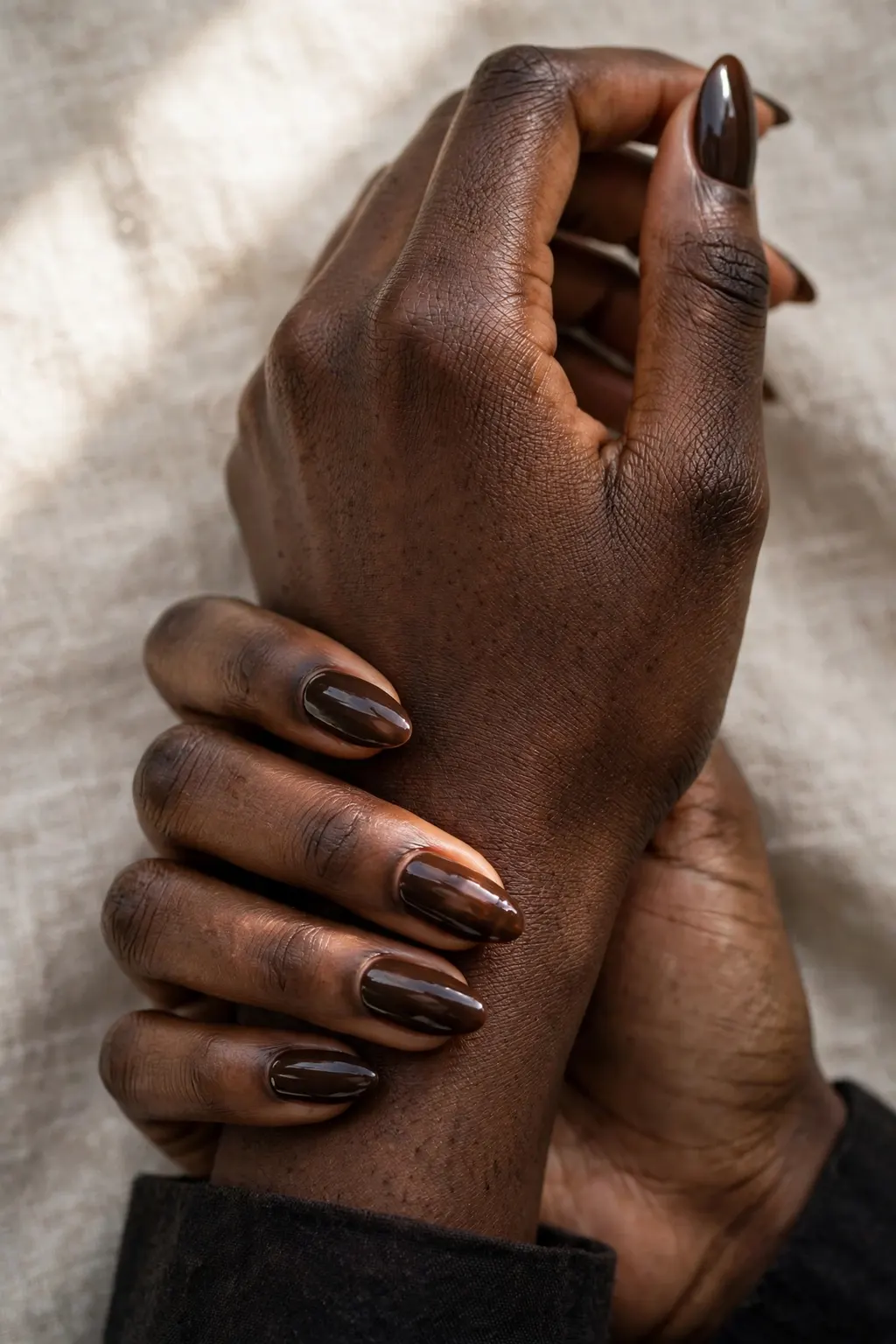
Espresso nails are the deepest coffee shade there is: a brown so dark it reads as black in a dim room and as a rich, warm brown in daylight. That is the whole appeal — it has the drama of a black manicure without the harshness, and the warmth of a brown without looking washed out. Espresso suits winter especially well, because a deep colour looks deliberate against dark clothes and pale winter light, and it suits evening best of all, because the depth shows up in low light where a mid-brown would disappear. The shade to ask for is a true espresso, not a black with a brown name: hold the bottle against a black polish and you should see the brown in it. If it looks identical to black, it is black, and the warmth that makes espresso flattering is missing.
Step by step
Prep the nails — file, push back the cuticles, wipe with remover so the base grips — then a base coat, cured or dried. Then the espresso colour: two thin coats, not one thick one, because a deep colour shows every streak and a thick coat never dries evenly. Let the first coat dry fully before the second, or the second drags the first and the depth turns patchy. Then a glossy top coat, wrapped over the free edge, because gloss is what makes espresso read as coffee rather than as black: a matte espresso looks flat and muddy, while a glossy one shows the brown in the light.
Common mistakes to avoid
The most common mistake is choosing a shade that is actually black and calling it espresso — the manicure looks harsh, and the warmth that flatters the hand is gone. The second is one thick coat instead of two thin ones, which streaks and never dries properly, so the colour dents at the first touch. And the third is skipping the top coat, or using a matte one by accident: espresso without gloss looks dull and almost grey-brown, while the same colour under a glossy top coat reads as deep, rich coffee.
Products and tools that help
A true espresso-brown gel or polish (test it against black before you commit), a ridge-filling base coat so the deep colour goes on evenly, and a glossy non-yellowing top coat, because gloss is the finish that makes the brown visible. A fine file for shaping before the colour goes on matters more with a dark shade than with a light one, because a dark colour shows every uneven edge. Keep the bottle clean around the neck, or dried polish drags into the coat and streaks the finish.
Mocha & Cacao: The Mid-Brown Sweet Spot
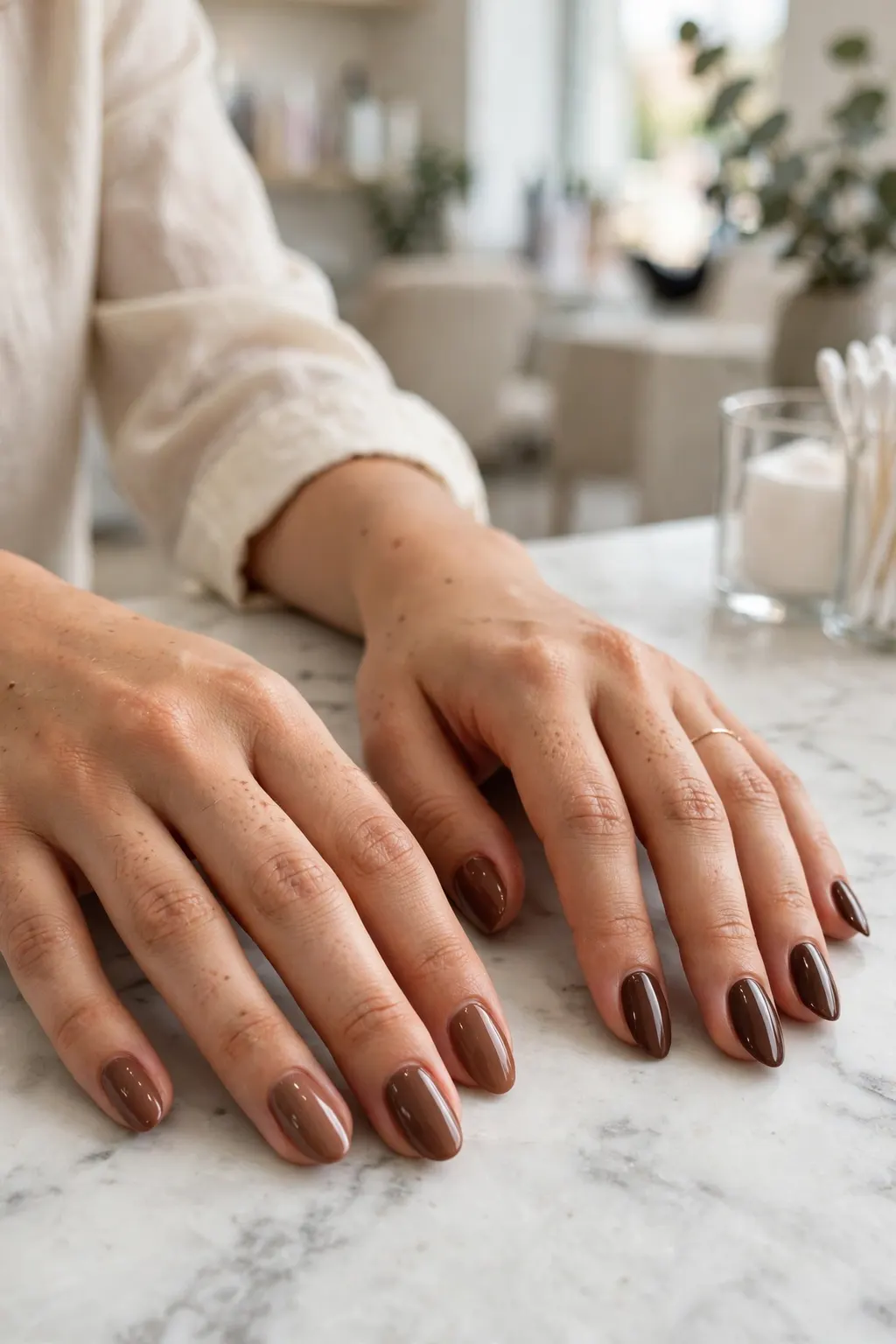
Mocha and cacao sit in the middle of the coffee menu, and that middle is the sweet spot for most people. Mocha is a warm mid-brown with a hint of chocolate in it; cacao is a touch deeper and a touch cooler, like dark chocolate rather than milk chocolate. Both are dark enough to read as a colour rather than a nude, and light enough to show the brown clearly in any light — which is why they are the easiest coffee shades to wear every day. They suit work, because they read as a polished neutral rather than a statement. They suit every season, because a mid-brown is neither a summer pastel nor a winter black. And they are the most forgiving coffee shades for a beginner at home, because a mid-brown hides a small mistake better than a sheer milky shade or a near-black one.
Who should skip this version
Skip mocha and cacao if you want your nails to read as either clearly dark or clearly light — the mid-brown sits in between, and if you love the drama of espresso or the softness of iced latte, mocha will feel like a compromise rather than a choice. Skip them too if your skin is very fair and cool-toned and you want the most flattering brown: a warm mocha can look slightly orange against cool fair skin, and the cooler cacao or the milky iced latte will suit you better. In both cases the fix is not a different mid-brown, it is a different end of the menu.
Works best on: shapes and lengths
Mocha and cacao suit every shape and length, because they are single-colour manicures and the colour does the work. They suit short nails especially well, because a mid-brown on a short nail looks neat and finished without needing length to carry it. They suit almond nails well, because the warm brown follows the curve of the nail, and they suit square nails too, because the straight edge gives the colour a clean frame. They suit medium and deep skin tones best of all, because a warm mid-brown glows against them, and they suit fair skin with the cooler cacao rather than the warmer mocha.
Maintenance schedule
A regular-polish mocha manicure lasts three to five days; a gel version lasts two to three weeks. The weak point is the tip, where a mid-brown meets the free edge — refresh the top coat at day three, wrapped over the edge, and the colour stays sealed. Keep cuticle oil on daily, because a mid-brown shows dry cuticles more than a sheer shade does: there is nothing else to look at, and neat skin is what makes a simple colour look expensive.
Iced Latte Nails: Cool, Milky & Sheer

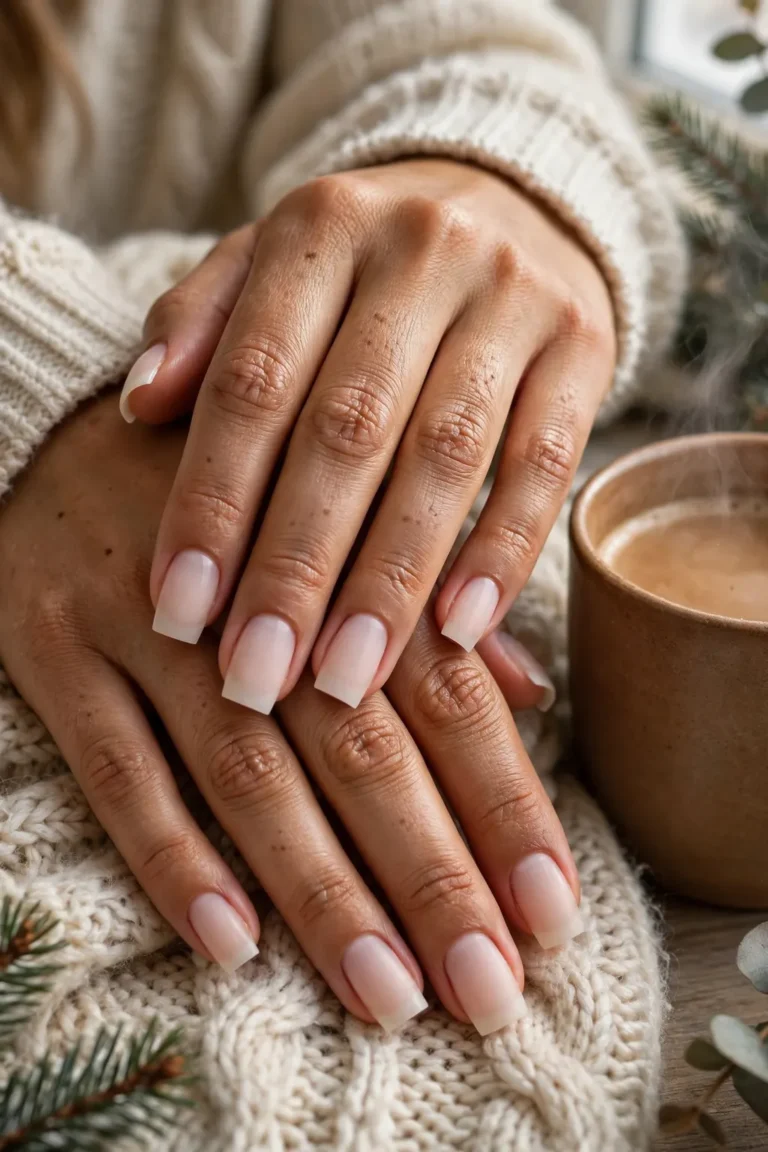
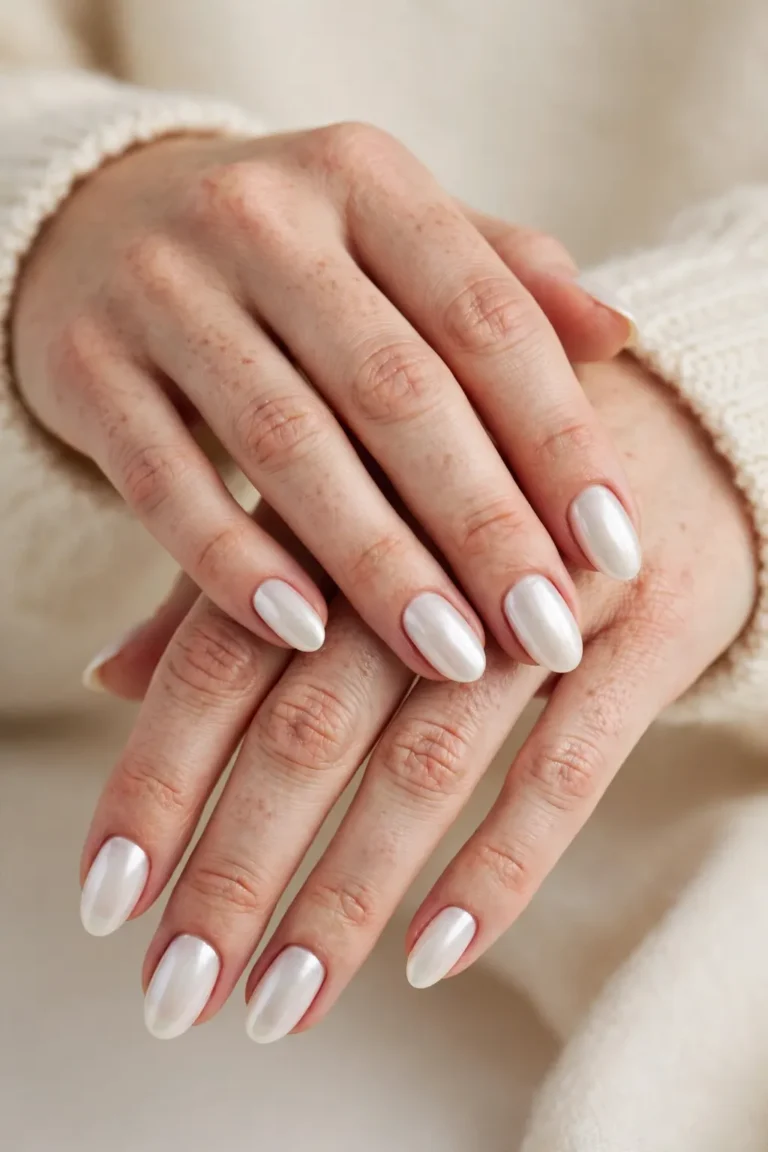
Iced latte nails are the milky end of the coffee menu: a sheer, cool brown that lets the natural nail show through, like milk poured into iced coffee. The colour is barely there, and that is the point — it reads as clean, healthy, expensive nails rather than as a colour at all. Iced latte suits fair and cool-toned skin best, because the milky sheer does not warm the hand the way a caramel brown would, and it suits work better than any other coffee shade, because it is the closest thing to a nude in the whole menu. If you love the soft-glam chrome family, the milky side of this look pairs naturally with our Milky White Chrome Nails on Almond guide — the same sheer milky base, with a chrome veil over it instead of a coffee tint.
Best for: nail shapes, lengths and skin tones
Iced latte suits short to medium nails best, because a sheer colour on a very long nail can look washed out, while on a short or medium nail it looks clean and deliberate. It suits almond and round nails well, because the soft curve suits the soft colour, and it suits square nails too, as long as the corners are kept soft rather than sharp. It suits fair and light skin tones best of all, and it suits cool undertones especially well — the milky sheer flatters a cool hand in a way a warm caramel cannot. On deep skin, iced latte still works, but it needs two coats rather than one so the milky colour actually shows.
The exact wording to show your nail tech
Say: “Iced latte — a sheer milky brown, not opaque, on almond nails” — or your shape — “one or two thin coats, so the nail still shows through.” The two phrases that matter are “sheer” and “milky”: if your tech hears only “brown”, you may get an opaque mid-brown; if they hear only “latte”, you may get a warm caramel that is the wrong temperature for a cool hand. Showing a photo helps here, because the difference between sheer and opaque is a matter of one coat, and a photo shows exactly how much nail should show through.
How long it lasts and what it costs
A regular-polish iced latte manicure lasts three to five days; a gel version lasts two to three weeks. The sheer finish is the weak point: a sheer colour shows chips and tip wear faster than an opaque one, because there is no depth of colour to hide behind — so a top coat wrapped over the free edge is not optional here. Cost is a standard manicure or gel set; a sheer milky brown is a normal polish colour, not an add-on, and a second thin coat to build the milkiness is part of the manicure.
Caramel Latte Swirls & Two-Tone Coffee Designs
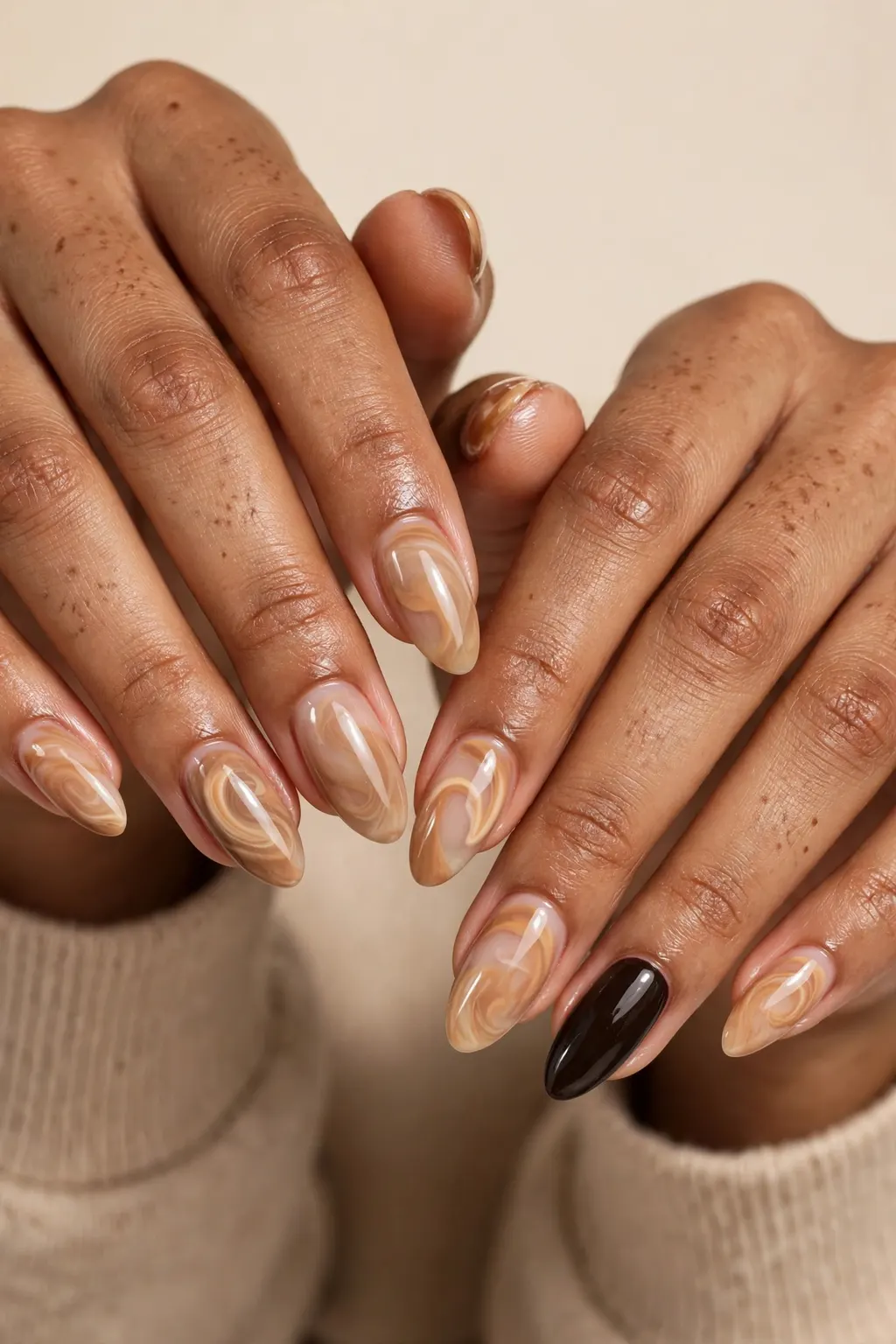
Caramel latte swirls are the first coffee design in this guide, and they are the one to choose when a single colour feels too plain. The design is exactly what it sounds like: a caramel brown swirled through a milky latte base, like the swirl on top of a flat white. Two-tone coffee designs are the simpler version: some nails in espresso, some in iced latte, or a caramel accent nail against milky nails. Both work because the colours come from the same menu — espresso, mocha, caramel and milky latte are all browns, so they sit together naturally, and the contrast between them is gentle rather than sharp. The swirl suits a party or a holiday best, because it has movement in it; the two-tone suits every day, because it is just a colour change from nail to nail.
Step by step
Prep the nails, then a base coat. For a swirl: paint the milky latte base in two thin coats and let it dry, then draw a thin caramel line across each nail with a liner brush or a toothpick, and drag it gently into a swirl with a clean brush before it dries — one drag per nail, no more, or the swirl turns to mud. For a two-tone: paint the nails in their two colours, alternating or with one accent nail, two thin coats each, and let each coat dry before the next. Then a glossy top coat over everything, wrapped over the free edge, so the swirl is sealed flat and the two tones share one shine.
Common mistakes to avoid
The most common mistake with a swirl is overworking it: dragging the caramel more than once turns a soft swirl into a muddy brown, and the two colours lose each other. The second is using colours that are too close together — a mocha swirl on a mocha base disappears, so the caramel needs to be clearly lighter or darker than the base. And the third, for two-tone designs, is picking two browns from different temperatures — a warm caramel against a cool espresso can clash — so keep both tones warm or both cool, and the design sits together.
Products and tools that help
A milky latte base polish, a caramel brown for the swirl, a thin liner brush or a toothpick for drawing the line, and a glossy top coat to seal the swirl flat. A dotting tool helps for the two-tone accent version, where a single caramel dot on a milky nail is the design. Keep a clean brush or a cotton bud with remover nearby, because a swirl that goes wrong is fixed by wiping that nail and starting it again, not by adding more caramel.
Coffee French & Ombré Fades
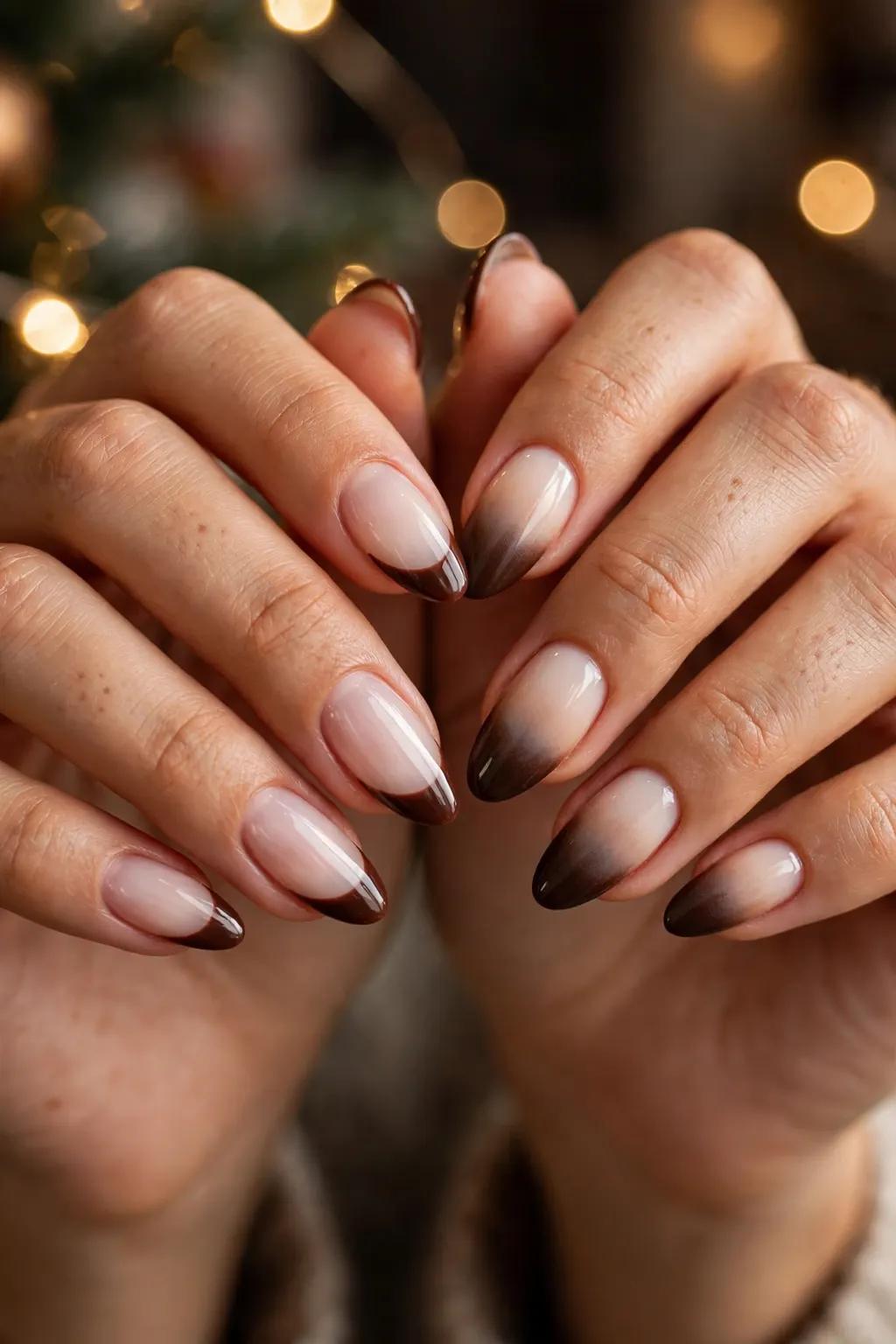
Coffee French and ombré fades are the two gradient ways to wear the coffee menu, and they are the most elegant versions of it. A coffee French is a French manicure with the tip in a coffee brown — deep espresso for drama, mocha for everyday, caramel for a soft version — on a sheer milky base. An ombré fade is the same family blended: the colour melts from a deep espresso at the tip into a milky latte at the cuticle, with no hard line anywhere. Both suit occasions best, because the gradient reads as done on purpose in a way a single colour does not. The French is the easier of the two to ask for and the easier to maintain; the ombré is the softer, more forgiving one, because a blend has no line to keep straight.
Who should skip this version
Skip the coffee French if you have very short nails and want the tip to show: on a very short nail, a French tip takes up most of the nail, and the sheer base disappears — a full coffee colour suits a very short nail better. Skip the ombré if you are doing your own nails at home for the first time: blending a fade smoothly needs a sponge and a light touch, and a first attempt often comes out streaky. In both cases the fix is the single colour from the same menu, which gives you the coffee shade without the technique.
Works best on: shapes and lengths
Coffee French suits medium to long nails best, because the tip needs room to read as a tip rather than as the whole nail. It suits square and almond nails well, because the edge gives the tip a clean line to follow. Ombré suits medium to long nails too, because the fade needs length to blend across — on a short nail, the fade has nowhere to go. Both suit every skin tone, because the base is sheer and the tip or fade can be matched to the hand: espresso for deep skin, mocha for medium, caramel for fair.
Maintenance schedule
A regular-polish coffee French or ombré lasts three to five days; a gel version lasts two to three weeks. The weak point is the tip, where the brown meets the free edge — refresh the top coat at day three, wrapped over the edge, and the line stays sealed. For ombré, the weak point is the blend itself: if the top coat wears thin, the fade starts to look patchy, so the same day-three refresh protects it. Keep cuticle oil on daily, because a gradient manicure shows dry skin around the nail more than a single colour does.
Coffee Shades by Skin Tone: Warm vs Cool Browns
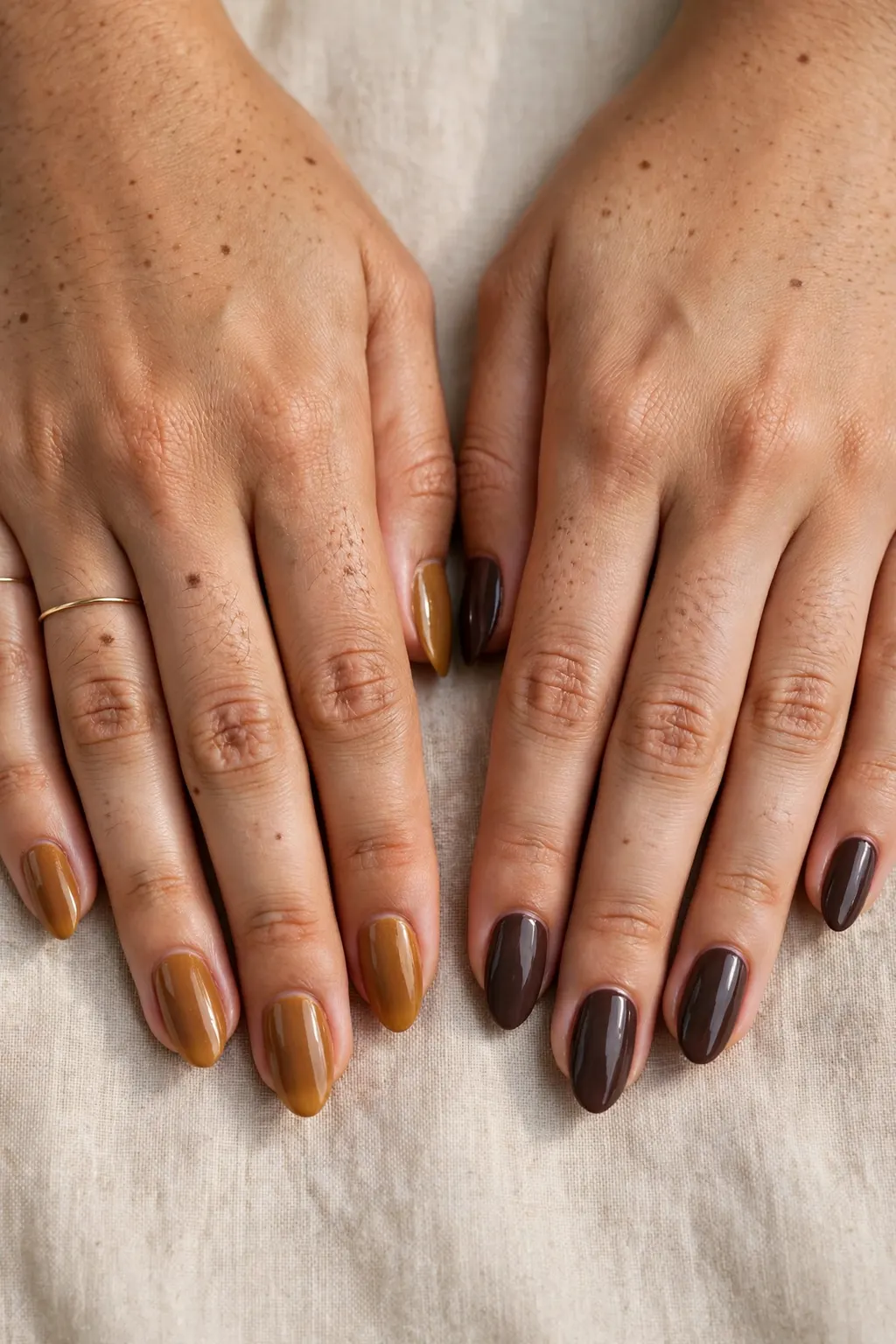
The difference between a coffee manicure that flatters you and one that washes you out is temperature, not depth. Warm browns — caramel, mocha, milk chocolate — have a golden or reddish undertone, and they flatter warm and olive skin, because they sit in the same family as the skin’s own warmth. Cool browns — espresso with a grey cast, cacao, iced latte — have a neutral or slightly ashy undertone, and they flatter cool and fair skin, because they do not add warmth the skin does not have. The test is simple: hold the bottle against the inside of your wrist. If the brown looks golden next to your skin, it is warm; if it looks grey-brown, it is cool. Then match warm to warm and cool to cool, and the manicure will look like it belongs on your hand rather than sitting on top of it.
Best for: nail shapes, lengths and skin tones
Skin-tone matching suits every shape and length, because it is a colour choice, not a design choice. It suits fair skin best with the cool end of the menu — iced latte, cacao, a cool espresso — because a warm caramel on very fair cool skin can read orange. It suits medium skin with the widest range, because medium skin takes both warm mocha and cool cacao. It suits deep skin best with the deepest shades — espresso and dark mocha — because a sheer milky brown can disappear against deep skin, while a deep brown glows on it. And it suits olive skin with warm mocha and caramel, because the golden undertone matches the skin’s own warmth.
The exact wording to show your nail tech
Say: “I have warm undertones — I want a warm mocha, not a cool brown” — or the reverse — “and I want it glossy, on almond nails.” The two phrases that matter are the undertone word and the depth word: “warm mocha” and “cool espresso” are two different polishes, and a tech who hears only “brown” will reach for whichever brown is closest. If you are not sure of your undertone, ask the tech to hold two bottles against your hand — one warm, one cool — and pick the one that makes your skin look brighter rather than greyer.
How long it lasts and what it costs
A skin-tone-matched coffee manicure lasts as long as any other coffee manicure: three to five days in regular polish, two to three weeks in gel. The match does not change the schedule, but it changes how a chip reads — a well-matched brown shows a chip less, because the colour sits naturally against the skin, while a badly matched one draws the eye to the nail. Cost is a standard manicure or gel set; asking for a temperature-matched shade is a colour choice, not an add-on, and a salon that charges extra for picking the right brown is charging for a conversation, not a product.
What to Ask Your Nail Tech: Opacity & Undertone Words That Work
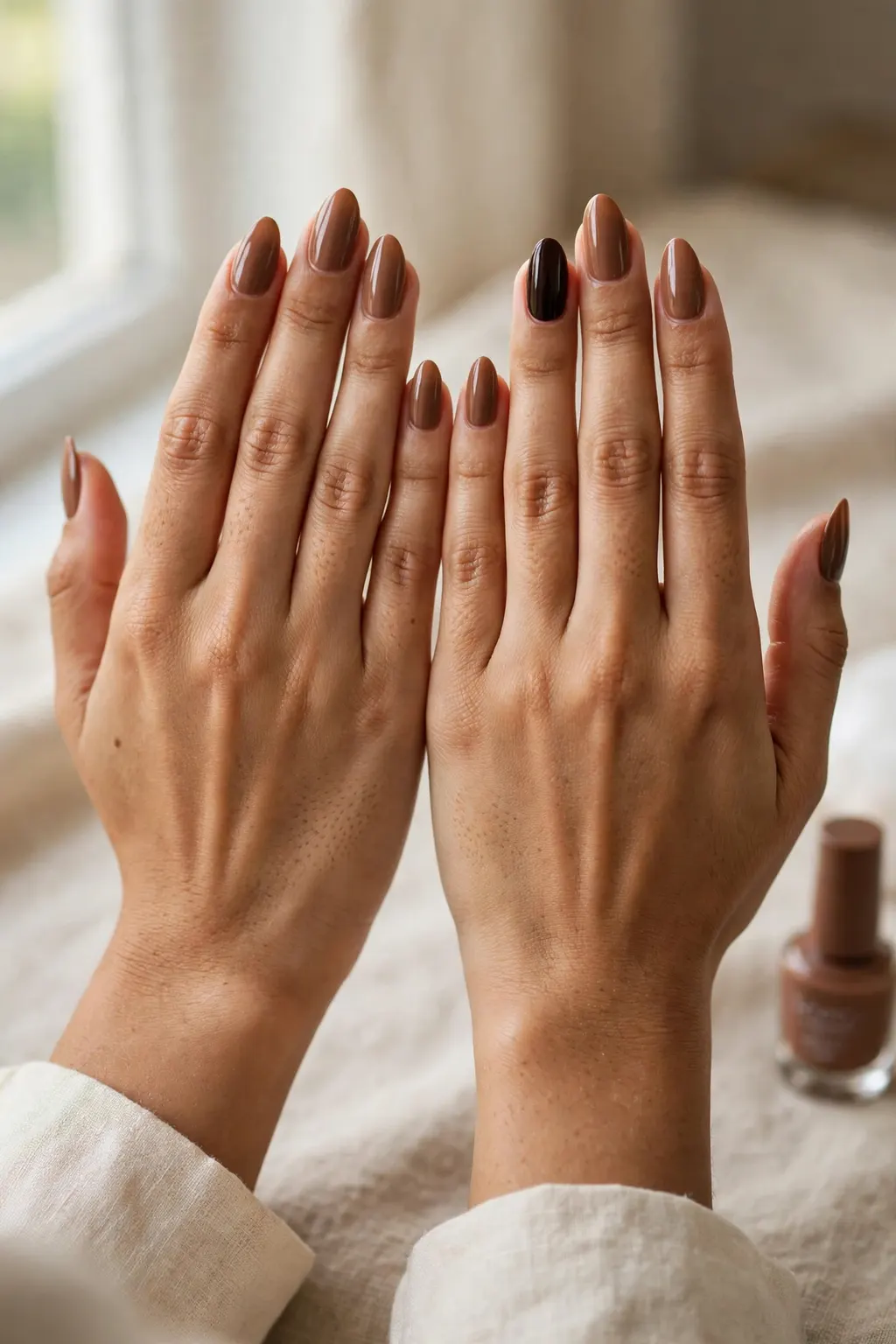
The coffee menu only works if your nail tech hears the same words you mean, and the two words that get lost most often are opacity and undertone. Opacity is how much the colour covers: sheer means the nail shows through, opaque means it does not, and one thin coat of a sheer brown is a different manicure from two coats of the same brown. Undertone is the temperature underneath the colour: warm means golden or reddish, cool means grey or ashy, and a warm mocha and a cool cacao are different polishes even though both are mid-brown. Say both words out loud — “sheer, cool iced latte” or “opaque, warm espresso” — and your tech can reach for the right bottle first time, instead of guessing from “brown”.
Your coffee nails salon brief: “Coffee nails in a [sheer / opaque] [warm / cool] [espresso / mocha / iced latte] — glossy finish, on [almond / square / round] nails, two thin coats, top coat wrapped over the tip.” Fill in the brackets before your appointment, show a photo of the shade you want, and ask the tech to hold the bottle against your hand before starting — the bottle against your skin is the test that settles warmth, depth and opacity in one look.
Step by step
Before the appointment, pick your depth from the menu and your temperature from your undertone, and save a photo of the exact shade. At the appointment, say the brief out loud — depth, opacity, undertone, finish, shape — and show the photo. Ask the tech to hold the bottle against your hand, and say yes or no to that bottle before any polish goes on the nail. During the manicure, check the first coat: a sheer shade should still show the nail, an opaque shade should not, and a warm shade should look golden against your skin, not orange. After the top coat, check the gloss in daylight — a coffee manicure should shine, and a dull finish means the top coat needs another layer.
Common mistakes to avoid
The most common mistake is saying only “brown” and hoping the tech guesses the rest — the menu exists so you do not have to guess, and the tech cannot guess your undertone. The second is not checking the bottle against your hand: a brown that looks perfect in the bottle can look orange or grey on your skin, and the bottle test takes five seconds. And the third is accepting a matte finish by accident — if the top coat looks dull, say so before you leave, because a coffee colour without gloss loses the depth that makes it coffee.
Products and tools that help
A photo of your chosen shade saved on your phone, the menu words written down so you do not forget them at the chair, and a clear idea of your undertone — warm, cool or in between — before you go. At the salon, the useful tools are the tech’s bottle collection and a daylight lamp: ask to see the colour in daylight, not only under salon lights, because brown changes more under different light than any other nail colour family.
Coffee Colour Care: Stop Browns Going Dull
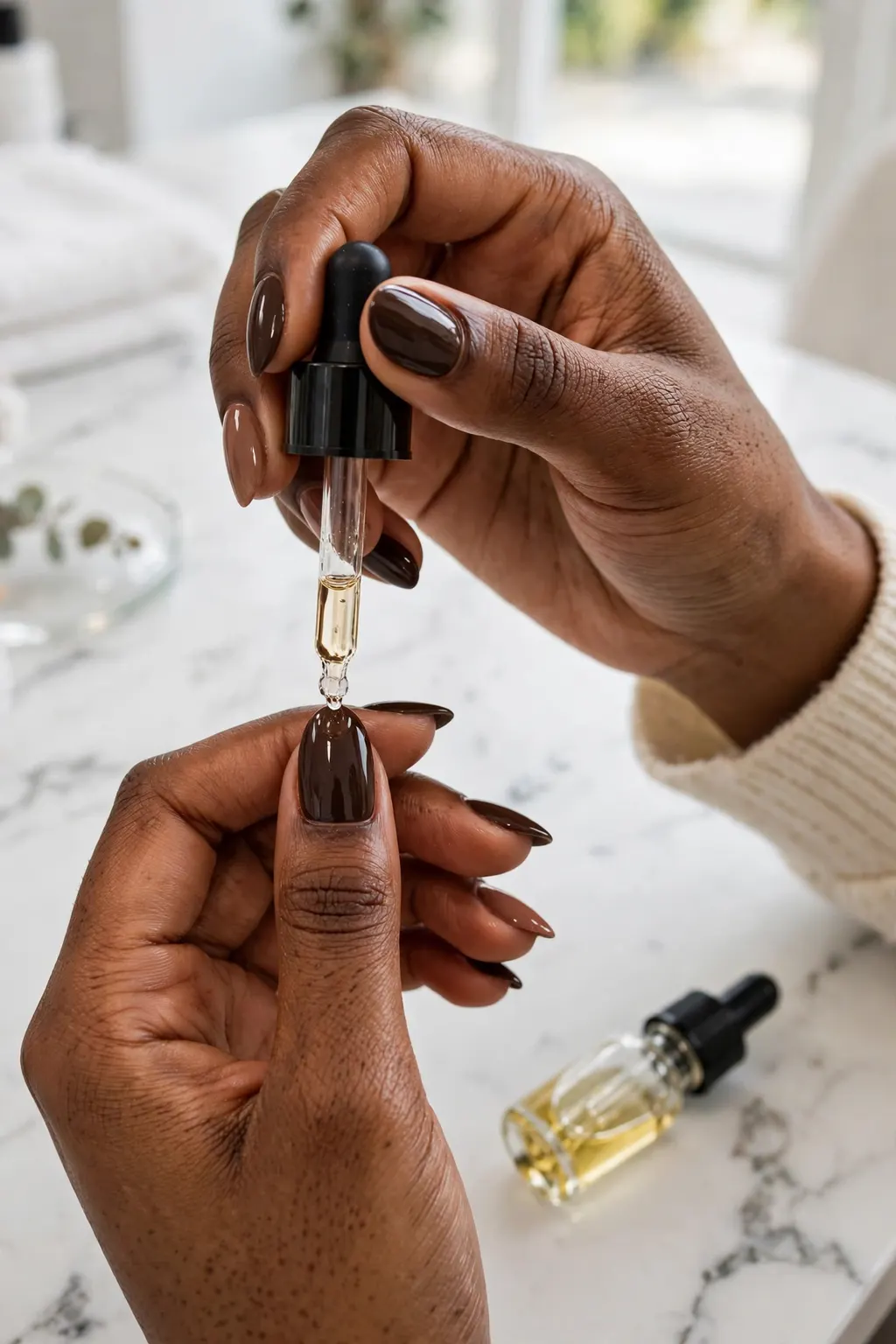
Browns go dull for one reason: the top coat wears thin, and the colour underneath loses its shine. A coffee manicure is only as glossy as its top coat, so the care routine is really a top-coat routine. Refresh the top coat at day three and again at day seven, wrapped over the free edge each time, and the brown stays rich for the whole wear. The other dullness trap is water and cleaning products: hot water and detergent lift the top coat first, and a lifted top coat makes the brown look cloudy within days. Wear gloves for washing up and cleaning, and the gloss survives. And keep cuticle oil on daily — neat skin around the nail is what makes a simple brown manicure look expensive, because there is no pattern to distract from it.
Who should skip this version
Skip the high-gloss care routine if you genuinely prefer a matte coffee manicure — a matte espresso is a real look, and the gloss routine is the wrong advice for it. Skip the top-coat refresh too if your manicure is a one-day look for a single event: a fresh manicure does not need a day-three refresh, because it will be removed before the wear starts. In both cases, the care advice still holds for the next manicure — gloss or matte is a finish choice, and the routine protects whichever finish you chose.
Works best on: shapes and lengths
Coffee colour care suits every shape and length, because it is about the top coat, not the design. It suits short nails best, because a short nail shows tip wear first, and a wrapped top coat protects exactly that edge. It suits long nails too, because a long nail has more surface to go dull, and a refresh restores the shine across the whole nail. It suits every skin tone, because the care is the same whatever the shade — gloss, gloves, oil, refresh — and the payoff is the same: a brown that still looks like coffee on day ten, not like a faded stain.
Maintenance schedule
A regular-polish coffee manicure lasts three to five days with a top-coat refresh at day three; a gel version lasts two to three weeks with a refresh at day seven. The schedule is the same for every shade in the menu, but it matters most for the deepest browns, because a dull espresso reads as black, while a glossy one reads as coffee. Keep the top coat in your drawer at home, not at the salon, because the refresh only happens if the bottle is there when you think of it — and keep cuticle oil beside it, because the two together are the whole care routine.
Frequently Asked Questions
What is the difference between mocha and espresso nails?
Mocha nails are a warm mid-brown, like milk chocolate, that shows its brown clearly in any light. Espresso nails are a deep, near-black brown that reads as black in dim light and as a rich warm brown in daylight. Mocha is the everyday shade — lighter, warmer, more forgiving — while espresso is the dramatic one, best for evenings and winter. If you are choosing between them, mocha suits medium skin and daily wear, and espresso suits deep skin and occasions.
Do coffee nails suit pale skin?
Yes — but pick from the cool, milky end of the menu. Iced latte, a sheer milky brown, and cool cacao flatter pale skin, because they do not add warmth the skin does not have. A warm caramel or a deep espresso can overwhelm very fair skin, making the hands look washed out or the nails look too dark. The test is the bottle against your wrist: if the brown looks golden next to your skin, it is warm, and on pale cool skin you want the brown that looks grey-brown instead.
Are coffee nails the same as latte nails?
They overlap but they are not the same. Latte nails are the milky, lighter end of the brown family — soft, sheer, often with a caramel tint. Coffee nails are the whole menu, from milky iced latte through mocha to deep espresso. A latte manicure is one coffee order; a coffee manicure can be any of them. If you want the lightest, milkiest version, ask for iced latte; if you want the full range of browns by skin tone, the coffee menu is the guide.
Conclusion & Bottom Line
Coffee nails are the brown family ordered like a menu, and the menu is what makes them easy: flat white for sheer, iced latte for milky, mocha for the warm middle, espresso for the deep end. Match the depth to your skin tone and the temperature to your undertone, say the opacity and undertone words out loud at the salon, keep the finish glossy, and refresh the top coat at day three and day seven. Done that way, a coffee manicure suits every skin tone, every shape and every length — and it stays rich, glossy and deliberate for the whole wear, from the first day to the last.
Bottom line: pick your depth from the coffee menu — iced latte, mocha or espresso — match its temperature to your undertone, say both words at the salon, and seal it glossy with a wrapped top coat, and the brown stays rich for two to three weeks.