Broken Bob Grow-Out Diary: The Bob That Looks Better at Week 8 Than Week 1

Most bobs have a best-before date, and every reader who has ever had one knows exactly when it arrives: about four weeks after the cut, when the sharp line has grown into a shelf, the ends have started to flip in different directions, and the mirror starts suggesting — firmly — that it is time to book again. The blunt bob is beautiful on day one and honest about its expiry; it is a cut that needs the salon the way a manicure needs the salon, every few weeks, on schedule. The broken bob is the answer to that exact problem, and the name is the method: instead of one clean, continuous edge, the ends are cut with texture — short pieces and long pieces sitting side by side, the line deliberately interrupted — so that as the hair grows, the growth itself looks like part of the design. This is a diary of that growth, week by week: what the cut looks like fresh, what happens at week 4 when a blunt bob would be failing, and what happens at week 8, when — the claim this whole article tests — the broken bob looks better than it did on day one. Bustle’s Spring 2026 trend coverage names the broken bob, and its stated selling point is the grow-out advantage (plan fresh check, 7 Nov 2026): this guide is the proof of that claim, in the mirror, over eight weeks.
Quick answer: A broken bob is a bob with a textured, interrupted edge instead of one clean line. Ask for point-cut ends and a broken perimeter — it grows out soft, not shelf-like, and looks best around week 8, when the texture has settled into the length.
Broken vs Blunt: The Edge Difference, Close Up
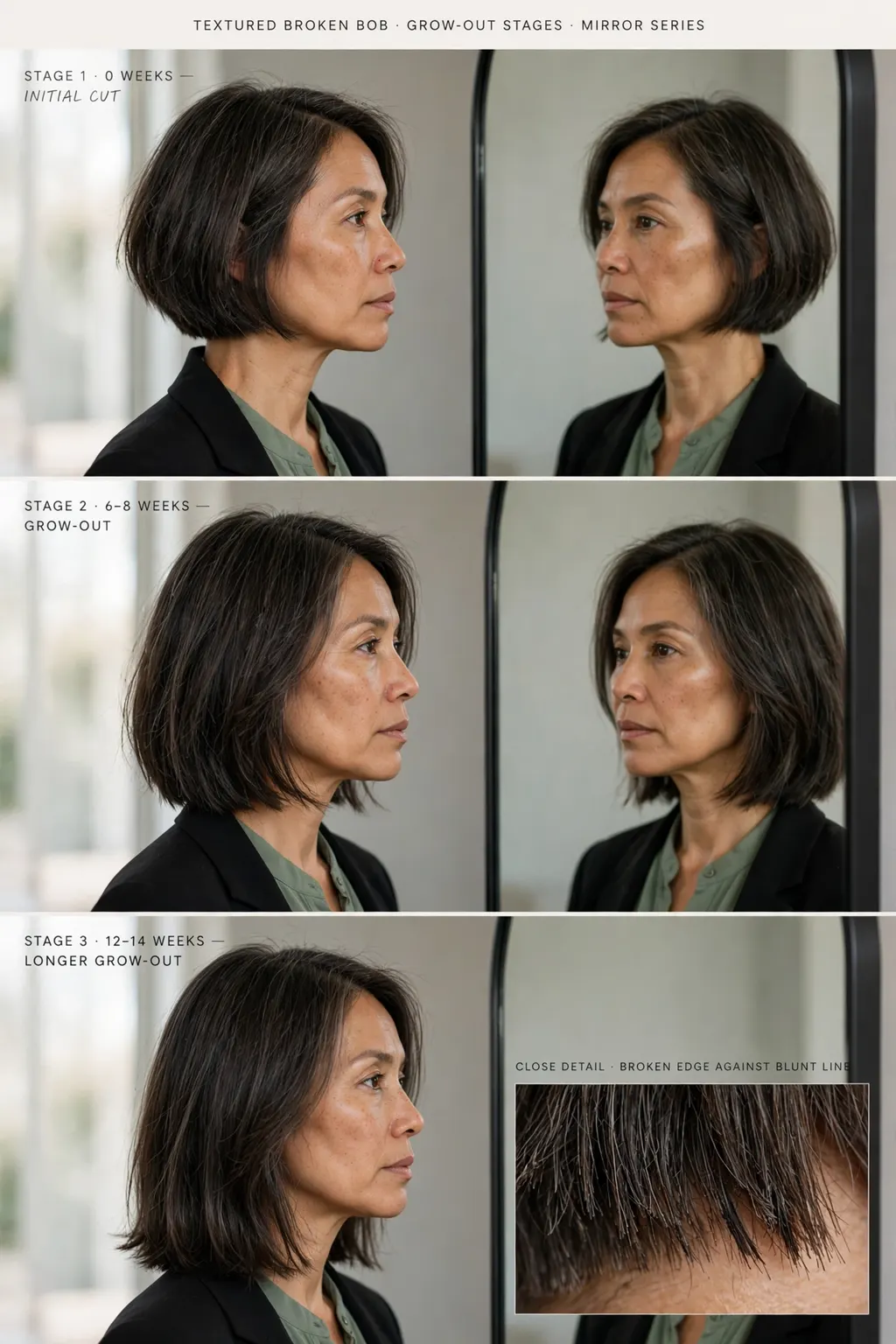
A blunt bob and a broken bob can look almost identical in a photograph taken on the day of the cut, and that is the first thing to understand: the difference is not in the shape, it is in the edge. A blunt bob is cut to a single line — every hair at the perimeter ends at the same length, the bottom edge reads as one unbroken stroke, and the whole cut depends on that line staying clean. A broken bob keeps the same shape and the same length, but the edge is interrupted on purpose: the stylist point-cuts into the perimeter, taking small, irregular pieces a few millimetres shorter than their neighbours, so the bottom edge reads as texture rather than a line. Close up, the difference is obvious — one edge is a ruler, the other is a torn page — and from a normal distance the broken bob simply looks softer, as if the hair had been lived in for a week already.
The reason the edge matters is that hair does not grow in a line. Every strand grows at its own rate, and after four weeks a blunt edge is no longer one line at all — it is a line with stragglers, a shelf where the faster-growing sections have dropped below the rest, and the eye reads the unevenness as neglect, because the cut promised a line and the growth broke the promise. A broken edge makes no such promise. Its whole point is irregularity, so when the strands grow at different rates they simply join an edge that was already irregular — the growth is invisible, because it looks like the cut. That is the entire mechanism of the grow-out advantage, and it is why the broken bob is the low-maintenance bob in the plan’s own words: not because it needs no care, but because the care it needs is so much less frequent, and the weeks between appointments still look deliberate.
📌 Save this before your appointment — a broken bob is a blunt shape with a point-cut edge. If the bottom reads as one clean line, it is not broken, whatever the stylist called it.
Who it suits best
The broken bob suits the reader who loves a bob but hates the four-week booking cycle — the reader whose calendar, budget or patience will not stretch to a trim every month, and who wants a cut that still looks intentional at week 8. It suits straight to wavy hair best, because the texture of the edge shows most clearly on hair that falls in one direction, and it suits fine to medium hair particularly well, because the point-cut ends create the illusion of more hair at the perimeter than a blunt line does — the eye reads the staggered ends as fullness, not thinness. It suits every face shape, because the shape is a bob and the edge is a detail: the face-framing is decided by the length and the front pieces, and the broken edge does not interfere with either. And it suits the reader growing out a shorter cut, because the broken edge is the most forgiving bridge between lengths — it hides the awkward stage by making the unevenness look like a choice.
How to ask for it (or do it at home)
At the salon, the sentence is: “A broken bob — same length all round, but point-cut the ends so the edge is broken, not blunt. No clean line at the bottom, and no thinning shears on the perimeter.” Then add the two details that make the cut work: “Cut it dry or nearly dry at the ends, so you can see where the texture falls, and keep the longest pieces at the length we agreed — the short pieces should be only a few millimetres up, not a whole layer.” If the stylist reaches for the razor at the ends, ask what it will do: a razor can create a broken edge, but on fine hair it can also feather the ends into wisps, and the broken bob needs ends with presence, not ends that disappear. Do not try this cut at home with kitchen scissors: point-cutting is done by feel, with the hair held at tension and the scissors angled into the edge, and a home attempt almost always takes too much off one side. The home version of this article is the styling and the trim-dusting section, not the cutting section — the cut belongs to the salon, and the script above is how you buy exactly it.
Styling and upkeep
A broken bob is styled the way it is cut: with texture, not against it. Rough-dry the hair with your fingers, scrunching the ends as they dry, and finish with a pea-sized amount of texture cream rubbed between the palms and pressed — not combed — into the bottom two inches. The upkeep is a dusting every eight to ten weeks and nothing else — no interior re-cut, no reshaping, just the perimeter refreshed — and the styling section of this guide covers the three finishes that carry the cut through the diary. The mistake to avoid is over-smoothing: a broken bob that is ironed straight every morning hides the very texture it was cut for, and the reader who flat-irons it daily has bought a cut she is styling away. Let the edge show.
Week 1: The Fresh-Cut Shape
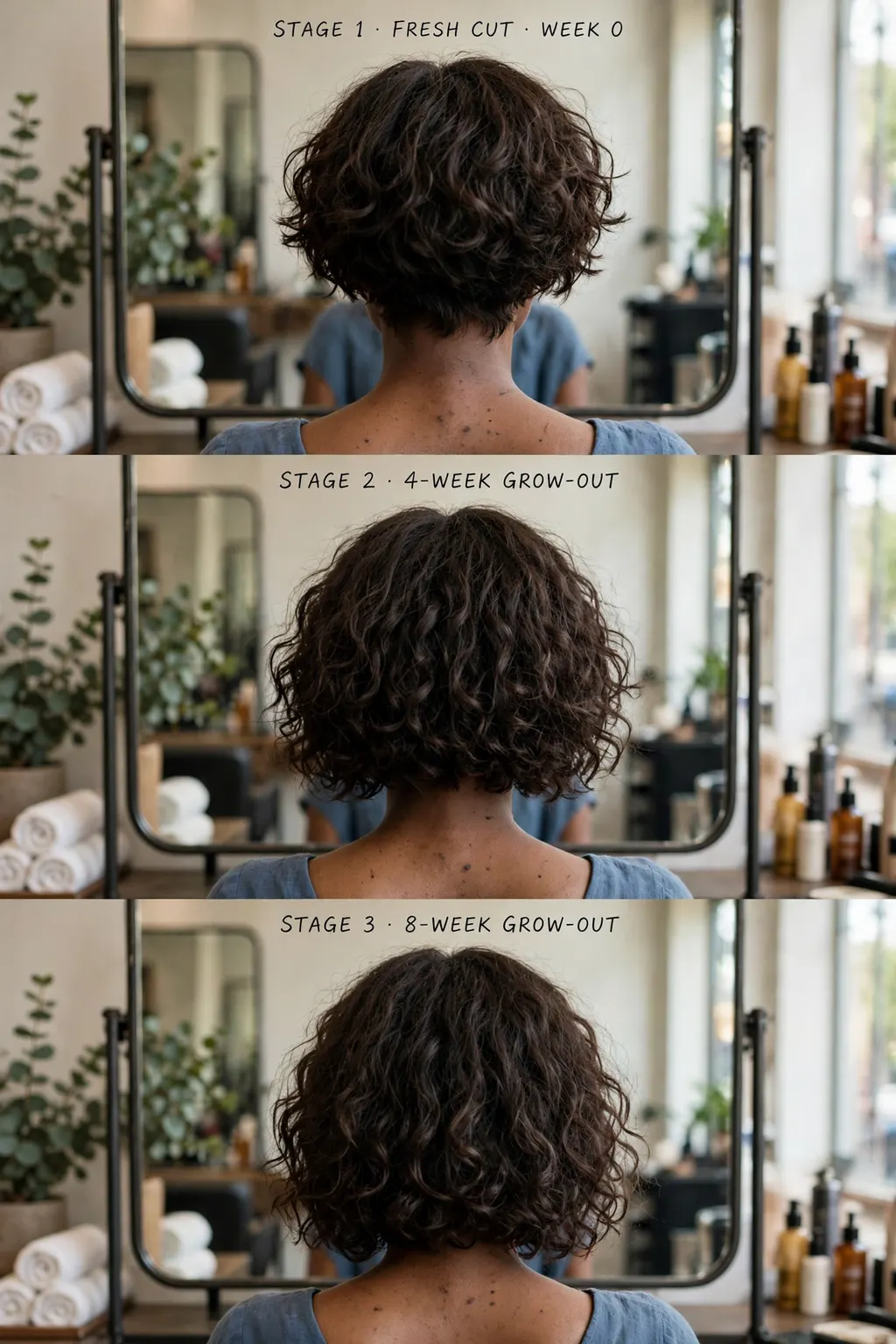
In week 1, the broken bob looks almost too neat for its own name. Fresh from the salon, the shape is crisp — the length sits where it was agreed, the front pieces frame the face, the back view shows a clean silhouette — and the broken edge is subtle, a softness at the bottom rather than an obvious texture. Readers who expected a visibly “broken” cut sometimes worry at this stage that nothing happened, and the worry is understandable: the point-cutting is measured in millimetres, and under salon lights, with the hair freshly blow-dried, the ends can read as nearly blunt. The test is not the salon mirror but the first morning at home: wash it, rough-dry it, and look at the ends. A blunt bob dries into a line; a broken bob dries into movement — the ends separate into soft points, the bottom edge breaks into a gentle zigzag, and the hair looks as if it has been worn for a week, in the best sense.
The first week is also when the cut teaches you how it wants to be styled, and the lesson is short: less is more. The texture is already in the cut, so the styling only has to let it show — a little root lift, a little texture cream on the ends, and the hair does the rest. The reader who piles on product in week 1, trying to force the texture, usually ends up with ends that clump together and read as heavy; the reader who does almost nothing finds the cut doing the work on its own. That is the first diary entry, and it is the one that sets the tone for the next seven weeks: the broken bob is a cut that asks less of you the longer you wear it, and week 1 is the week you learn to trust that.
📌 Save this for week one — wash it, rough-dry it, look at the ends. If they separate into soft points, the break is there — the salon lights were hiding it.
The technique, step by step
The stylist’s sequence is worth knowing, because it tells you what to watch for. First the shape is cut, damp, in one length all round, and checked from behind — this is the bob, and everything else serves it. Then the hair is dried, and the breaking happens on dry hair: the stylist takes small sections at the perimeter, holds them at tension, and point-cuts into the ends with the scissors angled upward, taking a few millimetres off irregular pieces while leaving their neighbours at full length. Then the hair is shaken out and checked in the mirror — the edge should read as texture, not as steps, and no single piece should stick out further than the rest. The whole breaking takes about ten minutes, and a stylist who rushes it is a stylist who will cut the edge into a visible step, so the appointment is not the one to hurry. The check in the chair is simple: run your fingers through the ends. If they feel like a soft fringe of different lengths, the break is right; if they feel like one clean line with a notch in it, it needs more work.
Common mistakes to avoid
The first mistake is asking for the break too deep: point-cutting more than a centimetre into the ends turns a broken bob into a shaggy bob, and the shape — the clean silhouette that makes it a bob — disappears. The second is letting the stylist thin the ends with thinning shears “to break it up”: thinning shears remove bulk from the inside of the ends, and a broken bob needs its ends to have presence — thinned ends read as wispy, not textured, and they will not survive the grow-out. The third is cutting the break on wet hair: wet hair stretches, and a point-cut made on stretched hair springs back shorter than expected once it dries, leaving the broken pieces noticeably shorter than the rest. If the stylist starts point-cutting while the hair is still wet, that is the moment to ask them to dry it first — the break belongs on dry hair, where what you see is what you get.
Products and tools that help
The broken bob needs almost nothing, and that is part of its appeal: a light texture cream or a salt spray for the ends, a wide-tooth comb for detangling, and a round brush only if you want a smoother finish for an occasion. What it does not need is heavy oil or serum on the ends — oil weighs the broken pieces down and glues them together, which hides the texture and makes the edge read as blunt again. What it does not need is a flat iron used daily: the iron presses the staggered ends into a single line, which is the opposite of the cut. The tool that matters most is the one you already own — your fingers, rough-drying the hair and scrunching the ends as they dry, which is the styling the cut was designed for. A broken bob styled with fingers looks like a broken bob; a broken bob styled with an iron looks like a blunt bob that had a bad day.
Week 4: Where a Blunt Bob Fails and a Broken Bob Softens

Week 4 is the week the diary earns its keep, because week 4 is where a blunt bob fails. Four weeks of growth — roughly half an inch, unevenly distributed — is enough to break a clean line: the faster-growing sections have dropped below the rest, the ends have started to flip outward in some places and curl under in others, and the mirror shows a cut that is visibly between appointments. The reader with a blunt bob books the trim at this point, not because the hair is long, but because the line has gone — and the trim is a full reshape, because the only way to restore a blunt line is to cut everything back to it. The broken bob at week 4 tells a different story: the same half inch of uneven growth has simply joined an edge that was already uneven, the ends still separate into soft points, and the shape — the silhouette from behind — is unchanged, because the shape was never in the edge. The cut looks, if anything, softer than it did at week 1: the texture has relaxed into the length, and the hair looks lived-in rather than grown-out.
The difference is not just cosmetic, it is economic: the blunt-bob reader is paying for a trim at week 4, and the broken-bob reader is not. Over a year, that is the difference between roughly twelve trims and roughly five — and the five are dustings, not reshapes, which cost less time in the chair as well as less money. The diary’s honest note is that week 4 is not the broken bob’s best week — that comes later, at week 8 — but it is the week that proves the premise: a cut whose edge is designed to be irregular cannot be ruined by irregular growth, and the reader who chose it is still wearing a deliberate haircut while the blunt-bob reader is wearing an appointment reminder.
📌 Save this for week four — a blunt bob books a trim when the line goes. A broken bob has no line to lose, so week four is a good hair week, not a booking.
Best for: hair types and face shapes
At week 4, the broken bob’s advantage shows most clearly on fine hair, because fine hair shows a broken blunt line fastest — the shelf is visible where there is no mass to hide it — and the broken edge hides exactly that. It shows on thick hair too, but differently: thick hair at week 4 tends to flip outward at the ends, and the broken edge breaks up the flip into separate soft points instead of one solid wing. It shows on wavy hair most of all, because the wave pattern and the broken edge work together — the wave gives the ends their direction, the break gives them their separation, and the result reads as intentional texture rather than grown-out mess. It suits every face shape at week 4 for the same reason it suited them at week 1: the face-framing is in the front pieces and the length, and neither has changed. The reader who should watch week 4 most carefully is the reader with very curly hair: curls shrink and spring as they grow, and a broken edge on tight curls can read as uneven in a way that looks accidental rather than textured — for curls, the break should be shallower, and the week-4 check is the moment to decide whether to dust the ends or let them run to week 8.
The exact salon wording
There is no salon visit at week 4 — that is the point — but there is a sentence worth preparing for the week-8 dusting, because the stylist who sees the grown-out cut needs to know what to preserve. The sentence is: “Just a dusting — take the split ends off the longest pieces only, and do not re-break the edge unless it has gone blunt.” Then add the detail that prevents the most common error at this appointment: “Do not cut everything back to the shortest piece.” A stylist who has not seen a broken bob grow out will sometimes assume the uneven edge is a mistake and “fix” it by cutting the whole perimeter to the shortest length — which turns the broken bob back into a blunt bob, shorter than you wanted, and the diary starts over from week 1. The wording matters because the grown-out edge looks, to an unfamiliar eye, like a cut that needs correcting — and the correction is the one thing that would undo it.
Maintenance schedule
The maintenance schedule at week 4 is: nothing. No trim, no reshape, no dusting — the cut is doing its job, and the only maintenance is the styling you were already doing: rough-dry, texture cream on the ends, and a weekly check of the ends for splits. If a few ends have split, snip them individually at home with sharp scissors — one snip per split end, never a straight cut across the perimeter — and the edge stays intact. The schedule that matters at week 4 is the one you are not on: the blunt bob’s four-week cycle, which would have had you in the chair this week. The broken bob’s next appointment is week 8 or week 10, and it is a dusting, not a reshape — fifteen minutes, not forty-five. That is the low-maintenance promise in numbers, and week 4 is the week it first shows up in the calendar.
Week 8: The Grown-Out Sweet Spot

Week 8 is the week the title of this article is either true or it is not, and the honest answer is that it is true — with one qualification, which this section will not hide. At eight weeks, the broken bob has grown roughly an inch, and the growth has done something the salon could not: it has settled the texture into the length. The point-cut ends, which at week 1 were crisp and slightly visible, have softened; the longer pieces have dropped just enough to give the bob a little swing it did not have fresh; and the shape, from the front and from behind, reads as a bob that has been worn, not a bob that has been neglected. The mirror test is simple: does the haircut look like a choice? At week 8, a blunt bob does not — it looks like an appointment missed. A broken bob does — it looks like a bob with a point of view, and the point of view is that texture is the style. That is why the title says better at week 8 than week 1: week 1 is the promise, week 8 is the proof, and the proof is softer, swingier and more lived-in than the promise was.
The qualification is that week 8 is the sweet spot, not a permanent state. Past week 10 or 12, the growth starts to change the shape itself — the length drops below the jaw, the front pieces lose their framing, and the bob starts becoming a lob, which is a fine haircut but a different one. The diary ends at week 8 because that is where the broken bob is at its best, and the next appointment — a fifteen-minute dusting — resets the clock without resetting the look. The reader who books that dusting at week 8 or 10 gets the sweet spot again, almost immediately: the dusting takes the split ends off the longest pieces, the shape is unchanged, and the cut is back to week 1 with the texture already in it. The reader who waits until week 14 gets a different cut, and a longer appointment, and the diary would have to start over.
📌 Save this for week eight — the sweet spot is real, and it is temporary. Book the dusting while it still looks like a choice, not after it has become a lob.
What it looks like in real life
In real life, the week-8 broken bob looks like this: in the mirror in the morning, the ends separate on their own — no styling needed to see the texture, because the growth has made it permanent. In photographs, the ends read as full, not thin, because the staggered lengths catch the light at different points and the eye reads the variation as density. At work, nobody can tell how long it has been since the salon — and that is the test that matters, because the whole point of a low-maintenance cut is that other people cannot tell. The Ghost Layers for Fine Hair guide covers the same idea from the inside — hidden layers that move without thinning the ends — and the two cuts share a philosophy: the best low-maintenance hair is hair whose structure does the work, so the styling does not have to. If your last bob needed a trim at week 4 to look deliberate, and this one still looks deliberate at week 8, that is the diagnosis — the edge was the problem, and the break was the fix.
Variations worth trying
If your hair is fine and you want the week-8 look to last even longer, the variation worth trying is a broken bob with ghost layers inside — the interior movement keeps the surface swinging as the length grows, and the two techniques together are the lowest-maintenance bob in this plan. If your hair is thick, the variation is a deeper break at the ends only — a few more millimetres off the shortest pieces, so the weight of the thick hair does not pull the texture flat by week 6. And if your hair is wavy, the variation is to cut the break on dry, natural-wave hair, so the stylist can see where the wave separates and place the broken pieces in the wave’s own gaps, instead of cutting blind on wet hair and hoping the wave agrees. The variation not worth trying is a broken bob with a blunt fringe: the fringe grows at a different rate from the bob, and at week 8 the fringe will be in your eyes while the bob is still perfect — if you want a fringe with this cut, keep it long and side-swept, so it grows out with the rest of the hair.
When to skip it
Skip the broken bob when what you actually want is a sharp, graphic line — a bob whose whole point is the precision of its edge, like a glass bob or a severe blunt cut — because the broken edge is the opposite of that, and a reader who wants a visible line will be disappointed by a cut designed to blur it. Skip it if your hair is extremely curly and tight, because the break can read as uneven in a way that looks accidental on tight curls, and a blunt or layered curly bob will serve you better. And skip it if you are about to grow your hair long: the broken edge is a wonderful place to be for eight weeks, but it is not a growing-out strategy — the staggered ends make the grow-out to shoulder length look messier than a blunt perimeter would, and the reader growing long hair should keep the edge clean until the length is there. The next section is the honest alternative for the reader who wants the low maintenance without the texture: the blunt bob, kept blunt, with the four-week booking accepted as the price.
Styling Through the Diary: Three Finishes

A broken bob needs three finishes, one for each stage of the diary, because the hair itself changes as it grows — and the styling that flatters a fresh cut is not the styling that flatters a grown-out one. The first finish is the fresh finish, for weeks 1 to 3: smooth and swung, with the ends tucked under just enough to show the shape, the texture cream pressed into the bottom inch, and the part worn where the cut was designed. The second finish is the lived-in finish, for weeks 4 to 6: rough-dried with the fingers, the ends scrunched as they dry, a little salt spray for separation, and the part allowed to wander — this is the finish that makes week 4 look deliberate, because it leans into the texture instead of fighting it. The third finish is the grown-out finish, for weeks 7 to 8: air-dried or roughly dried, the hair tucked behind one ear to show the length, a single soft bend at the front pieces with a straightener used only on those two pieces, and nothing at all on the ends — by week 8 the ends are doing the work themselves, and the styling only has to get out of their way.
The thread through all three finishes is the same rule the cut itself follows: the texture is already there, so the styling only has to let it show. The reader who changes her styling with the diary — smoother early, rougher late — gets eight good weeks out of the cut; the reader who styles it the same way every week gets four good weeks and four weeks of fighting it. That is the diary’s practical lesson, and it is the one the salon will not tell you, because the salon sees the cut once — you live with it for eight weeks, and the styling is how you live with it well.
📌 Save this before you style it — smooth early, rough late. The cut changes as it grows, and the styling should change with it.
Who it suits best
The three finishes suit different readers, and the diary is honest about that: the fresh finish suits the reader who wants polish — the office, the wedding, the photograph — because it shows the shape at its best. The lived-in finish suits the reader who wants ease — the school run, the weekend, the everyday — because it takes five minutes and looks like it took none. The grown-out finish suits the reader who wants length — the one who is enjoying the swing of week 8 and does not want to hide it under a smooth blow-dry. All three suit every face shape, because the finishes change the texture, not the outline — the face-framing is the same in all three, and the choice is about the occasion, not the face. The reader who should learn all three is the reader who wears her bob every day: she is the one who needs a fresh finish for Monday and a lived-in finish for Saturday, and the broken bob is the cut that gives her both without a second appointment.
How to ask for it (or do it at home)
The finishes are all home styling — no salon visit needed — and the how-to is short enough to learn in one morning. For the fresh finish: blow-dry with a round brush, turning the ends under, then press a pea-sized amount of texture cream into the bottom inch. For the lived-in finish: rough-dry with your fingers, scrunching the ends as they dry, then mist salt spray from arm’s length and scrunch once more. For the grown-out finish: let the hair air-dry to 80 percent, tuck it behind one ear, and bend only the two front pieces with a straightener, one pass each, then leave the ends completely alone. The detail that makes all three work is the same: product goes on the ends, never on the roots — product on the roots flattens the swing the cut was designed to create, and a broken bob with flat roots looks like a bob that has given up. If a finish is not working, the fault is almost always too much product, not too little — wash it out, start again with half as much, and the texture will reappear.
Styling and upkeep
The upkeep across the diary is the same light routine: wash every two to three days, rough-dry or air-dry, texture cream on the ends, and a weekly check for split ends, snipped individually. The styling that does matter is the one that protects the cut: never iron the whole bob straight, because the iron presses the staggered ends into a single line and undoes the break; never brush the ends dry with a paddle brush, because the brush pulls the broken pieces into a solid curtain and hides the separation. The upkeep that does not matter is the one the blunt bob demands: no weekly reshaping, no constant trims, no fighting the growth. The broken bob’s upkeep is the upkeep of a cut that trusts its own structure — and the diary’s eight weeks are the proof that the trust is earned.
The Only Trim You Need: A 15-Minute Dusting

The only trim a broken bob needs is a dusting, and the word matters: a dusting is not a haircut, it is the removal of split ends from the longest pieces only — a quarter inch, fifteen minutes, and the shape is untouched. The appointment is short because there is nothing to reshape: the perimeter stays where it is, the break stays where it is, and the stylist’s only job is to take the damaged tips off the pieces that have grown longest. Compare that with the blunt bob’s trim, which is a full reshape — the whole perimeter cut back to a line, the shape re-established, forty-five minutes in the chair — and the difference is the difference between maintenance and repair. The broken bob needs maintenance; the blunt bob needs repair, every four weeks, because its line cannot survive growth.
The dusting is scheduled at week 8 to 10, and the timing is part of the technique: too early, and there is nothing to dust — the ends are still healthy, and the appointment is wasted. Too late, and the splits have travelled up the hair shaft, and the dusting becomes a cut — the stylist has to take more off to get past the damage, and the length you were enjoying is gone. The fifteen-minute appointment is also the cheapest appointment in the salon’s book, and over a year the arithmetic is kind: five dustings instead of twelve reshapes, fifteen minutes instead of forty-five, and a cut that looks deliberate in every week between them. That is the low-maintenance bob, in numbers, and the dusting is the whole secret.
📌 Save this before you book — a dusting, not a haircut. Longest pieces only, a quarter inch, fifteen minutes. If the appointment runs to forty-five, something went wrong.
The technique, step by step
The stylist’s sequence for a dusting is worth knowing, because it tells you what to watch for. First the hair is dried and checked — the stylist looks for split ends on the longest pieces, not on the whole perimeter. Then, piece by piece, the longest strands are twisted gently, and the split tips that stick out of the twist are snipped off, a millimetre or two at a time. Then the perimeter is checked from behind: the shape should be exactly as it was, the break exactly as it was, and the only change should be that the ends look healthier. The whole appointment takes fifteen minutes, and a stylist who reaches for the clippers or the thinning shears at a dusting appointment is a stylist who has misunderstood the job — the dusting is done with scissors, on dry hair, piece by piece, and nothing else. The check in the chair is simple: after the dusting, the hair should look exactly as it did before, only healthier — if it looks shorter, or blunter, the dusting became a cut, and the next appointment should be with a different stylist.
Common mistakes to avoid
The first mistake is letting the dusting become a reshape: the stylist who “evens up” the broken edge has undone the cut, and the diary starts over. The second is dusting too often: a dusting every four weeks takes length off faster than the hair grows it, and the bob gets shorter instead of staying the same — the schedule is eight to ten weeks, not four. The third is doing the dusting yourself with blunt scissors: blunt scissors crush the hair shaft instead of cutting it, and the crushed ends split again within days — if you dust at home, use sharp hair scissors, snip one split end at a time, and never cut across the perimeter. The mistake that matters most is the one from the week-4 section: cutting everything back to the shortest piece. A dusting takes from the longest pieces only, and the shortest pieces are left exactly alone — that is what keeps the break broken, and the bob a broken bob.
Products and tools that help
The dusting needs no products, and that is part of its appeal: the appointment is scissors and a mirror, nothing else. What helps between dustings is a weekly split-end check — twist a small section, look for the tiny white tips that stick out, and snip them individually with sharp scissors — and a light leave-in conditioner on the ends, which keeps the hair flexible enough that it does not split in the first place. What does not help is a heavy repair mask used daily: the mask coats the ends and hides the splits instead of preventing them, and the reader who relies on it finds the damage has travelled further up the shaft by the time the dusting comes. The tool that matters most is the one the salon uses — sharp scissors, kept sharp — and the habit that matters most is the weekly check, which takes two minutes and saves a centimetre at the next appointment.
Broken Bob by Hair Type: Fine, Thick and Wavy
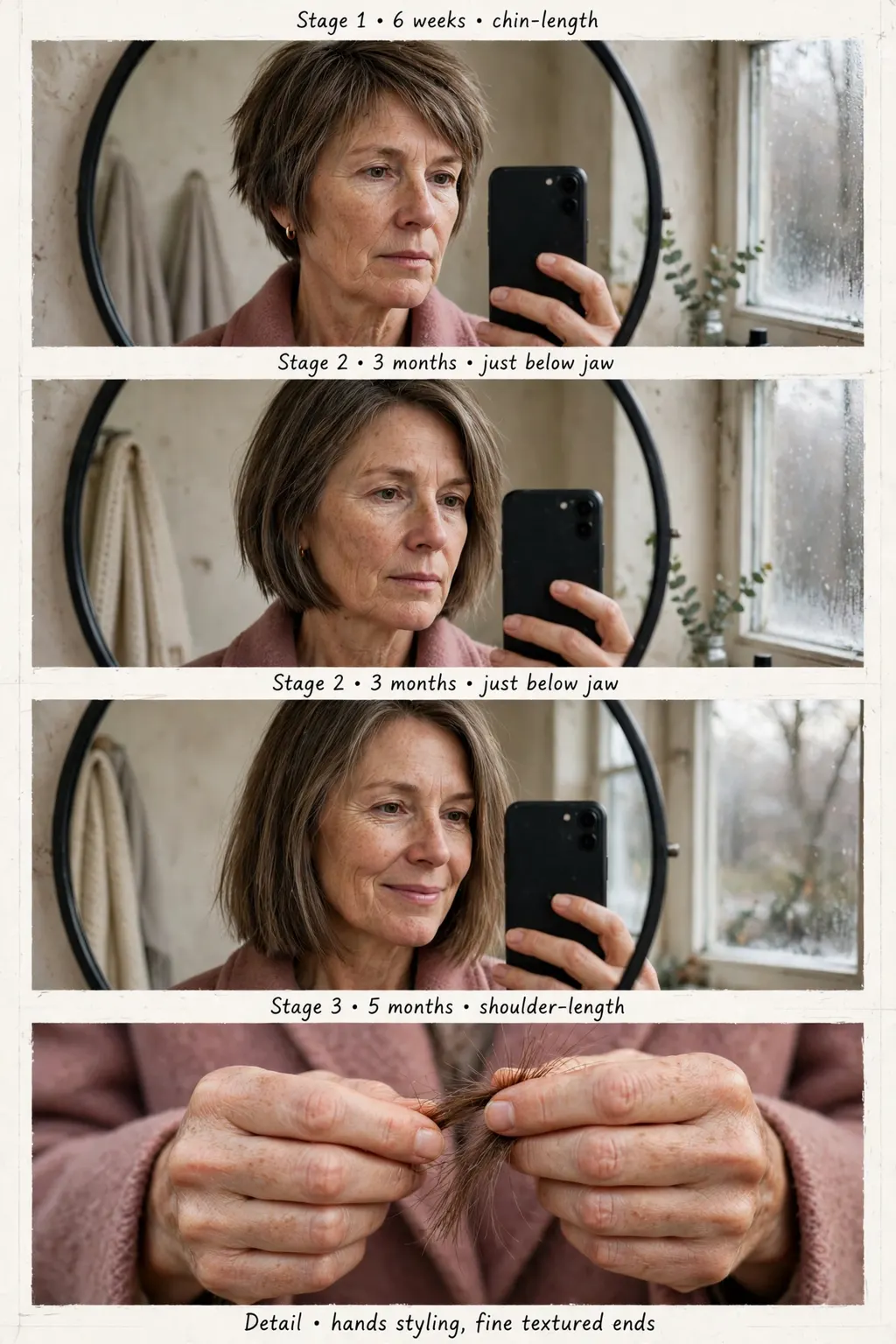
The broken bob is not one cut, it is one idea applied to three different kinds of hair — and the idea changes with the hair, because the edge behaves differently on each. On fine hair, the broken bob is at its best: the point-cut ends create the illusion of more hair at the perimeter, because the staggered lengths catch the light at different points and the eye reads the variation as fullness. The break should be shallow on fine hair — a few millimetres, no more — because fine hair has no bulk to hide a deep break in, and a deep break on fine hair reads as thin, not textured. On thick hair, the broken bob is a weight-shedding cut: the point-cut ends break up the solid curtain that thick hair forms at the perimeter, and the bob swings instead of sitting as a slab. The break can be deeper on thick hair — up to a centimetre — because there is mass underneath to support it. On wavy hair, the broken bob is a partnership: the wave gives the ends their direction, the break gives them their separation, and the two together read as intentional texture. The break on wavy hair should be cut on dry, natural-wave hair, so the stylist can place the broken pieces in the wave’s own gaps.
The hair type that needs the most care is fine hair that is also low-density — the reader whose ponytail is thin as well as fine — because on that hair the broken edge can tip from textured into see-through if the break is cut too deep. For that reader, the guardrail is the same one the ghost-layers guide uses: the perimeter stays full, the break stays shallow, and the interior does the moving. The 6 Stylish Bob Hairstyles for Thin Hair guide shows the bob styles that flatter thin hair, and the broken bob belongs among them precisely because its staggered edge reads as fullness — the styles that work for thin hair are the ones that protect the ends, and a shallow broken edge protects them while adding the movement a blunt line cannot.
📌 Save this before you choose — fine hair, shallow break; thick hair, deeper break; wavy hair, cut it dry. The break is the same idea, but the depth is the hair’s decision, not yours.
Best for: hair types and face shapes
The broken bob is best for fine to medium hair, straight to wavy, at any age — the technique is about density and texture, not about youth, and it works wherever the problem is “my bob needs a trim every month and I cannot keep up.” It suits straight hair best, because straight hair shows the broken edge most clearly, and wavy hair well, because the wave and the break work together. It suits every face shape, because the shape is a bob and the edge is a detail: the face-framing is decided by the length and the front pieces, and the broken edge does not interfere with either. It suits the reader whose hair is growing out, because the broken edge is the most forgiving bridge between lengths, and the reader who has been burned by blunt bobs before, because the diary — eight good weeks instead of four — is the proof that this time is different. The face shapes that benefit most are the ones that suit a bob with softness at the edge: round faces, because the texture breaks up the roundness of the silhouette, and square faces, because the softened edge takes the severity out of the jawline.
The exact salon wording
At the salon, the sentence is: “A broken bob — same length all round, point-cut ends, and the break depth matched to my hair: shallow, because my hair is fine” — or “deeper, because my hair is thick” — “and cut the break on dry hair, so you can see where the texture falls.” Then add the two details that make the cut work: “Keep the longest pieces at the length we agreed, and do not thin the ends.” If the stylist suggests thinning shears to “break it up,” that is the moment to stop them — thinning shears are the opposite of this cut, and a broken bob never needs them. The wording matters because “textured bob” on its own is the most misunderstood request in the salon after “layers”: said without the guardrail, it buys a shaggy cut, a thinned cut, or a layered cut, and the whole point of this article is that the broken bob is none of those — it is a blunt shape with a broken edge, and the sentence above is how you buy exactly it.
Maintenance schedule
The maintenance schedule is the diary itself: a dusting at week 8 to 10, then the diary starts again — week 1 fresh, week 4 soft, week 8 sweet spot, dusting, repeat. Over a year, that is five or six dustings, fifteen minutes each, and no reshapes at all — unless the reader wants a different length, in which case the reshape is a new cut, not maintenance. The trim schedule is the normal one for the length — about every eight to ten weeks for a bob — and the trim is a perimeter dusting only, a quarter inch off the longest pieces, with the break left alone until it has gone blunt, which takes two or three dustings. The maintenance that does matter is styling, not cutting: the texture the break creates is activated by rough-drying and by keeping product off the roots, and the styling section of this guide covers both. A broken bob that is styled flat, with heavy product on the ends, looks like a blunt bob that had a bad day — the texture is there, but it needs air at the root to show.
Who Should Stay Blunt Instead
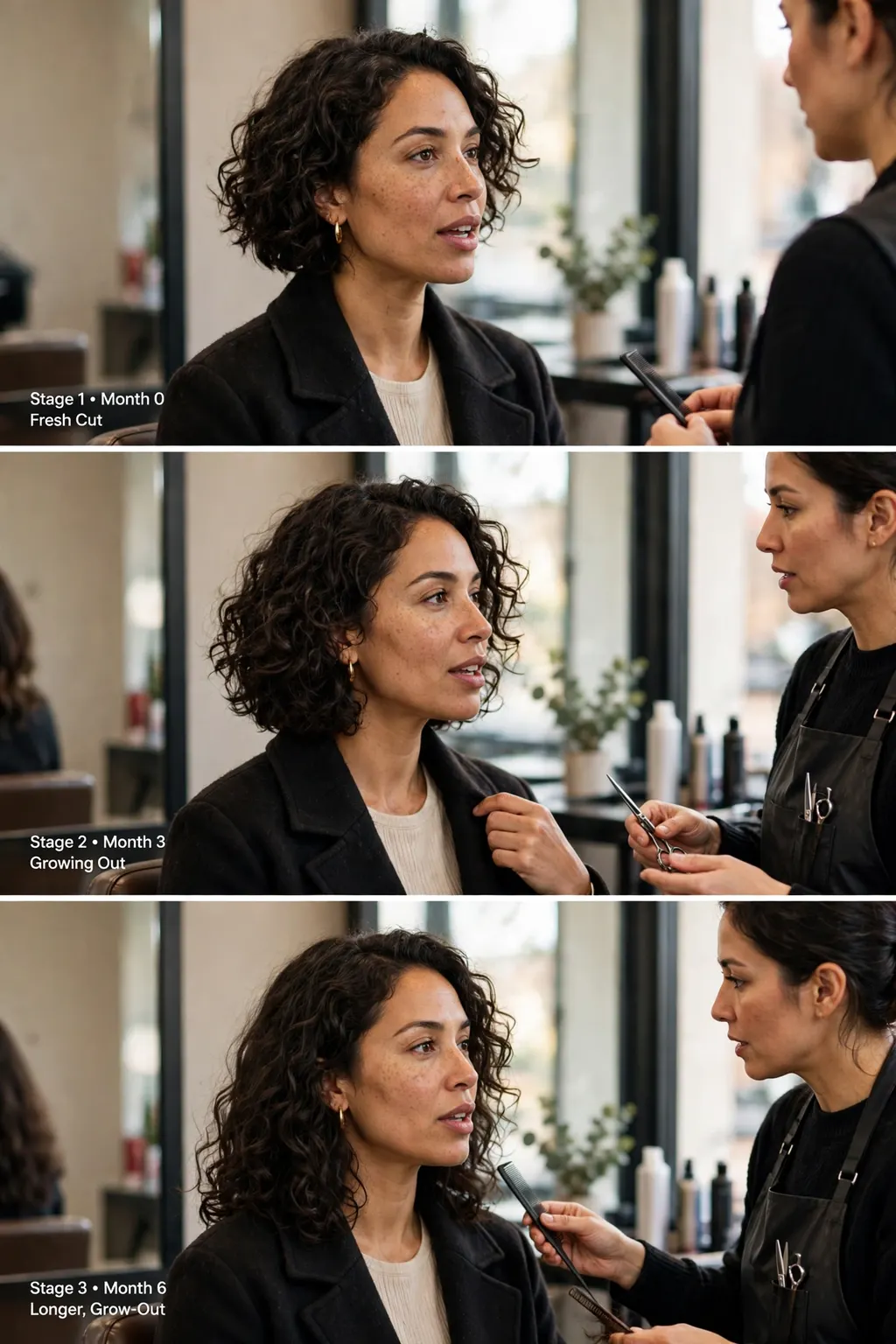
Not every reader should have a broken bob, and this section is the honest counterweight to the rest of the article — because a cut that is wrong for you is wrong even if it grows out beautifully. The reader who should stay blunt is the reader who wants a sharp, graphic line: the glass bob, the severe blunt cut, the bob whose whole point is the precision of its edge. That reader will be disappointed by a broken bob, because the broken edge is the opposite of what she wants — she wants a line, and the broken bob refuses to give her one. The reader who should stay blunt is also the reader with extremely tight curls, because the break can read as uneven in a way that looks accidental on tight curls, and a blunt or layered curly bob will serve her better. And the reader who should stay blunt is the reader who is about to grow her hair long: the broken edge makes the grow-out to shoulder length look messier than a blunt perimeter would, and the reader growing long hair should keep the edge clean until the length is there.
The other reader who should stay blunt is the one who loves the salon — the reader who enjoys the four-week appointment, who likes the feeling of a freshly sharpened line, who treats the trim as a ritual rather than a chore. For that reader, the blunt bob is not a burden, it is a pleasure, and the broken bob’s main selling point — fewer appointments — is not a selling point at all. The broken bob is a cut for the reader who wants her hair to look deliberate with less effort; the blunt bob is a cut for the reader who is happy to put the effort in. Both are good cuts. The diary’s job is to help you choose the right one, not to pretend there is only one right answer.
📌 Save this before you decide — if you love a sharp line, or you love the salon, stay blunt. The broken bob is for the reader who wants eight good weeks, not four — and that reader knows who she is.
What it looks like in real life
In real life, the reader who stayed blunt looks like this: at week 1, her bob is the sharpest haircut in the room — a clean line, a clean silhouette, a cut that photographs beautifully. At week 4, she is in the salon, and the line is sharp again. She is happy, because the ritual is part of the pleasure, and the cut is exactly what she wanted. The reader who chose broken looks like this: at week 1, her bob is softer, less sharp, less photographic — and at week 8, it still looks deliberate, while the blunt reader is on her second trim. Neither reader is wrong. The difference is what they value: the blunt reader values the line, and pays for it in appointments; the broken reader values the time, and pays for it in softness. The diary’s honest conclusion is that the broken bob is better at week 8 than week 1, and the blunt bob is better at week 1 than week 8 — and the reader should choose the cut whose best week is the week she lives in most.
Variations worth trying
If you stay blunt but want some of the broken bob’s forgiveness, the variation worth trying is a blunt bob with a micro-break — the very tips point-cut by a millimetre or two, so the line stays clean from a distance but the growth does not show a shelf at week 4. If you stay blunt and want the low maintenance without the texture, the variation is a blunt bob with a longer length — a lob, which grows out more gracefully than a jaw-length bob because the extra length hides the unevenness. And if you are torn between the two, the variation is to try the broken bob once, on a length you are comfortable with, and judge it at week 8, not week 1 — because the broken bob’s case is made at week 8, and the reader who judges it at week 1 has judged the promise, not the proof. The variation not worth trying is a broken bob cut by a stylist who does not believe in it: the cut needs a stylist who understands that the irregular edge is the design, not a mistake, and a stylist who keeps trying to “even it up” will turn it blunt by the second appointment.
When to skip it
Skip the broken bob when your hair is already very short — a pixie or a chin-length bob with almost no perimeter to break — because there is nowhere for the texture to live, and a broken edge with no length behind it reads as choppy, not textured. Skip it if your hair is extremely thick as well as coarse in texture: thick, coarse hair does not need the break to move, and a blunt bob will give you more polish for less fuss. And skip it if what you actually want is a visible change — a new shape, a new silhouette, a cut people notice — because the broken bob is deliberately subtle, and a reader who wants a visible change will be disappointed by a cut designed to look like a bob that has simply been worn well. The next section answers the three questions every reader asks before booking, and the conclusion tells you what to do next.
Frequently Asked Questions

What is a broken bob haircut?
A broken bob is a bob with a textured, interrupted edge: the shape is the same as a blunt bob, but the ends are point-cut into irregular lengths, so the bottom reads as texture, not a line. It grows out soft, not shelf-like.
Which bob grows out best?
The broken bob grows out best, because its edge is already irregular — uneven growth joins the design instead of breaking it. A blunt bob needs a trim at week 4; a broken bob still looks deliberate at week 8.
How often does a broken bob need trimming?
Every eight to ten weeks, and only a fifteen-minute dusting: a quarter inch off the longest pieces, split ends only. No reshape is needed — the shape and the break stay as cut.
Conclusion: Broken Bob Grow-Out Diary — Your Next Step
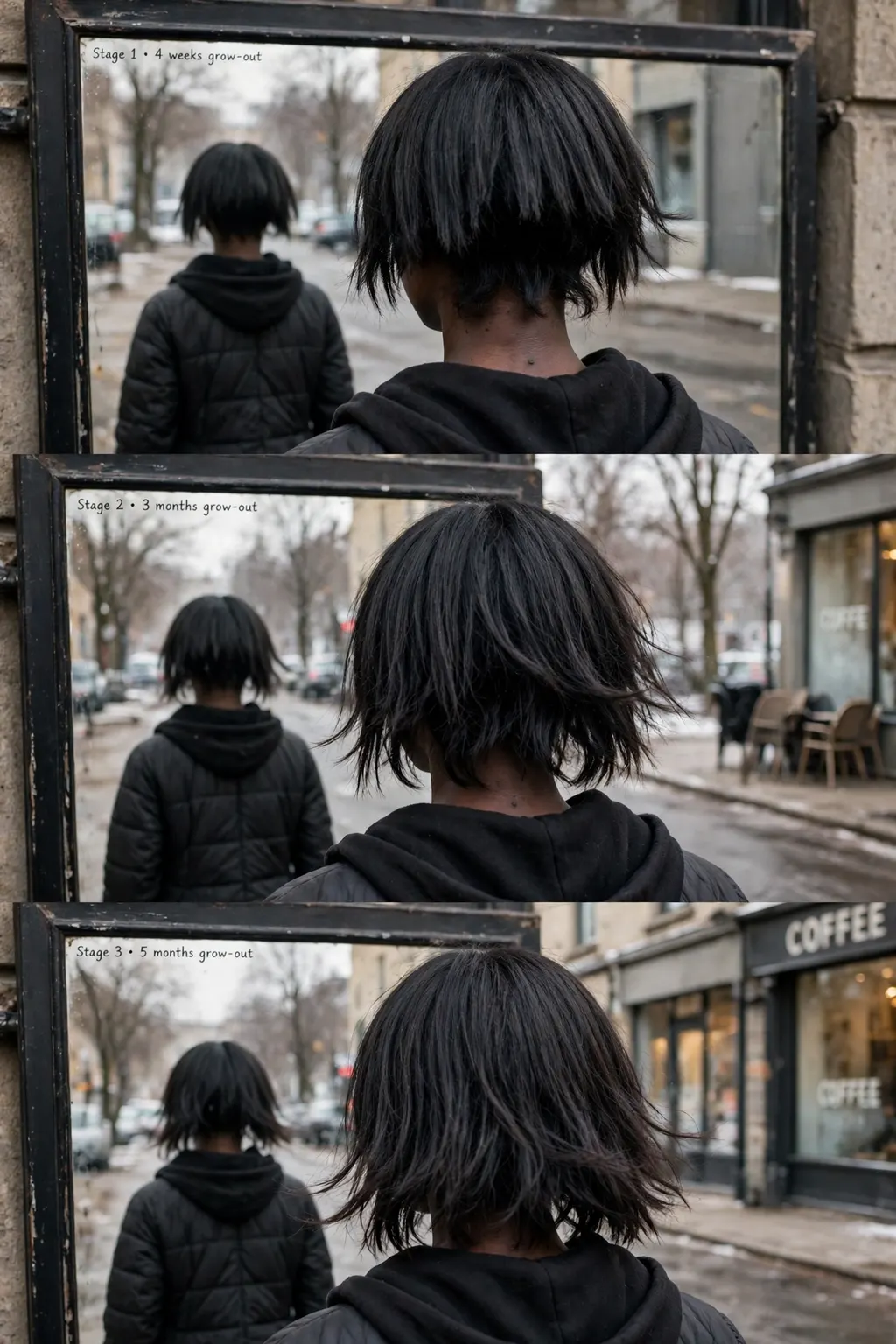
The diary’s verdict is the one in its title: the broken bob looks better at week 8 than at week 1, and the reason is not magic, it is mechanism. A blunt edge promises a line and growth breaks the promise; a broken edge promises texture and growth keeps it. The cut is a blunt shape with a point-cut edge, the maintenance is a fifteen-minute dusting every eight to ten weeks, and the styling is rough-dry, texture cream on the ends, and nothing on the roots. The reader who wants it should take the salon script from this guide — “point-cut the ends, keep the longest pieces, no thinning shears, cut the break on dry hair” — and judge the cut at week 8, not week 1, because week 8 is where its case is made. The AboutSuperstars home page has the rest of the bob and short-hair guides, including the thin-hair bobs and the ghost-layer cut that pairs with this one, for the reader who wants to keep going. The next step is simple: book the cut, wear it for eight weeks, and let the mirror at week 8 do the arguing.
Bottom line: A broken bob is a blunt shape with a broken edge — and the edge is the whole point: it turns eight weeks of growth from a problem into the best week of the cut.