Dark Red Nails: Black Cherry, Wine & Burgundy Shades for Winter
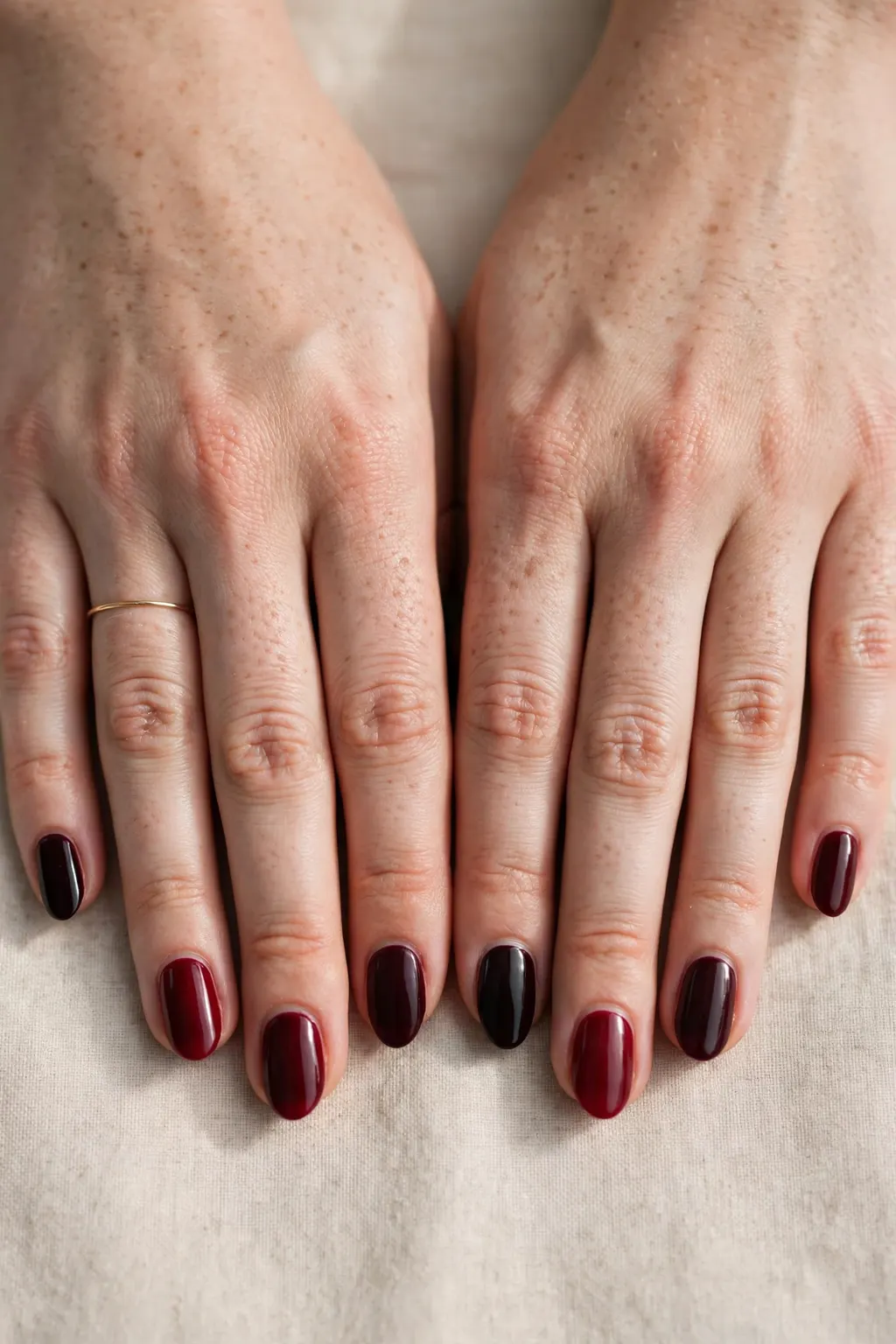
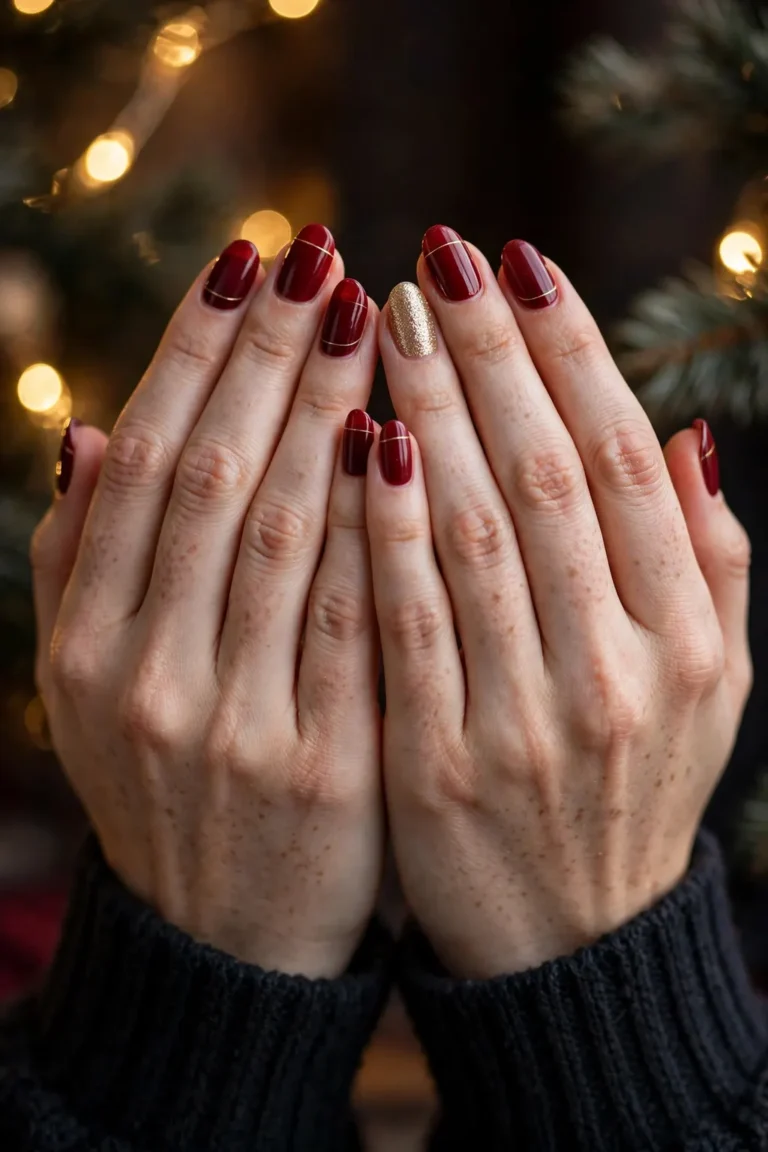
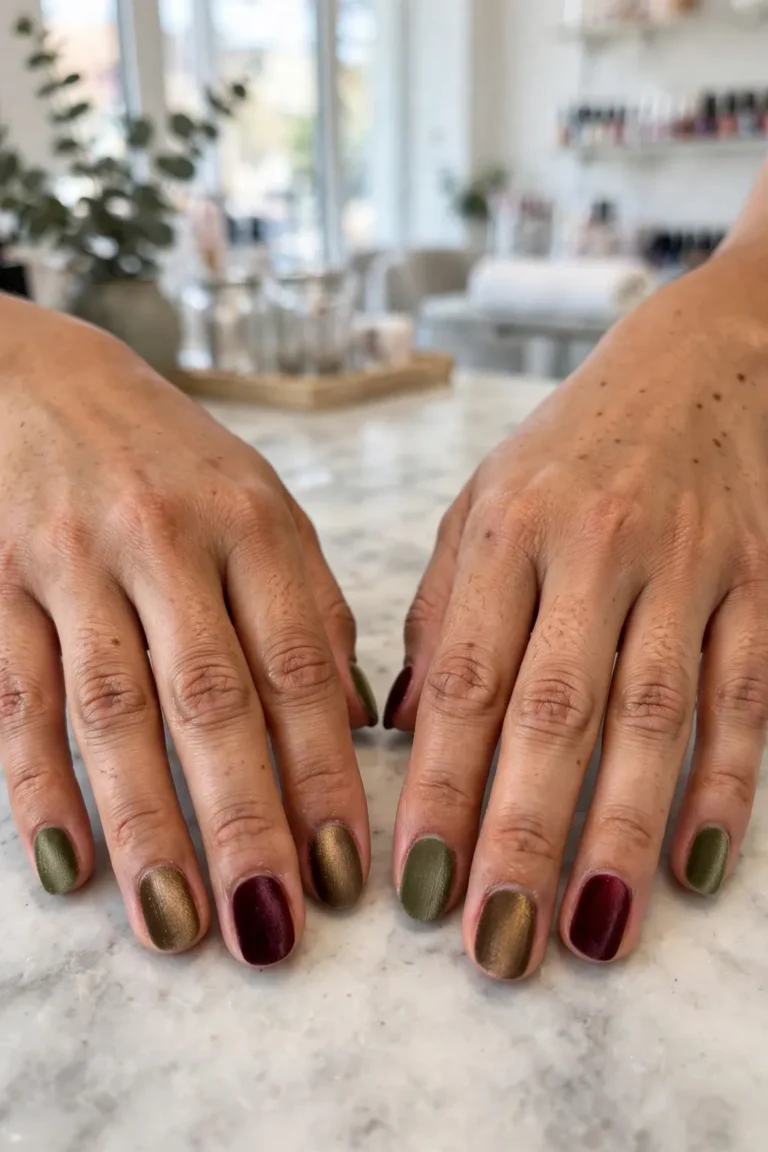
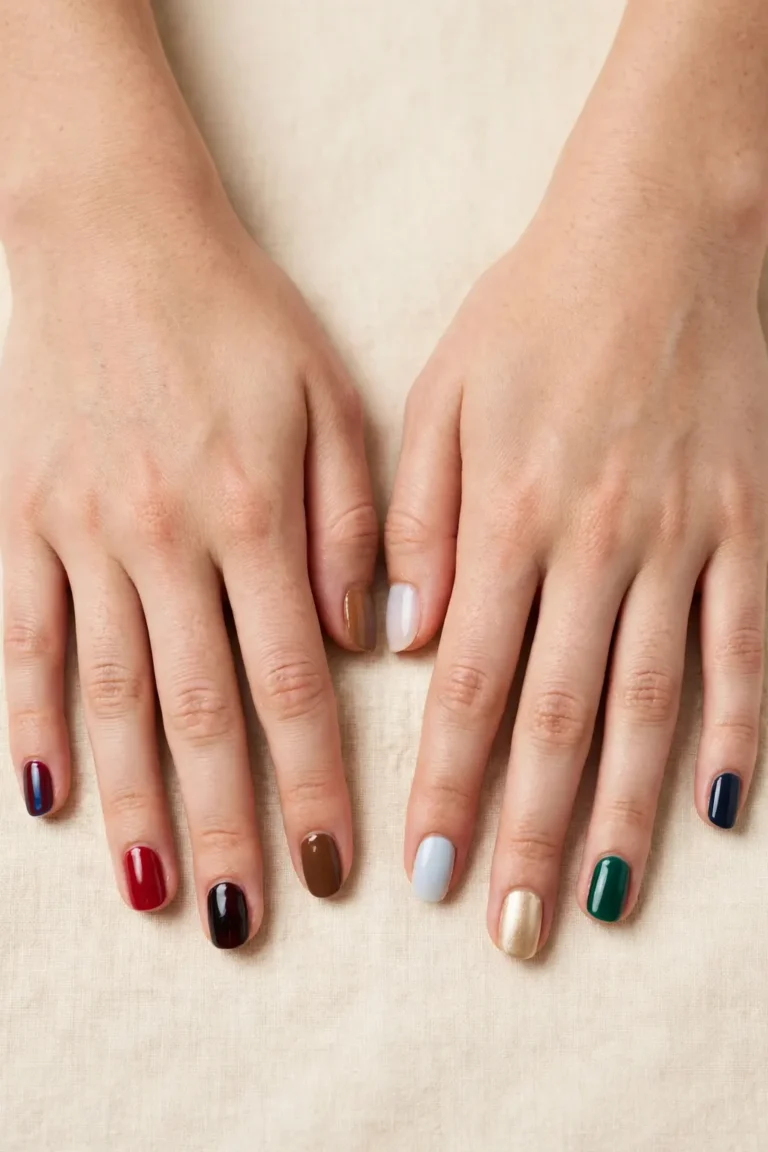
Dark red nails are the shade winter was made for — not the bright red of Christmas morning, but the red that lives in a wine glass at midnight, in a black cherry held up to the light, in a burgundy coat against a grey street. It is the darkest red that still reads as red, and that is exactly why it works: it is polished without being loud, seasonal without being a costume, and it suits the short nails, the long nails and the nails in between. This guide is the spectrum — black cherry, wine and merlot, burgundy with brown — plus the finishes that make dark red glow, the French and accent details that keep it from reading flat, the skin-tone matching that decides between cool wine and warm brick, the salon wording that gets the depth right in daylight rather than salon light, and the base-coat rules that keep a dark polish from staining. ‘Dark red nails’ runs at 916,000 searches a month and peaks in December (Pinsearch, Nov 2026), and dark red cat eye is up 735% in Pinterest’s official Beauty Report — the shade is arriving on time for the peak, and this guide is about arriving at the right dark red, not just any dark red. For more colour inspiration, start at AboutSuperstars.
Quick answer: Dark red nails run from black cherry (almost black, clearly red) through wine and merlot to warm burgundy. Pick by skin tone — cool wine for cool skin, warm brick-burgundy for warm skin — use a base coat every time, and check the shade in daylight before you leave the salon.
Dark Red Nails Spectrum: From Black Cherry to True Burgundy
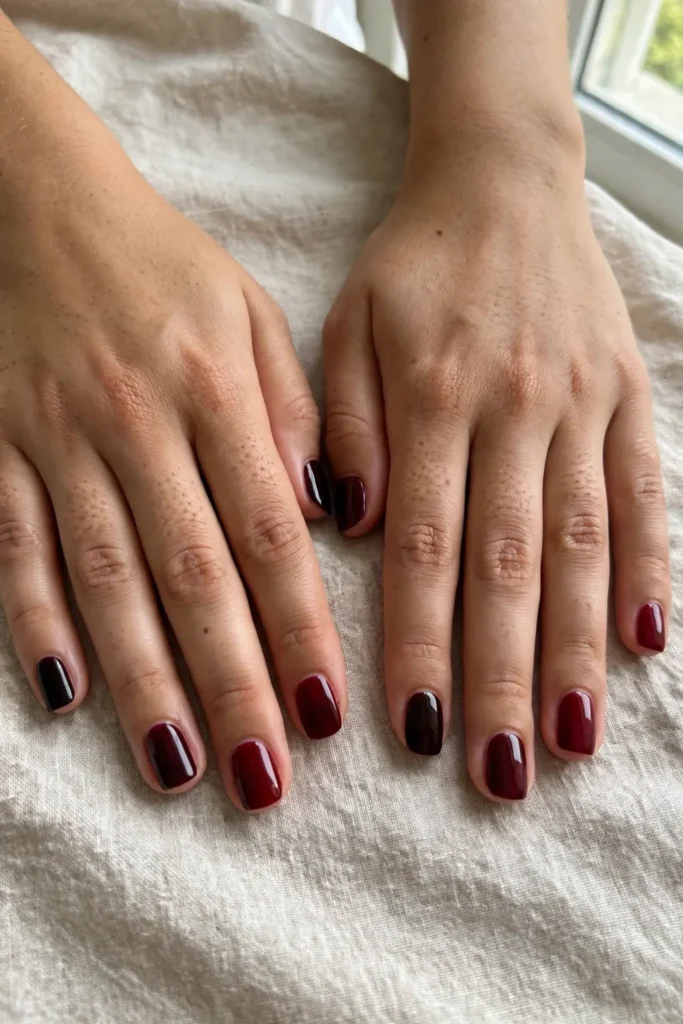
Dark red is not one shade, it is a spectrum, and the spectrum is the whole point of this guide — because the reader who asks for “dark red” and gets the wrong end of it ends up with a manicure she does not recognise. At the darkest end sits black cherry: almost black in the bottle, clearly red on the nail, the shade that reads as black from across the room and red when the light catches it. In the middle sit wine and merlot: the evening reds, deep and blue-toned, the shades that look like the drink they are named for. At the warm end sits burgundy with brown: the warm dark red, brick-toned and earthy, the shade that reads as brown in dim light and red in daylight. And behind all three sits true burgundy: the balanced dark red, neither black nor brown, the shade the spectrum is measured against. The first decision in this guide is therefore not a colour, it is a position on the spectrum — and the position is decided by the skin, the season and the occasion, in that order.
The skin decides first, because dark red is a high-contrast shade and high contrast shows the undertone. Cool skin — pink or blue undertones, veins that read blue at the wrist — takes the cool end of the spectrum: black cherry and wine, the blue-toned darks that match a cool undertone. Warm skin — golden or olive undertones, veins that read green — takes the warm end: burgundy with brown, the brick-toned darks that match a warm undertone. Neutral skin takes the middle: true burgundy, the balanced shade that flatters both. The season decides second: December is the peak for dark red, and the darkest shades — black cherry, wine — read best in December light, while the warm burgundies read best in the low, warm light of a heated room. The occasion decides third: an evening event takes wine, a working week takes burgundy, and a party takes black cherry, because the darkest shade is the one that photographs as a statement.
📌 Save this spectrum before you book — black cherry, wine, burgundy: three reds, three skins, three occasions. Pick the position first, the shade second.
Step by step
The spectrum is chosen in daylight, not in the salon, and the steps are the choosing. First, hold the bottle against the back of the hand in daylight — a window, not a salon lamp — and look at the shade on the skin, not in the bottle, because the bottle lies and the skin tells the truth. Second, paint one nail, not ten, and let it dry fully, because a dark red dries darker than it applies, and the dried nail is the shade you will live with. Third, check it against the outfit you will wear most — a dark red that fights the coat is a dark red that stays in the bottle — and check it against the skin in the same light you will be seen in. The steps take five minutes, and they are the difference between a dark red that flatters and a dark red that fights.
Common mistakes to avoid
The first mistake is choosing from the bottle: a dark red in the bottle is always darker than it is on the nail, and the reader who chooses the bottle’s shade ends up with a manicure two shades darker than she wanted. The second is choosing under salon light, because salon light is warm and flattering, and it makes every dark red read as richer than it is — daylight is the honest light, and the shade that looks right in daylight looks right everywhere. The third is choosing the darkest shade because it is the most dramatic: black cherry on warm skin reads as black, not red, and the drama is lost — the shade that matches the undertone is always more dramatic than the shade that fights it. The fourth is forgetting the occasion: a black cherry for a working week is a statement that needs no statement, and a burgundy for a party is a whisper where the night wants a voice.
Products and tools that help
A base coat is the most important product in this whole guide, because dark red stains — it is the first rule of the spectrum, and it is covered in full in the last section. A ridge-filling base coat is the second, because dark red shows every ridge and every imperfection, and a smooth base is what makes a dark shade read as expensive. A top coat with a high shine is the third, because dark red lives on its shine — a matte dark red reads as flat, and a glossy one reads as deep — and a cuticle oil is the fourth, because dark polish draws the eye to the cuticle, and a neat cuticle is what makes the shade look professional. None of these is expensive; the cost of a good dark red is in the five minutes of choosing, not in the product.
Black Cherry Nails: Almost-Black, Clearly Red
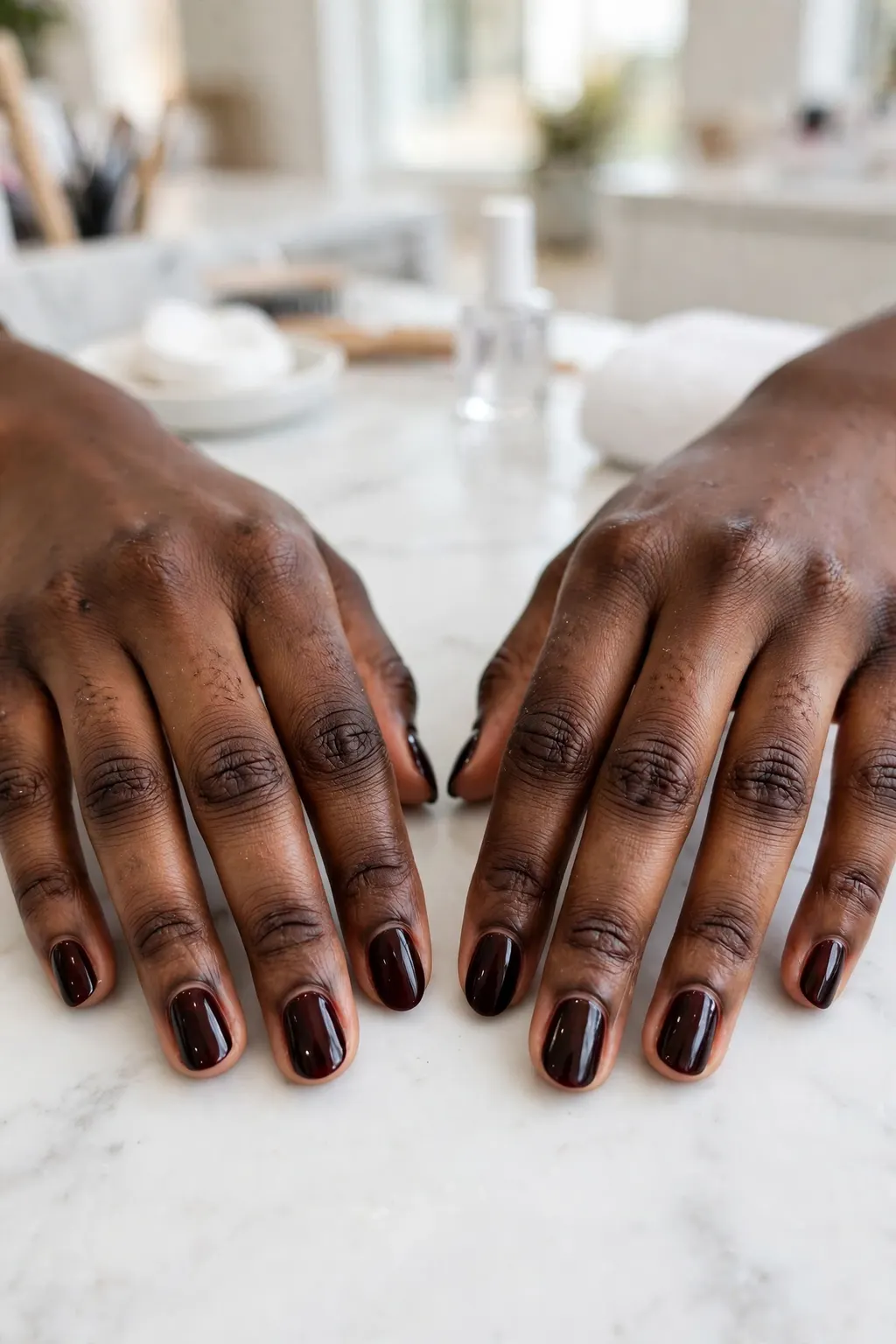
Black cherry is the darkest red in this guide and the most dramatic — the shade that reads as black from across the room and red when the light catches it, like a black cherry held up to a lamp. It is the shade for the reader who wants a statement without a colour: it is not black, and it is not red, and it is both, and that ambiguity is the whole appeal. On the nail it is deep, glossy and almost liquid, and it suits the winter best of all the dark reds, because December light is low and cool, and a black cherry in low light reads as a jewel, not as a nail. It is also the shade that most rewards a perfect application: black cherry shows every streak, every ridge and every uneven edge, because there is nowhere for an error to hide in a shade this dark — and that is why the base coat and the thin coats in the last sections matter most for this shade.
The application is two thin coats, never one thick one. A thick coat of black cherry pools at the cuticle, streaks down the centre and takes an hour to dry — and a dark shade that is not dry smudges, and a smudged dark shade is the most visible smudge there is. Two thin coats, each dried fully before the next, give the depth without the pooling, and a top coat on top gives the shine that makes the red read through the black. The shape that suits black cherry best is the short almond or the short squoval: the dark shade shortens the nail visually, and a short nail in a dark shade reads as deliberate, where a long nail in the same shade reads as a statement that needs no help. The finish that suits it best is the high-gloss cream — the flat, deep, reflective finish that lets the red show through — and the cat-eye version, covered in the finishes section, is the black cherry with a magnetic shimmer running through it.
📌 Save this before you go black cherry — two thin coats, never one thick. A dark shade that is not dry smudges, and a smudged dark shade is the most visible smudge there is.
Who should skip this version
Skip black cherry if your skin is very warm and golden, because the blue-toned black cherry against warm skin reads as black, not red, and the drama of the shade is lost — burgundy with brown is the warm-skin answer, and it is covered in the fourth section. Skip it if your nails are very long and narrow, because a long nail in black cherry reads as a claw, not as a jewel, and the shade needs the balance of a shorter nail. Skip it if you work with your hands all day and cannot protect the manicure, because black cherry chips visibly — a chip in a dark shade is a white line, and a white line on a black cherry is the first thing anyone sees. And skip it if you hate maintenance: black cherry needs a top coat every two to three days to keep its shine, and a shade that loses its shine loses its red with it.
Works best on: shapes and lengths
Black cherry works best on short to medium nails, in almond, squoval or soft square — the shapes that give the dark shade a frame without letting it dominate the hand. It works best on nails with a smooth, ridge-free surface, because the shade shows every ridge, and a ridge-filling base coat is not optional for this shade, it is the foundation. It works best on hands with neat, young-looking cuticles, because the dark polish draws the eye to the cuticle line, and a ragged cuticle against a black cherry is the detail that undoes the whole manicure. It works best, above all, on the reader who wants one shade for the whole of December — black cherry is the darkest red, and it is the one that carries from the first week of the month to the last without ever reading as a Christmas shade or a party shade, only as a dark red.
Maintenance schedule
A black cherry manicure lasts ten to fourteen days in gel, and five to seven days in regular polish — and the schedule is the top coat’s schedule, not the polish’s. A fresh top coat every two to three days keeps the shine that makes the red read, and a cuticle oil every day keeps the cuticle neat, because the dark shade draws the eye there. The regrowth shows in a week for gel, because the dark shade against the bare nail is a visible line, and the fix is a fill, not a full recolour, because re-doing the whole manicure costs time for no gain. The removal is the gentle part: soak-off for gel, never peel, and a base coat under the next dark shade, always, because the stain from a black cherry is the darkest stain in this guide.
Wine & Merlot Reds for Evening
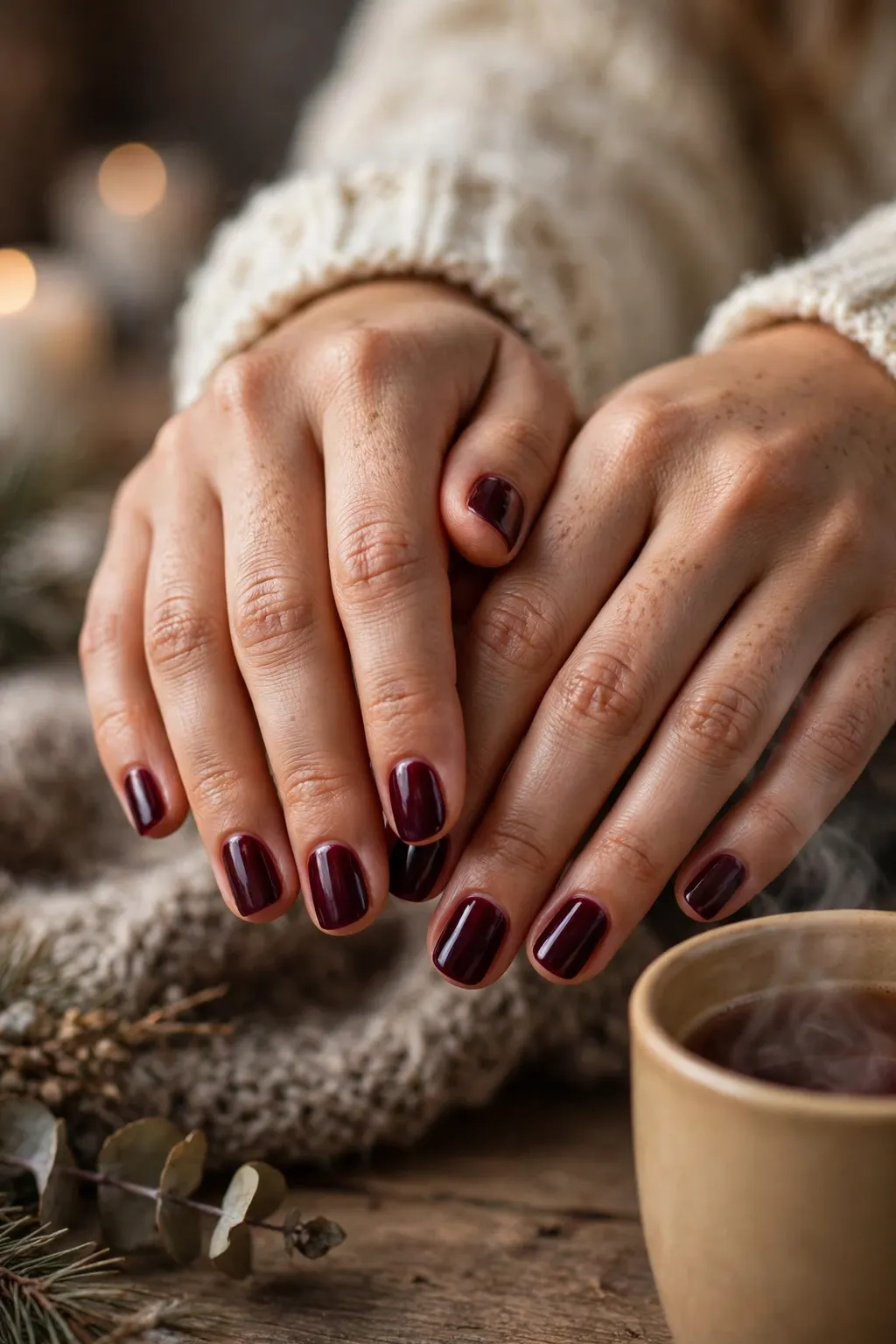
Wine and merlot are the evening reds — the shades that look like the drink they are named for, deep and blue-toned, with a warmth that comes from the depth rather than from the brown. They are the dark reds for the reader who wants to be noticed at an evening event without wearing a bright red: wine is the deeper of the two, almost purple in dim light, and merlot is the softer one, a red with a wine depth that reads as expensive in candlelight. They suit the evening because they are the shades that change with the light: in daylight they read as a deep red, in warm indoor light they read as a rich wine, and in the photographs they read as a statement — and that change is the whole appeal, because a shade that changes with the light never looks the same twice, and a shade that never looks the same twice never gets boring. Red Christmas Nails covers the brighter end of the red family for the same season, and its evening-red logic applies here too — the red that suits the evening is the red with depth, not the red with brightness.
The application is the same two thin coats as black cherry, with one difference: wine and merlot are more forgiving than black cherry, because they are a shade lighter, and a small streak hides in the depth where a streak in black cherry shows. The shape that suits them best is the medium almond or the medium oval — the shapes that give the evening shade a length to work with, without the claw effect of a long stiletto. The finish that suits them best is the high-gloss cream, with the velvet finish — covered in the finishes section — as the evening alternative, because a velvet wine in candlelight reads as the most expensive shade in this guide. The occasion that suits them best is the evening event: a dinner, a party, a night out, where the light is warm and low and the shade can do its changing.
📌 Save this before the evening — wine for dinner, merlot for the party, both checked in candlelight first. The shade that changes with the light is the shade that never gets boring.
Who should skip this version
Skip wine and merlot if your skin is very warm and golden, because the blue-toned wine against warm skin can read as purple, not red, and the evening elegance is lost — burgundy with brown is the warm-skin evening answer. Skip them if you want a daytime shade, because wine and merlot are evening reds: in bright daylight they read as dark and heavy, and the depth that flatters in candlelight reads as flat in the sun. Skip them if you hate the upkeep: wine shows regrowth in a week, and a dark shade against bare nail is a visible line that needs a fill, not a shrug.
Works best on: shapes and lengths
Wine and merlot work best on medium nails, in almond or oval — the shapes that give the evening shade a length to work with. They work best on hands that are looked after, because the dark polish draws the eye to the cuticle, and a neat cuticle is what makes the shade read as expensive. They work best, above all, on the reader who has an evening to dress for: a dinner, a party, a night out, where the light is warm and low and the shade can do its changing.
Maintenance schedule
A wine manicure lasts ten to fourteen days in gel, and five to seven days in regular polish. A fresh top coat every two to three days keeps the shine that makes the red read, and a cuticle oil every day keeps the cuticle neat. The regrowth shows in a week for gel, and the fix is a fill. The removal is soak-off for gel, never peel, and a base coat under the next dark shade, always.
Burgundy With Brown: The Warm Dark Red
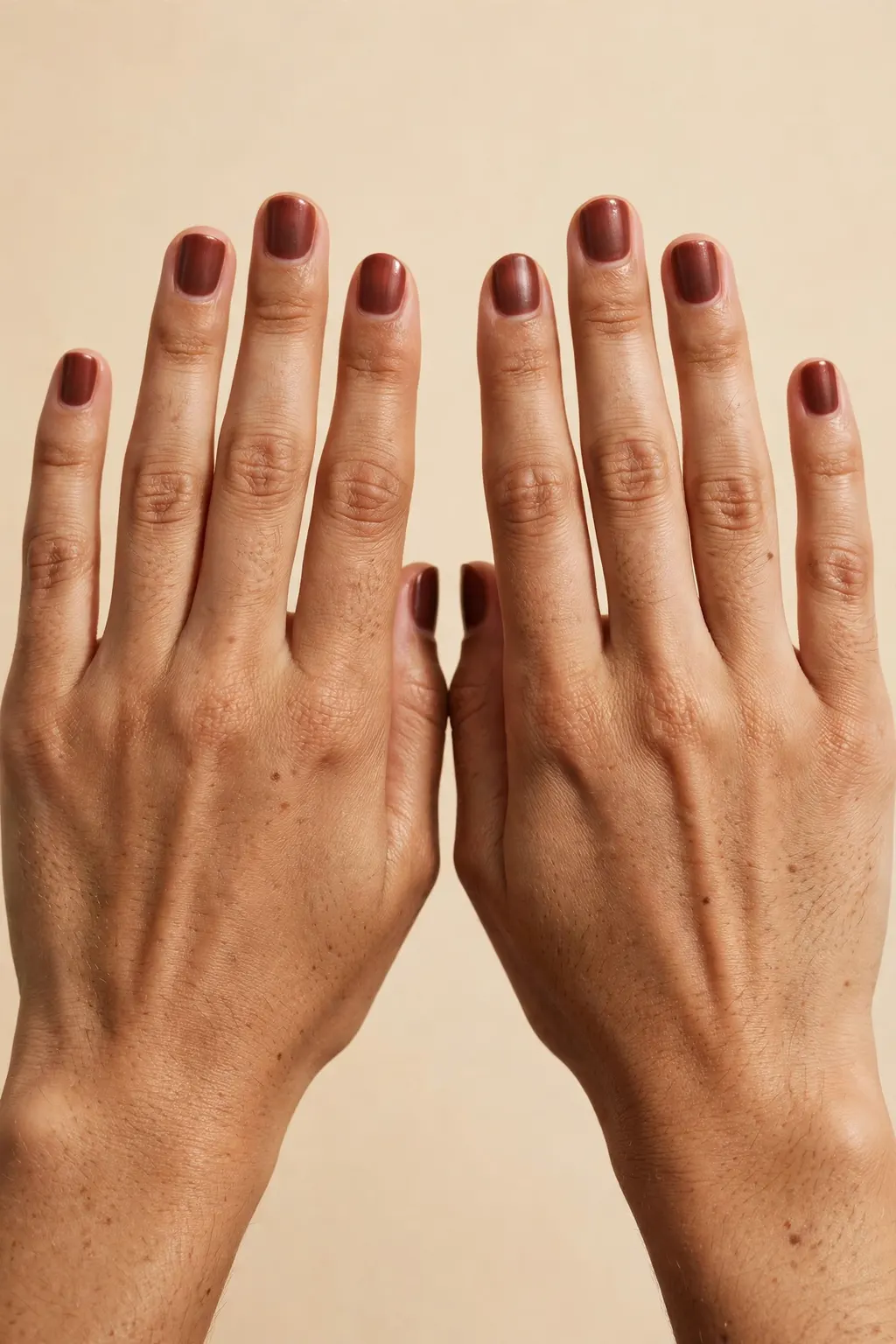
Burgundy with brown is the warm dark red — the shade for warm skin, the shade that reads as brown in dim light and red in daylight, the shade that meets warm skin halfway. It is brick-toned and earthy, the dark red with brown in it, and it is the warm end of the spectrum: where black cherry is almost black and wine is almost purple, burgundy with brown is almost brown, and that almost-brown is what makes it flatter warm skin, because warm skin has brown in it too. It is the dark red for the reader whose skin is golden or olive, whose veins read green at the wrist, whose wardrobe is warm — and it is the dark red that looks like it belongs, not like it was borrowed. Caramel Nude Nails covers the warm-colour family this shade sits in, and its undertone logic is the same: match the warmth, and the shade disappears into the hand in the best way.
The application is two thin coats, never one thick one, with a ridge-filling base coat first, because burgundy with brown shows every ridge, and a smooth base is what makes the warm shade read as expensive rather than muddy. The shape that suits it best is the short squoval or the short almond: the dark shade shortens the nail visually, and a short nail in a warm dark red reads as deliberate. The finish that suits it best is the high-gloss cream, with the velvet finish as the evening alternative. The occasion that suits it best is the working week and the daytime: burgundy with brown is the dark red that works at the office, at lunch, at school pickup, because it is polished without being loud.
📌 Save this for warm skin — burgundy with brown is the warm-skin dark red. If your veins read green, this is your shade, not black cherry.
Who should skip this version
Skip burgundy with brown if your skin is very cool, because the warm brick tone against cool skin can read as muddy, not rich, and the warmth that flatters warm skin fights cool skin — black cherry or wine is the cool-skin answer. Skip it if you want a statement shade, because burgundy with brown is the quiet dark red: it flatters, it does not shout, and a party that wants a voice wants black cherry. Skip it if your nails are very long, because a long nail in a warm dark red reads as heavy, and the shade needs the balance of a shorter nail.
Works best on: shapes and lengths
Burgundy with brown works best on short to medium nails, in squoval, almond or soft square. It works best on warm and olive skin, because the brick tone matches the undertone. It works best on hands with neat cuticles, because the dark polish draws the eye there. It works best, above all, on the reader who wants one dark red for the working week — the shade that is polished without being loud, seasonal without being a costume.
Maintenance schedule
A burgundy manicure lasts ten to fourteen days in gel, and five to seven days in regular polish. A fresh top coat every two to three days keeps the shine, and a cuticle oil every day keeps the cuticle neat. The regrowth shows in a week for gel, and the fix is a fill. The removal is soak-off for gel, never peel, and a base coat under the next dark shade, always — burgundy with brown stains as surely as black cherry does.
Dark Red Cat Eye & Velvet Finishes
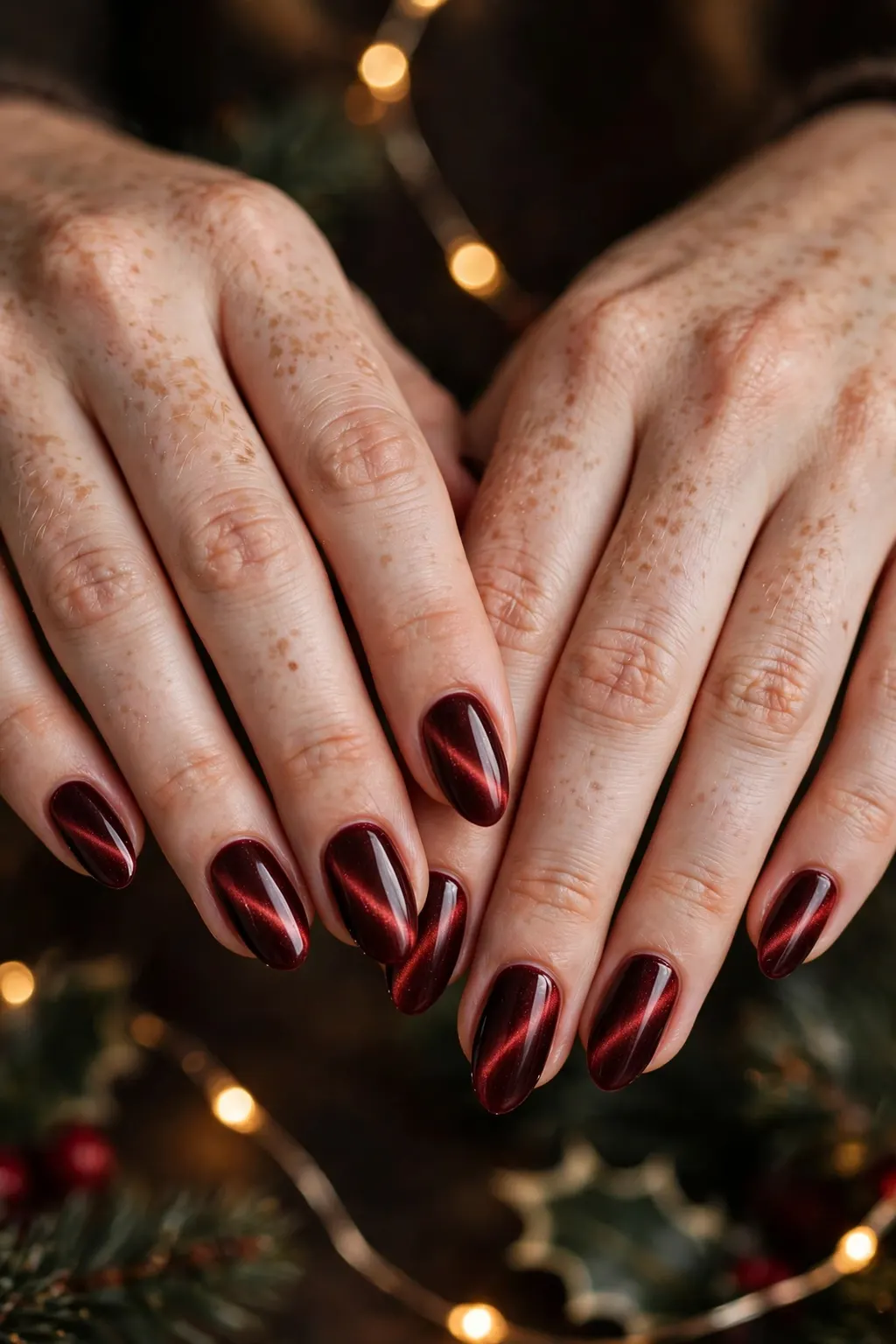
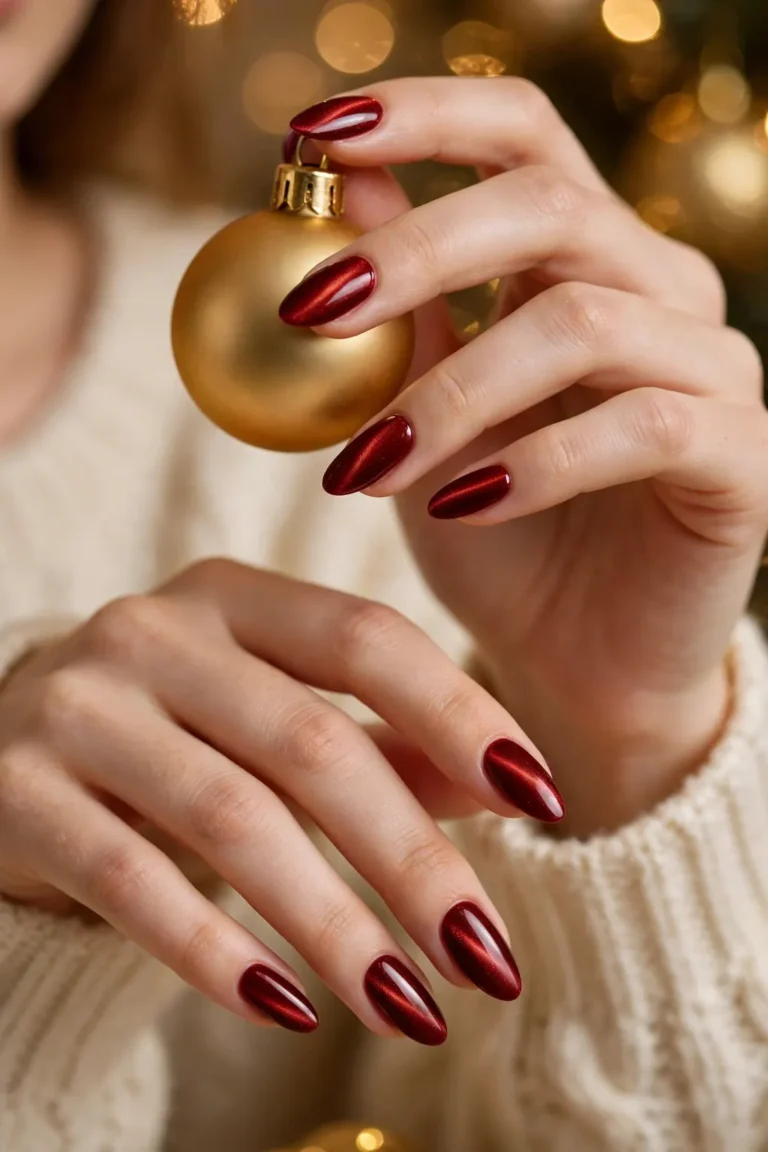
The finishes are what make dark red glow: cat eye and velvet, the two finishes that turn a flat dark red into a shade with movement. Cat eye is the magnetic finish — a shimmer that runs through the polish like a line of light, moved with a magnet while the polish is wet, so the shimmer sits where the magnet held it. On dark red it reads as a glow, not a glitter: a black cherry cat eye glows red at the centre and black at the edges, a wine cat eye glows like wine held up to a lamp. Velvet is the soft finish — the same magnetic shimmer, held softer, diffused across the nail like brushed velvet, so the nail reads as fabric, not as metal. On dark red it reads as the most expensive finish in this guide: a velvet wine in candlelight is the shade that stops a room.
The application is the same two thin coats, with the magnet step added: paint the cat-eye coat, hold the magnet over the nail for ten seconds before curing, and the shimmer sets where the magnet held it. For velvet, hold the magnet further away, and the shimmer diffuses. The shape that suits both finishes best is the medium almond: the finishes need a nail with room to show the movement, and a medium almond gives it. The occasion that suits cat eye best is the party, and velvet best is the dinner — cat eye for the night that wants a statement, velvet for the night that wants elegance.
📌 Save this finish guide — cat eye for the party, velvet for the dinner, two thin coats always. The magnet does the work; your job is to hold it still.
Who should skip this version
Skip cat eye and velvet if you want a low-maintenance manicure, because the finishes need a skilled hand and a magnet, and a bad cat eye reads as a smear, not a glow. Skip them if your nails are very short, because the finishes need room to show the movement, and a very short nail gives the shimmer nowhere to go. Skip velvet if you work with your hands all day, because the soft finish shows wear first, and a velvet that has worn reads as patchy, not soft.
Works best on: shapes and lengths
Cat eye and velvet work best on medium nails, in almond or oval, because the finishes need length to show the movement. They work best on smooth, ridge-free nails, because the shimmer shows every ridge. They work best on the reader who has a party or a dinner to dress for, and a nail tech who knows the magnet: ask for it by name, and check the shimmer before the top coat goes on.
Maintenance schedule
A cat-eye or velvet manicure lasts ten to fourteen days in gel. A fresh top coat every two to three days keeps the shine, and the shimmer itself does not fade — it is set in the polish. The removal is soak-off for gel, never peel, and a base coat under the next dark shade, always.
Dark Red French & Accent Details
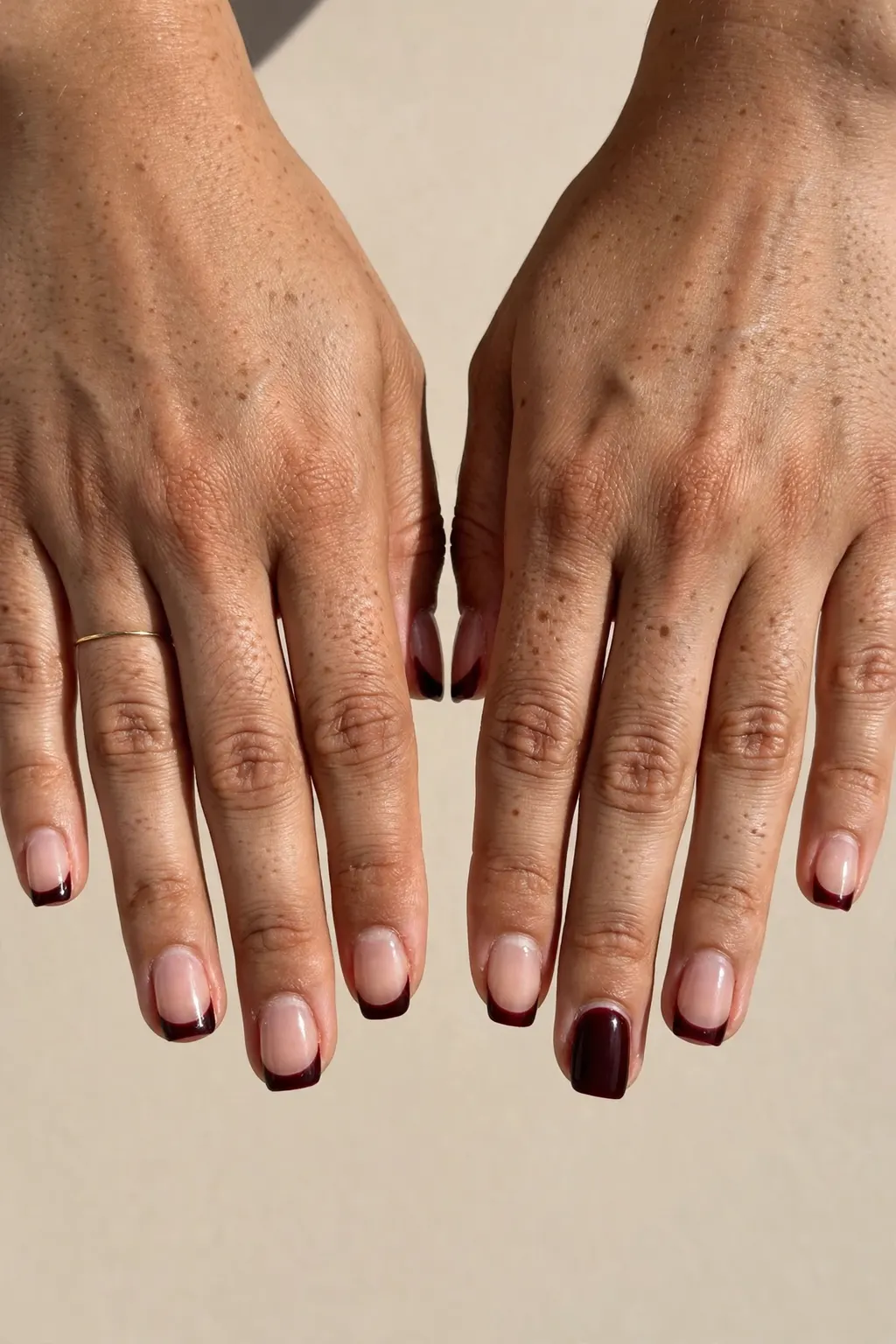
A dark French is the dark red in a small area: the tip, not the manicure, the high contrast in a small place that reads as deliberate. A dark red French tip — black cherry or wine on a sheer nude base — is the dark red for the reader who wants the shade without the commitment: the tip is the statement, the rest of the nail is bare, and the whole hand reads as groomed, not painted. An accent nail — one dark red nail among nine nude or milky ones — is the same idea in reverse: one nail carries the shade, the rest carry the quiet, and the dark red reads as a choice, not as a default.
The application is a steady hand and a fine brush: paint the nude base, let it dry fully, then paint the tip with a thin brush, following the free edge, and clean the line with a small brush dipped in remover before the top coat goes on. The shape that suits a dark French best is the short squoval or the short almond: the tip needs a free edge to sit on, and a short nail gives it a clean line. The accent nail that suits dark red best is the ring finger: one dark red nail, nine nude, and the hand reads as deliberate.
📌 Save this French idea — the tip, not the manicure. A dark French is the dark red for the reader who wants the shade without the commitment.
Who should skip this version
Skip a dark French if your nails are very short, because the tip needs a free edge to sit on, and a very short nail gives the tip nowhere to go. Skip an accent nail if you want a uniform look, because the accent is a choice that draws the eye, and a uniform manicure is a choice that does not. Skip both if you hate the upkeep: a French tip shows regrowth at the cuticle, not at the tip, and the fix is a fill, not a re-tip.
Works best on: shapes and lengths
A dark French works best on short to medium nails, in squoval or almond, with a sheer nude base that matches the skin. An accent nail works best on the ring finger, with nine nude or milky nails beside it. Both work best on the reader who wants the dark red in a small area: the tip, not the manicure, the accent, not the set.
Maintenance schedule
A dark French manicure lasts ten to fourteen days in gel, and five to seven days in regular polish. A fresh top coat every two to three days keeps the shine, and the tip itself does not fade. The removal is soak-off for gel, never peel, and a base coat under the next dark shade, always.
Dark Red Nails by Skin Tone: Cool Wine vs Warm Brick
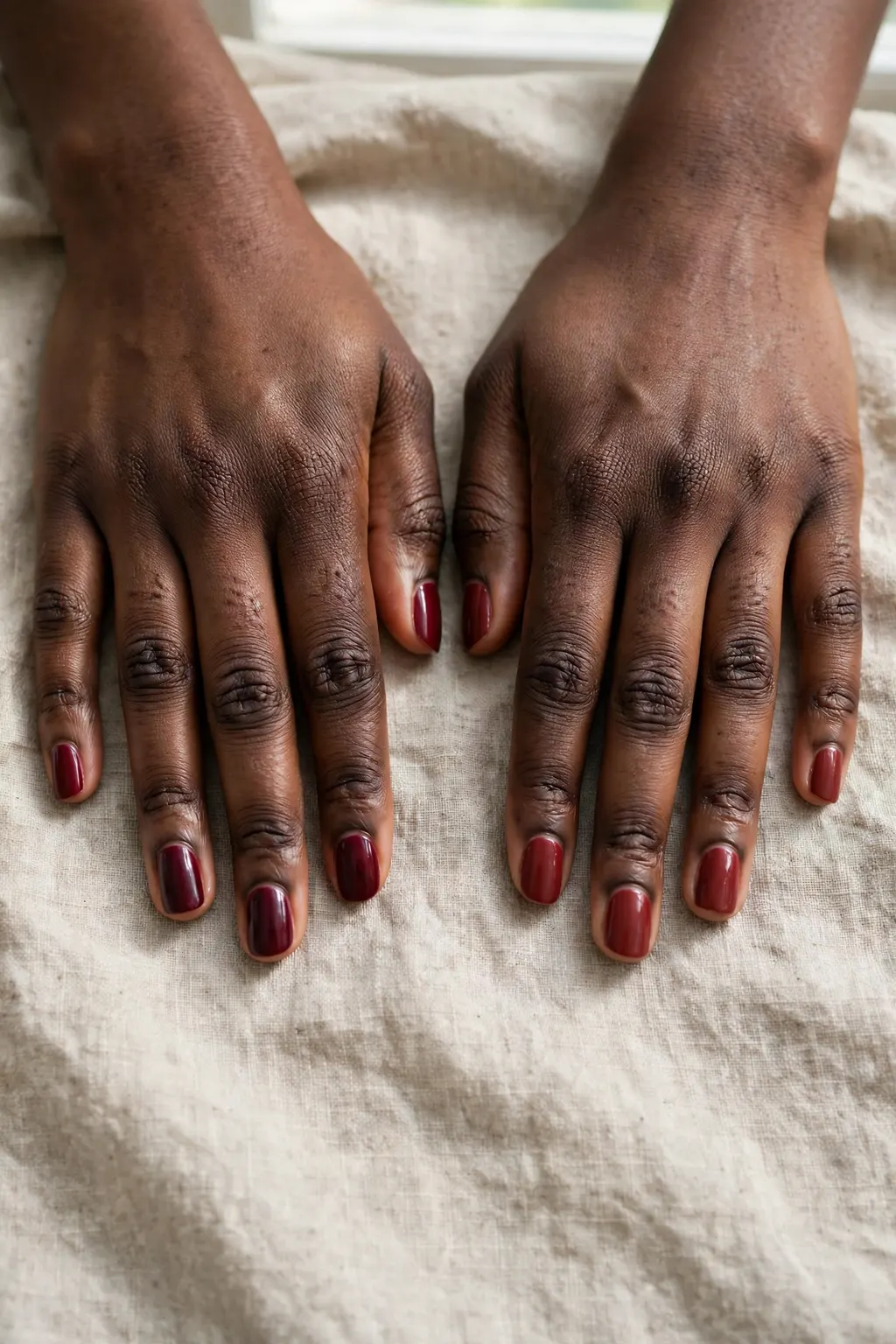
The skin decides the shade, because dark red is a high-contrast shade and high contrast shows the undertone. Cool skin — pink or blue undertones, veins that read blue at the wrist — takes the cool end of the spectrum: black cherry and wine, the blue-toned darks that match a cool undertone. Warm skin — golden or olive undertones, veins that read green — takes the warm end: burgundy with brown, the brick-toned darks that match a warm undertone. Neutral skin takes the middle: true burgundy, the balanced shade that flatters both. The test is the wrist, in daylight: hold the bottle against the back of the hand by a window, look at the veins, and the veins will tell you which you are — blue means cool, green means warm, and both means neutral, and the shade follows the veins.
The season decides second, and the occasion third, but the skin decides first, and the skin is the decision that cannot be argued with: a black cherry on warm skin reads as black, not red, and a burgundy with brown on cool skin reads as muddy, not rich. The shade that matches the undertone is always more dramatic than the shade that fights it, because a shade that matches disappears into the hand in the best way, and a shade that fights stands out in the worst way. Check the shade in daylight, not in salon light, because salon light is warm and flattering, and it makes every dark red read as richer than it is — daylight is the honest light, and the shade that looks right in daylight looks right everywhere.
📌 Save this skin-tone rule — blue veins mean cool, green veins mean warm. Check the wrist in daylight, and the veins will tell you which dark red is yours.
Who should skip this version
Skip the skin-tone rule if you have already found your dark red and it works — a shade that flatters is a shade that flatters, whatever the veins say. Skip it if you are choosing for a photograph, not for a hand, because a photograph flattens the undertone, and the shade that photographs best is the darkest one, whatever the skin. Skip it if you hate rules: the wrist test is a guide, not a law, and the shade you love is the shade you should wear.
Works best on: shapes and lengths
The skin-tone rule works best on every shape and every length, because it is a rule about colour, not about shape. It works best on hands that are looked after, because the dark polish draws the eye to the cuticle. It works best, above all, on the reader who has chosen the wrong dark red before and wants to choose right this time: check the wrist, check the daylight, and the shade follows.
Maintenance schedule
The skin-tone rule has no maintenance schedule, because it is a choosing rule, not a wearing rule. The wearing rules are the top coat every two to three days, the cuticle oil every day, the fill at a week for gel, and the soak-off removal, never peel.
What to Ask Your Nail Tech: Shade Depth in Daylight vs Salon Light
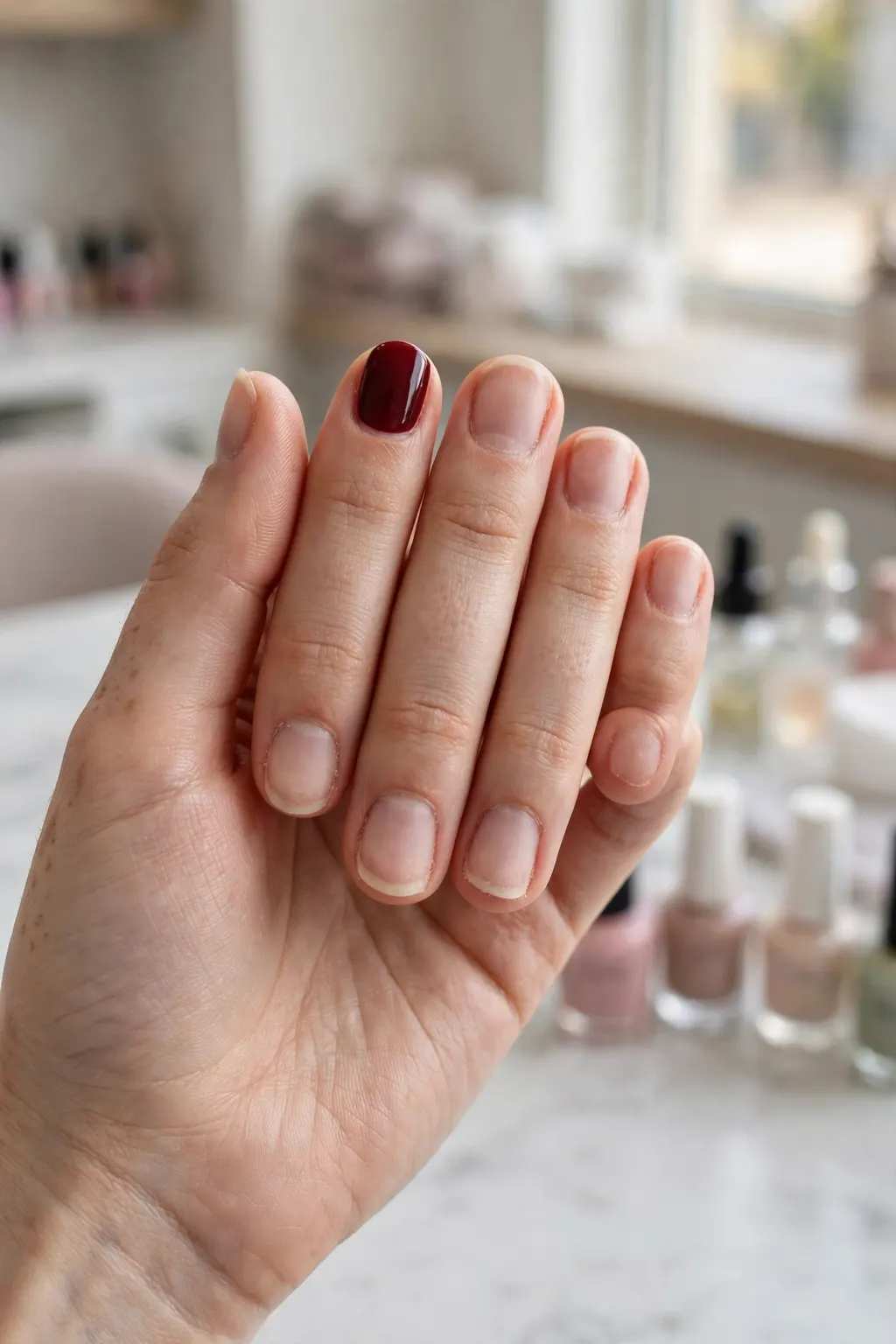
Your December salon brief: ask for the shade by its position on the spectrum, not by its name, because names lie and positions do not. Say the depth out loud — “black cherry, almost black, clearly red” or “burgundy with brown, warm, brick-toned” — and ask the tech to paint one nail, not ten, and let it dry fully, because a dark red dries darker than it applies, and the dried nail is the shade you will live with. Then walk to the window and check it in daylight, because salon light is warm and flattering, and it makes every dark red read as richer than it is. If the dried nail in daylight is the shade you wanted, say so, and the other nine follow. If it is not, say so now, while only one nail is painted.
The wording that gets the depth right is the wording in this guide: the spectrum position first, the finish second, the shape third. Say “two thin coats, never one thick” out loud, because a thick coat of dark red pools at the cuticle and streaks down the centre. Say “a ridge-filling base coat first” out loud, because dark red shows every ridge. Say “clean the edges before the top coat” out loud, because a dark edge that is not clean is a dark edge that stays dirty. And say “check one nail in daylight before the other nine” out loud, because the daylight check is the whole brief in one sentence.
📌 Save this salon brief before you book — say the shade depth out loud, paint one nail, check it in daylight. The brief is five lines; the manicure is two weeks.
Who should skip this version
Skip the salon brief if you do your own nails at home, because the brief is written for a salon visit — but keep the daylight check, because the daylight check is the whole brief in one sentence, and it works at home too. Skip it if your tech already knows your shade, because a tech who knows your shade does not need the brief. Skip it if you hate talking in the salon, because the brief is five lines, and five lines is a lot to say — but say the daylight check, at least, because the daylight check is the one line that matters.
Works best on: shapes and lengths
The salon brief works best on every shape and every length, because it is a brief about colour and wording, not about shape. It works best on the reader who has a salon appointment booked and a shade in mind, and wants the shade in mind to be the shade on the nails. It works best, above all, on the reader who has chosen the wrong dark red before: say the depth out loud, paint one nail, check it in daylight, and the wrong dark red does not happen twice.
Maintenance schedule
The salon brief has no maintenance schedule, because it is a choosing brief, not a wearing brief. The wearing rules are the top coat every two to three days, the cuticle oil every day, the fill at a week for gel, and the soak-off removal, never peel.
Dark Polish Rules: Staining, Base Coats & Clean Edges
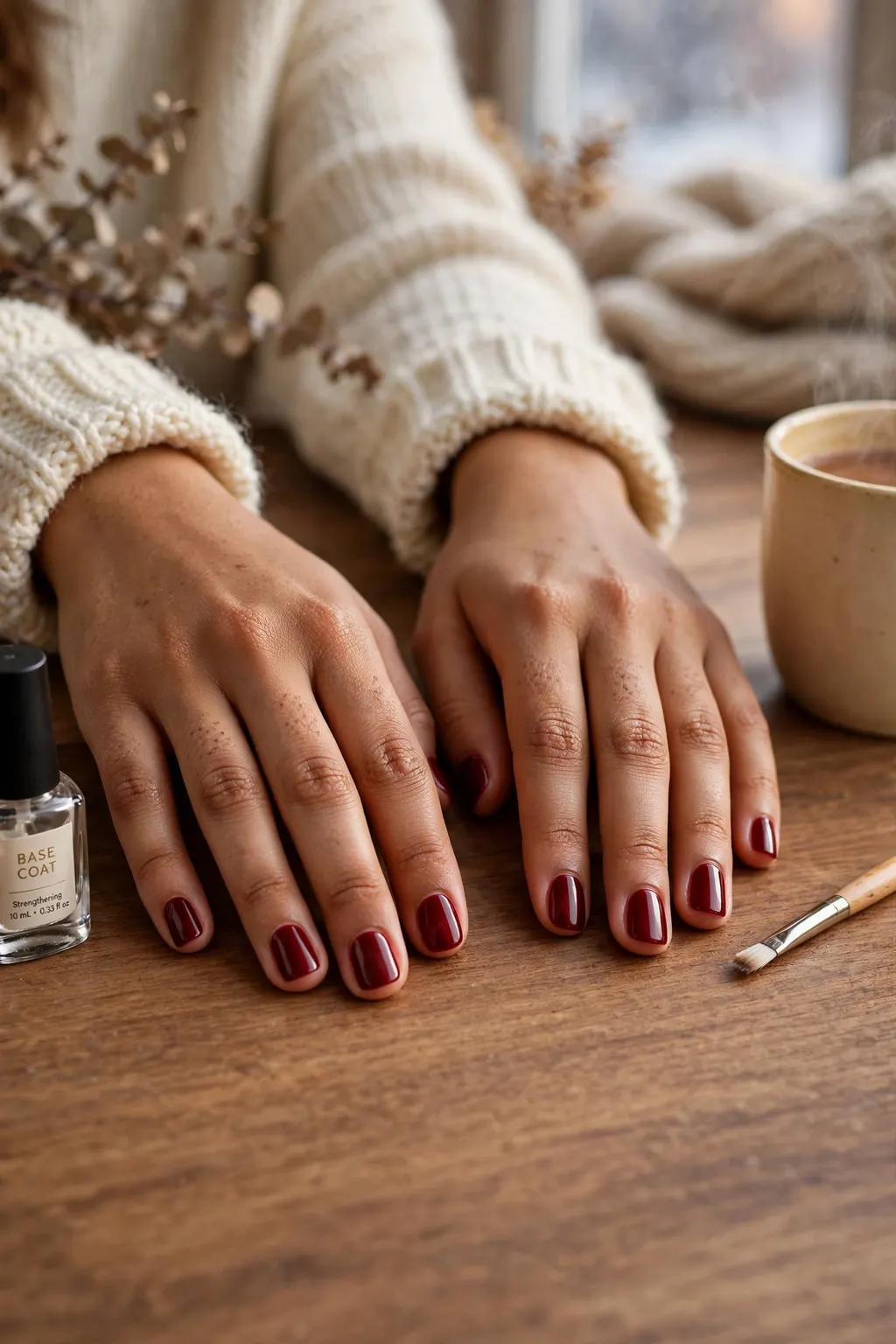
Dark polish stains — it is the first rule of dark red, and the rule that everything else in this guide depends on. A dark red without a base coat stains in one application, and the stain takes a week to grow out. The base coat is the only thing that stops it: a ridge-filling base coat, one thin coat, dried fully before the colour goes on, every time, without exception. Two thin coats of colour, never one thick, and clean the edges with a small brush dipped in remover before the top coat goes on, because a dark edge that is not clean is a dark edge that stays dirty. And when the manicure comes off, soak gel off, never peel it, because peeling takes the nail with the polish, and a peeled nail is a damaged nail.
The clean edge is the detail that makes a dark manicure read as professional: a dark polish that has flooded the cuticle reads as amateur, whatever the shade, and a dark polish with a clean edge reads as expensive, whatever the price. The tools are a small brush, a bottle of remover, and a steady hand — and the time is two minutes, at the end of the manicure, before the top coat. The top coat itself is the shine that makes the red read: a fresh top coat every two to three days keeps the shine that makes the red read, and a shade that loses its shine loses its red with it.
📌 Save this rule before you paint — base coat every time, two thin coats, clean edges before the top coat. The base coat is the only thing that stops the stain.
Who should skip this version
Skip the base-coat rule if you never wear dark polish, because the rule is written for dark red — but keep it for any dark shade, because any dark shade stains. Skip the clean-edge rule if you do your nails at home and do not mind a flooded cuticle, because the rule is about reading as professional — but keep the base coat, because the stain does not care whether you are at home or in a salon.
Works best on: shapes and lengths
The polish rules work best on every shape and every length, because they are rules about application, not about shape. They work best on the reader who wears dark red often, because the stain is cumulative, and a base coat every time is the only thing that stops it. They work best, above all, on the reader who has stained her nails before and does not want to stain them again.
Maintenance schedule
The polish rules are the maintenance schedule: a base coat every time, two thin coats, clean edges before the top coat, a fresh top coat every two to three days, a cuticle oil every day, a fill at a week for gel, and soak-off removal, never peel. Follow the rules, and the dark red stays clean, stays glossy, and stays on the nail, not in it.
Frequently Asked Questions
What is the difference between burgundy and black cherry nails?
Burgundy is the balanced dark red — deep, rich, neither black nor brown — while black cherry is the darkest red in the family: almost black in the bottle, clearly red on the nail, the shade that reads as black from across the room and red when the light catches it. Burgundy suits every skin tone; black cherry suits cool and neutral skin best, because its blue undertone against warm skin reads as black, not red. If you want a statement, choose black cherry; if you want the dark red that flatters everyone, choose burgundy.
Do dark red nails suit short nails?
Yes — dark red suits short nails best of all, because the dark shade shortens the nail visually, and a short nail in a dark shade reads as deliberate, where a long nail in the same shade reads as a statement. The shapes that suit short dark red best are the short almond and the short squoval, and the finishes that suit it best are the high-gloss cream and the velvet. The one rule for short dark red is the cuticle: the dark polish draws the eye to the cuticle line, so keep it neat, and the short nail will read as polished, not as small.
How do I keep dark red polish from staining?
Use a base coat every time, without exception — a ridge-filling base coat, one thin coat, dried fully before the colour goes on. Paint two thin coats of colour, never one thick, and clean the edges with a small brush dipped in remover before the top coat goes on. When the manicure comes off, soak gel off, never peel it, and put a base coat under the next dark shade as well. A dark red without a base coat stains in one application, and the stain takes a week to grow out — the base coat is the only thing that stops it.
Conclusion & Bottom Line
Bottom line: dark red nails are the December shade that is not Christmas — black cherry for the statement, wine for the evening, burgundy with brown for the working week, all of them checked in daylight, all of them on a base coat. Pick your position on the spectrum first, the shade second, and the dark red you wear will be the dark red you meant.
Dark red is the shade winter was made for, and this guide is the spectrum: black cherry, wine and merlot, burgundy with brown, the cat-eye and velvet finishes, the French and accent details, the skin-tone matching, the salon wording, and the base-coat rules. The shade is arriving on time for the December peak, and the guide is about arriving at the right dark red, not just any dark red. For more colour inspiration, start at AboutSuperstars.