December Nail Colours: The 12 Shades to Book Before Christmas
December nail colors have to do three jobs at once: look right at the office party, photograph well in fairy light, and still look intentional on New Year’s Day. The shades that manage all three are a small, specific set — not every red, not every dark, but the twelve that suit cold light, knitwear and gold jewellery at the same time. This guide names the twelve, groups them so you can choose in one sitting — three reds, three browns, three lights, three deeps — and then adds the two party-week finishes that sit on top of them: black and metallic chrome. ‘December nail colors’ sits inside ‘winter nails’ at 5,000,000 searches a month and ‘christmas nails’ at 11,000,000 a month (Pinsearch, Nov 2026), both peaking in December, which is why salons book out: the shades below are the ones worth booking before the slots go. For more beauty inspiration, start at AboutSuperstars.
Quick answer: The 12 December nail colours are classic red, cherry, dark red, espresso, mocha, caramel, milky white, icy blue, champagne, emerald, navy and plum — pick one family by skin tone, book it before mid-December, and keep it glossy with a top-coat refresh at day seven.
The December Dozen: How the 12 December Nail Colors Break Down
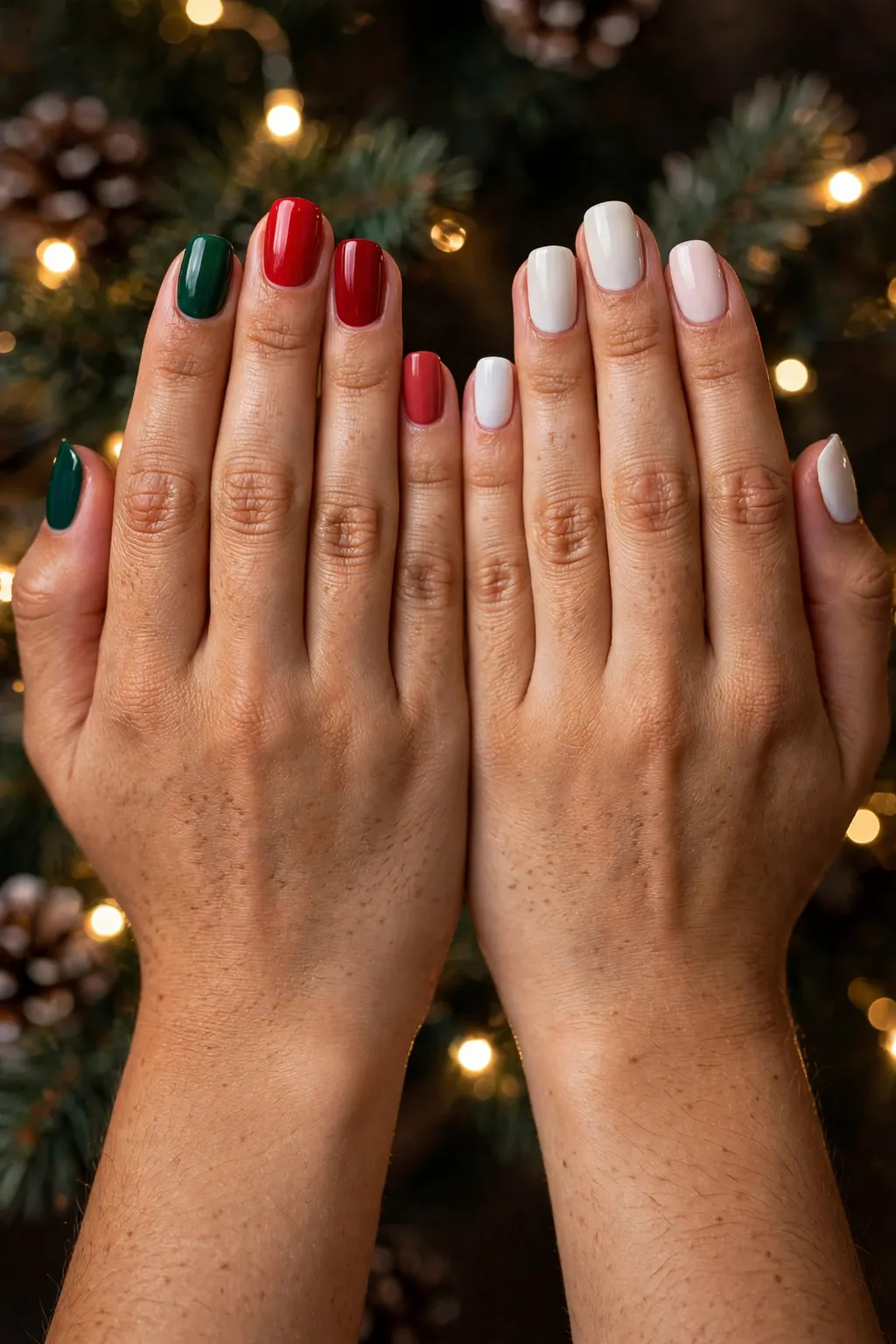
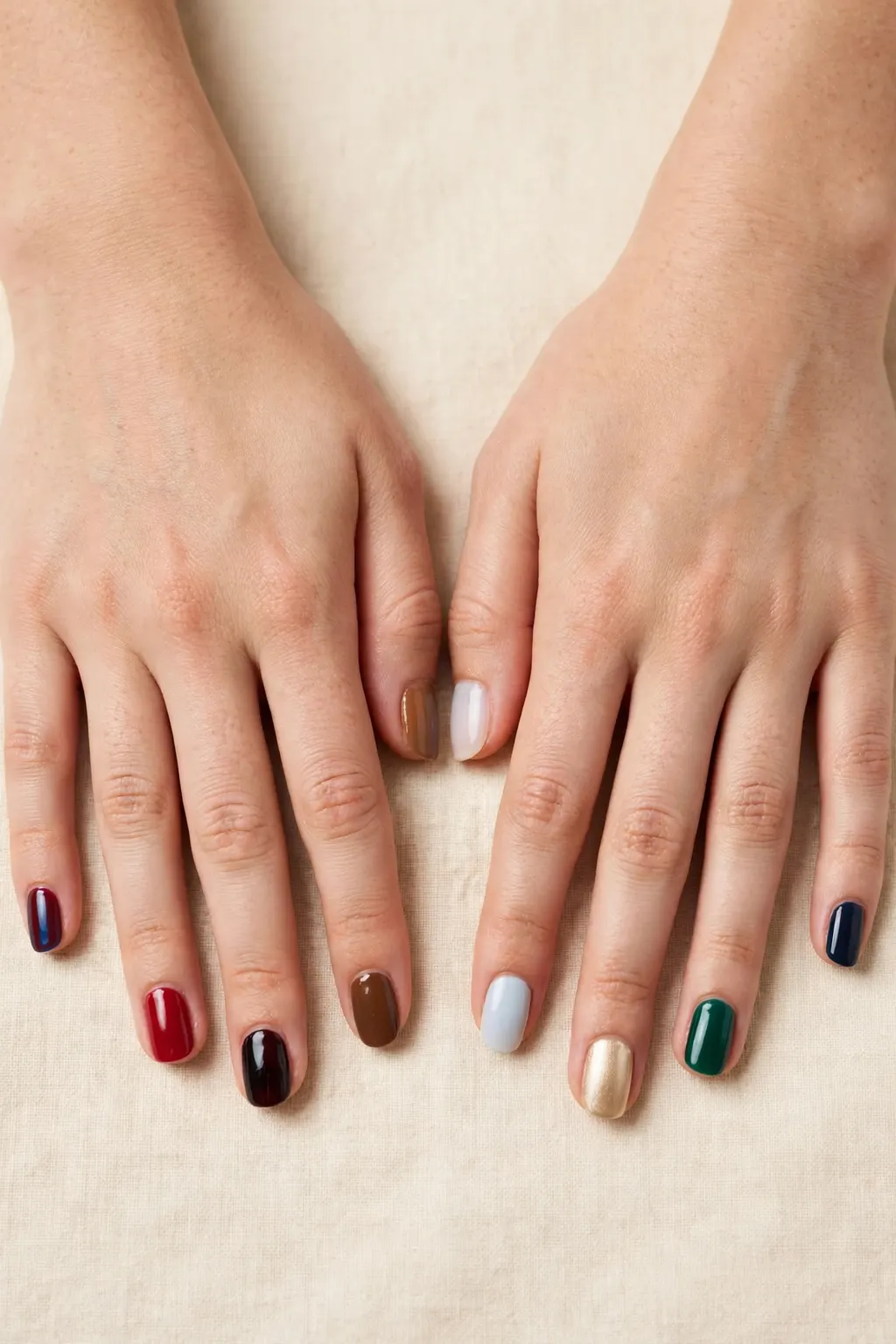
The dozen breaks down as four families of three. The reds — classic, cherry and dark — are the December default, the colour of the month in every sense. The browns — espresso, mocha and caramel — are the quiet-luxury answer, the shades that look expensive without shouting. The lights — milky white, icy blue and champagne — are the winter-morning shades, pale without washing out. And the deeps — emerald, navy and plum — are the evening shades, dark without going black. That is twelve. Black and the two metallic chromes, gold and silver, are not counted in the dozen: black is the thirteenth shade for the reader who wants the darkest possible nail, and the chromes are finishes laid over the dozen rather than colours in their own right — gold chrome over a red base, silver chrome over a milky one. Knowing the dozen as four families of three is what makes choosing fast: pick a family first, by skin tone and by how loud you want the manicure to be, and the shade inside it almost picks itself.
The other thing the dozen shares is timing. Every one of these shades is a gel-friendly, two-to-three-week colour, which means one December appointment can carry you from the first party to New Year’s Eve if you choose well and maintain it — and that is the whole point of booking the right shade rather than the first shade. A colour that chips on day four costs you a second appointment in the busiest fortnight of the year; a colour chosen for your skin tone and your wardrobe costs you one appointment and a bottle of top coat. The sections below take each family in turn — what it looks like, who it flatters, what to say in the salon, and how long it lasts — and then close with the skin-tone map, the booking script and the three-week maintenance plan that keeps one shade looking fresh.
Who should skip this version
Skip the dozen-as-a-list if you already know your family: readers who wear the same red every December do not need twelve options, they need the one red done properly, and this guide’s Reds section is the place for them. Skip it too if your December is a single event rather than a season — one party, one outfit, one photograph — because then the right move is to match the shade to that outfit alone, and the skin-tone section at the end will do that faster than the full dozen. The dozen is for the reader choosing a colour to live in for three weeks, not for a single night.
Works best on: shapes and lengths
The dozen as a set works best on short to medium nails, because that is where a considered colour shows its quality: on a short nail the shade is the whole design, so a good red or a good espresso reads as deliberate, while a poor one reads as an accident. Almond and squoval shapes show the families off best — almond gives the deeps room to look velvety, squoval gives the lights a clean frame — but the honest rule is that the dozen works on every shape, because these are all solid, single-colour shades with no art to distort. If your nails are very long, the deeps and the metallics will suit you best, because length gives a dark shade the surface it needs to look rich rather than flat.
Maintenance schedule
One December shade, worn for three weeks, needs a top-coat refresh on day seven and again on day fourteen, cuticle oil daily, and gloves for washing up — that is the whole schedule, and it is the same for all twelve shades. The lights show wear first, at the free edge, where a milky white goes dull before a dark red does; the deeps hide wear longest, because a tiny chip in emerald reads as a shadow rather than a hole. Book the appointment for the first week of December, refresh the top coat yourself at home mid-month, and the same shade carries you to New Year’s Eve without a second salon visit.
The Reds: Classic, Cherry & Dark
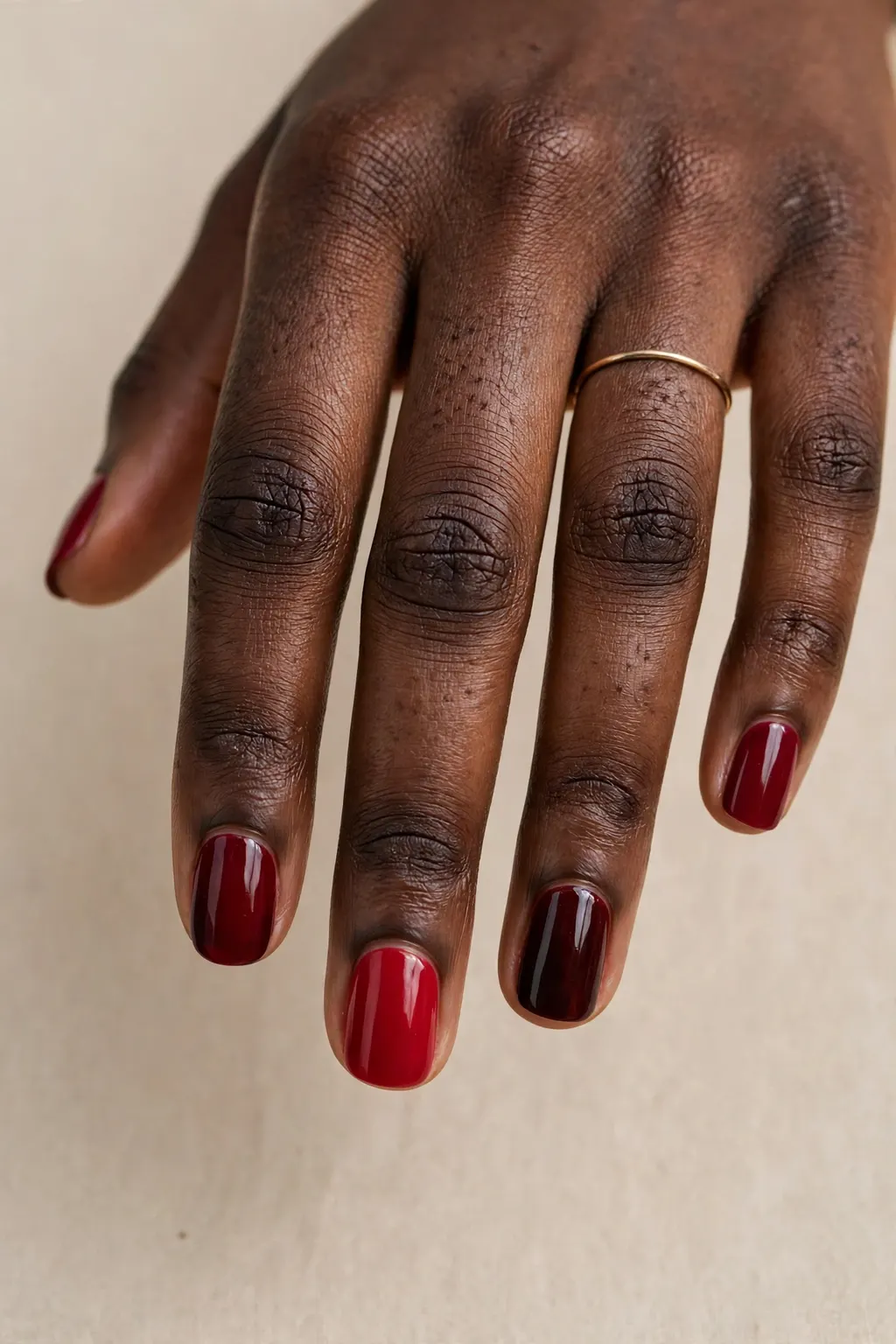
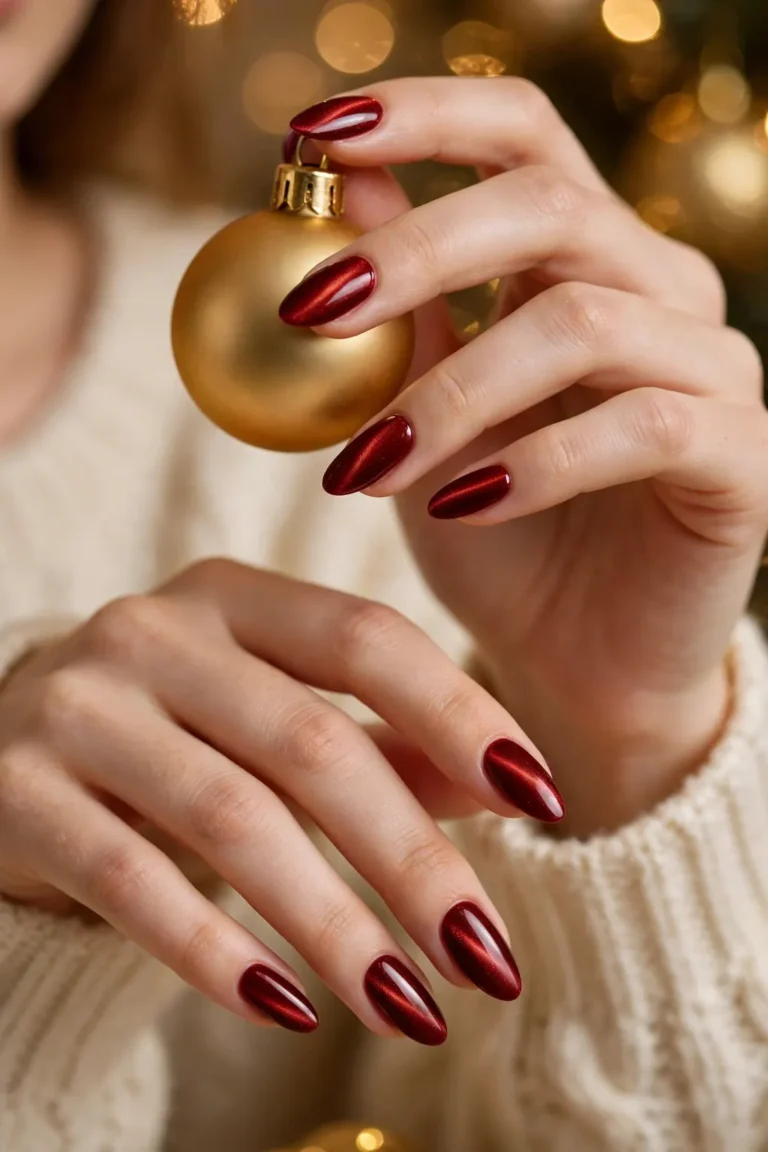
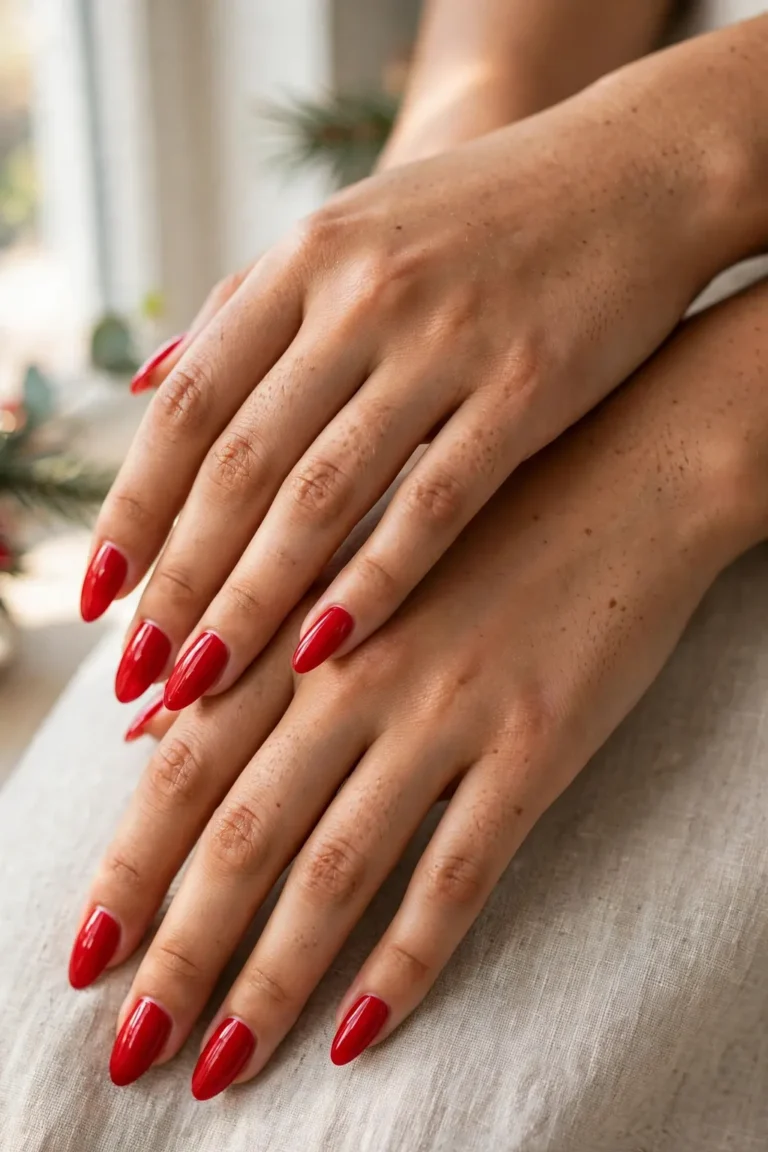
Classic red is the December default for a reason: a true, blue-toned red suits every skin tone, matches every Christmas outfit, and photographs warm under fairy lights in a way no other shade does. Cherry is its brighter sister — a vivid, slightly pink red that reads as joyful rather than formal, and suits the reader who wants the manicure to be the outfit’s energy. Dark red, the black-cherry and wine end of the family, is the evening version: almost black in dim light, clearly red in daylight, and the shade that looks most expensive with gold jewellery. The three are not interchangeable — classic is the safe choice, cherry is the fun choice, dark is the grown-up choice — and the mistake is picking one for the wrong reason, usually cherry for a formal dinner or dark for a daytime family lunch. Pick by the room you will be in most: classic for everywhere, cherry for parties, dark for evenings.
All three reds share one practical advantage: red is the most forgiving December colour for regrowth, because a millimetre of bare nail at the cuticle reads as a shadow under red, while under a pale shade it reads as a gap. They also share one weakness: red stains. A base coat is not optional with any of them, and dark red in particular will tint the nail plate yellow if it is worn without one for three weeks. Ask for the base coat by name, and check the free edge is wrapped, because red chips show first at the tip and a wrapped edge is what keeps a red manicure looking sharp into week three.
Best for: nail shapes, lengths and skin tones
Classic red suits every shape and every skin tone, which is why it is the default: on fair skin it reads as bold, on deep skin it reads as rich, and on every skin in between it reads as correct. Cherry suits warm and neutral skin best, and short to medium nails, because its brightness needs a neat, compact nail to look joyful rather than loud. Dark red suits long nails and almond shapes best, because the depth needs length to show its wine tones, and it suits cool skin particularly well, where its blue undertone matches the hand. If you are choosing between the three and cannot decide, classic red on a squoval nail is the choice that has never been wrong in December.
The exact wording to show your nail tech
For classic red, say: “a true classic red, blue-toned, not orange — full coverage, glossy, no shimmer.” For cherry, say: “a bright cherry red, vivid not dark — the joyful one, not the wine one.” For dark red, say: “a black-cherry dark red, almost black in dim light — wine, not burgundy-brown.” In every case add: “base coat first, two coats of colour, top coat wrapped over the free edge.” The wording matters because salons stock a dozen reds and the difference between them is undertone, not name — “blue-toned” and “not orange” are the two phrases that stop you leaving with the wrong red.
How long it lasts and what it costs
A regular-polish red lasts three to five days; a gel red lasts two to three weeks, which is the December standard. The weak point is the free edge, where red wears first — refresh the top coat at day seven and the colour stays even. Cost is a standard manicure or gel set; red itself adds nothing, because it is a single-colour application with no art and no extra product. Dark red costs the same as classic — the only red that can cost more is a cherry that needs three coats for full opacity on a pale base, and even that is a small difference, not a different price.
The Browns: Espresso, Mocha & Caramel
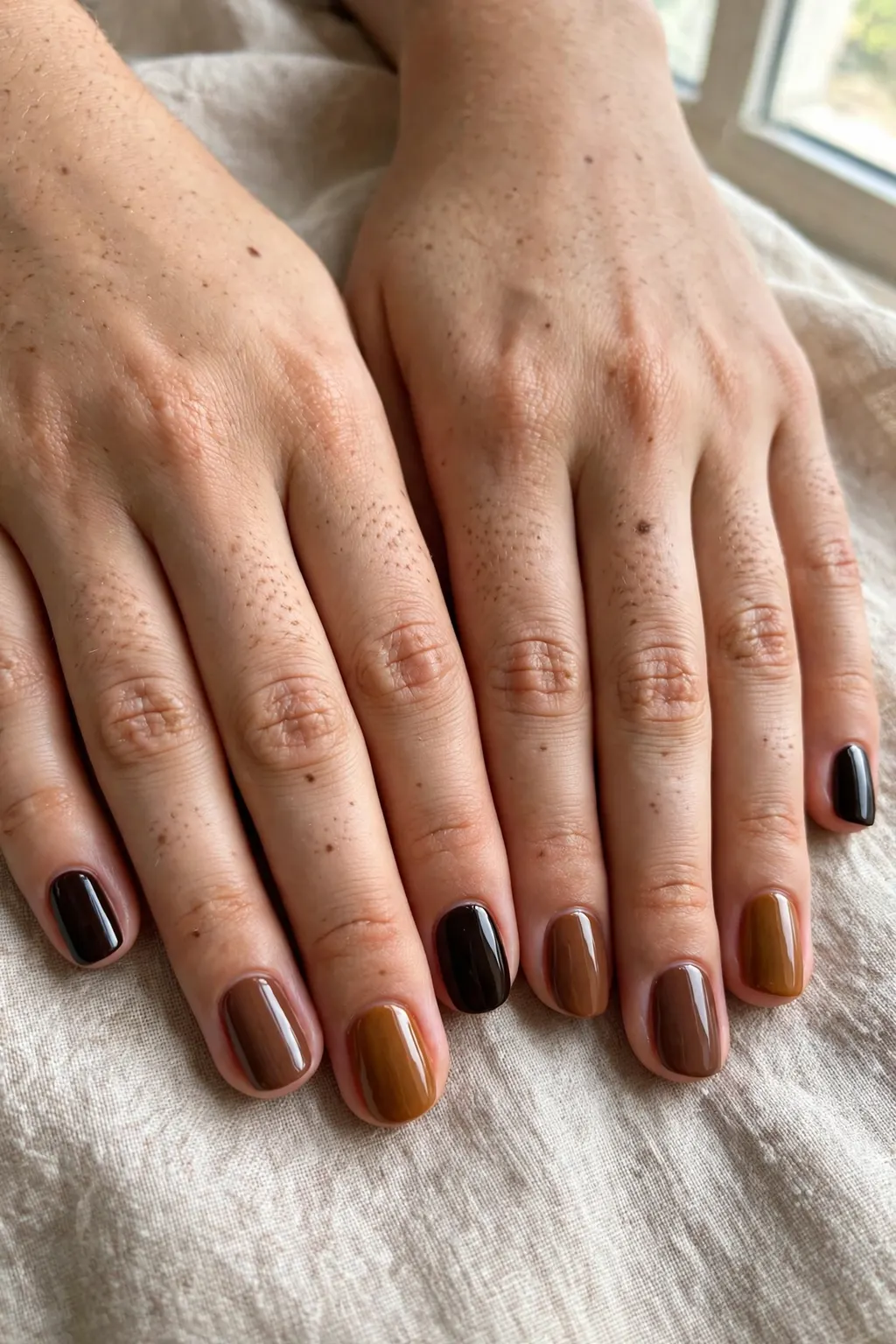
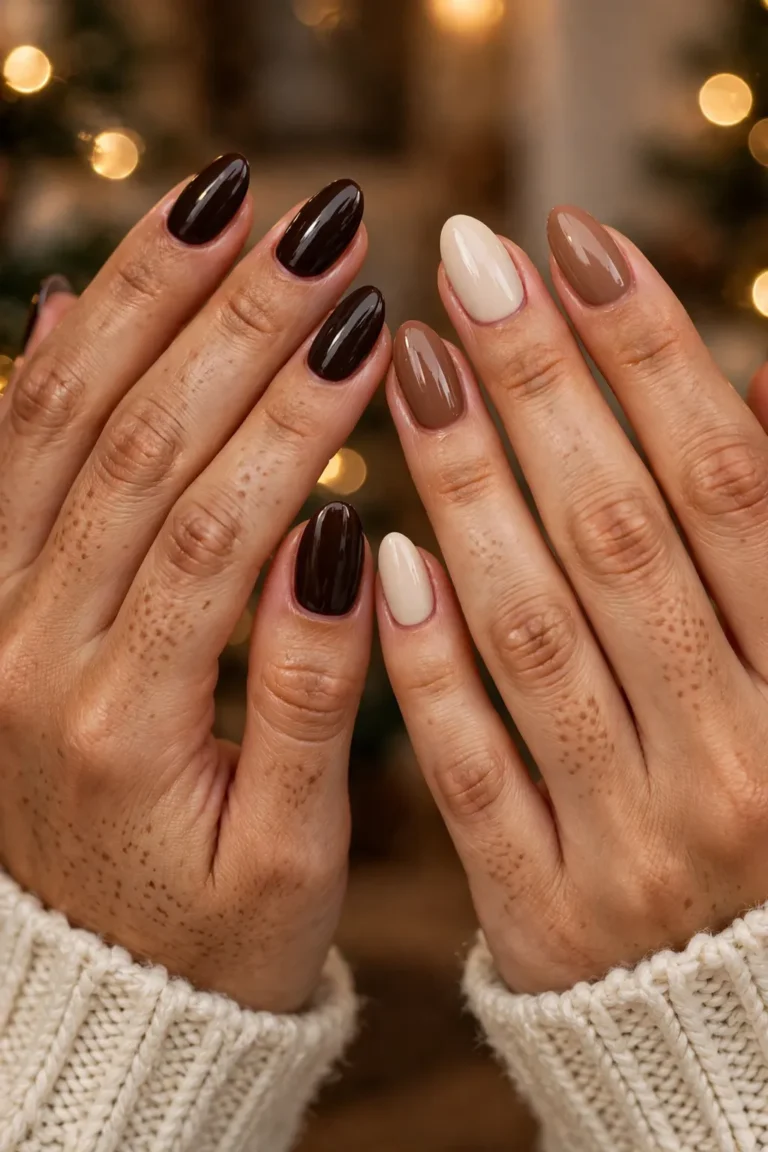
The browns are December’s quiet-luxury family: espresso is the deepest coffee shade, almost black in dim light but warm up close; mocha is the mid-brown sweet spot, the colour of milk chocolate; caramel is the lightest of the three, a warm nude-brown that reads as a neutral on most hands. Together they are the shades for the reader who finds red too loud and black too harsh — brown is the colour that looks considered, expensive and calm, and it is the family that pairs best with knitwear, camel coats and gold jewellery. The Caramel, Coffee & Latte Nails guide covers this family in full, from the mocha-brown neutrals to the latte shades by skin tone, and it is the companion read if the browns are your family. The key decision inside the family is depth: espresso for evening and for deep skin, mocha for everyone and every occasion, caramel for daytime and for fair skin that wants warmth without darkness.
Browns have one honest weakness: a brown that is too close to your skin tone will wash the hand out, and a brown with the wrong undertone will look muddy rather than rich. The fix is to choose by undertone, not by bottle: warm browns — caramel, a warm mocha — suit warm skin; cool browns — an espresso with a plum undertone, a mocha with a grey cast — suit cool skin. Hold the bottle against your hand in daylight before you commit, because salon lighting is warm and flatters every brown, hiding the one that will read as muddy on your skin. And keep the finish glossy: brown in a matte finish reads as flat and tired in December light, while the same brown in a high gloss reads as polished and deliberate.
Step by step
Prep the nails — file to an even length, push back the cuticles, wipe with remover so the base grips — then paint a base coat, because brown without a base coat can tint the nail plate, and dark browns tint more than light ones. Then paint two thin coats of the brown, curing between coats for gel, letting each coat dry fully for regular polish, because brown shows streaks more honestly than any other family — one thick coat will read as patchy, two thin coats read as velvet. Then seal with a glossy top coat, wrapped over the free edge, because gloss is what makes a brown read as a deliberate colour rather than as a bare nail. The whole point of the two-thin-coats routine is that brown is a colour of depth, and depth comes from layers, not from thickness.
Common mistakes to avoid
The most common mistake is choosing a brown that matches your skin tone exactly, which makes the hand look washed out, because there is no contrast between nail and skin — the fix is to go one shade deeper or one shade warmer than your skin, so the nail reads as a colour. The second is a matte brown in December, which reads as flat under fairy light and tired in photographs, where a glossy brown reads as rich. And the third is skipping the base coat, because espresso and dark mocha will tint the nail plate yellow-brown over three weeks, and the tint is the part you notice in January. If any of these happen, the fix is the same: remove, re-base, and redo one shade deeper, glossier, and with a base coat.
Products and tools that help
A base coat that blocks staining, a brown gel or polish in your chosen depth, a glossy non-yellowing top coat, and cuticle oil — because brown draws the eye to the skin around the nail, and neat skin is what makes a brown manicure look expensive rather than plain. A clean-up brush with remover keeps the brown off the skin, which matters more with brown than with a pale colour, because a stray smudge of espresso on the cuticle reads as dirt. A ridge-filling base coat is worth having if your nails have ridges: brown shows every ridge, and a smooth base is what makes it read as velvet.
The Lights: Milky White, Icy Blue & Champagne
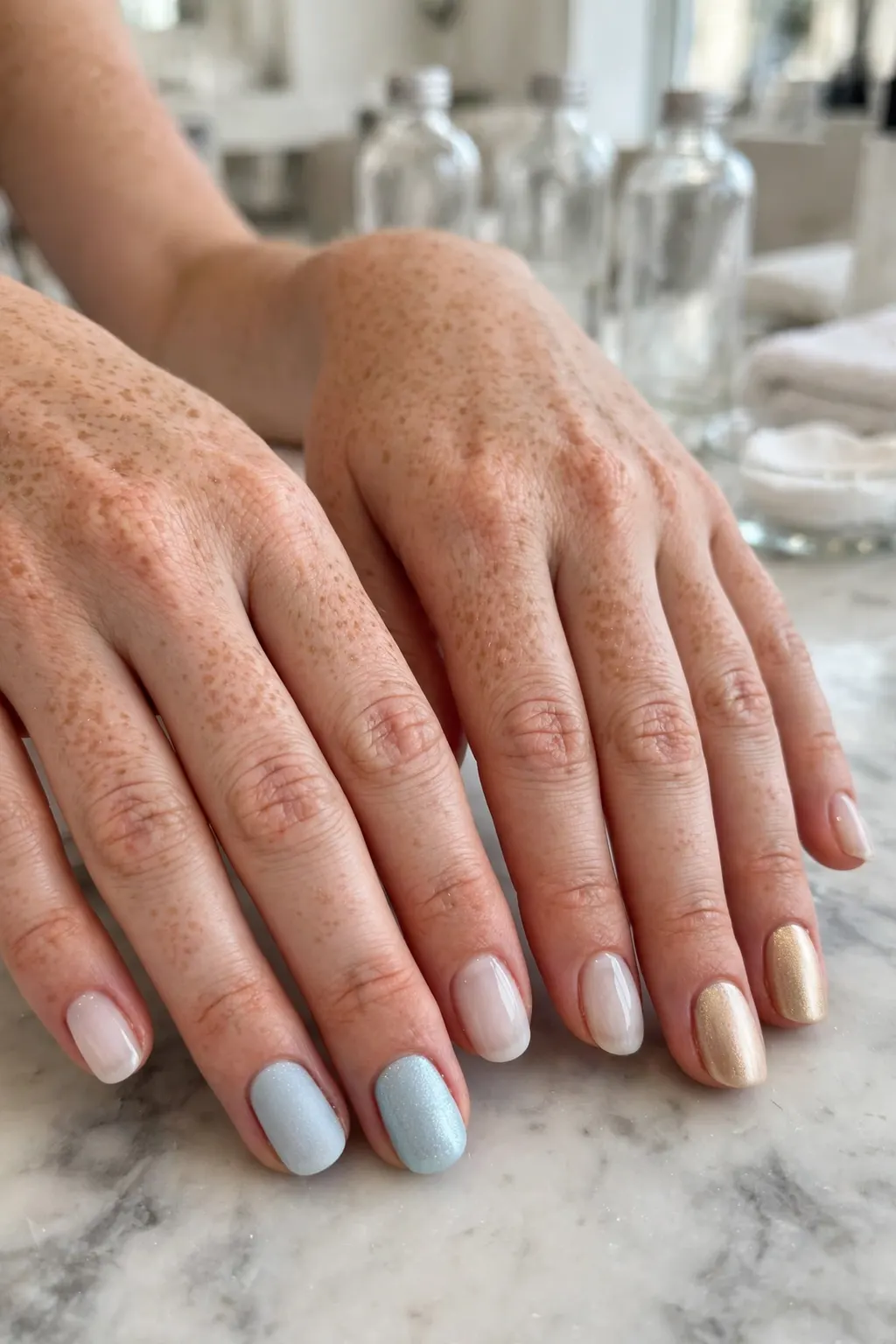
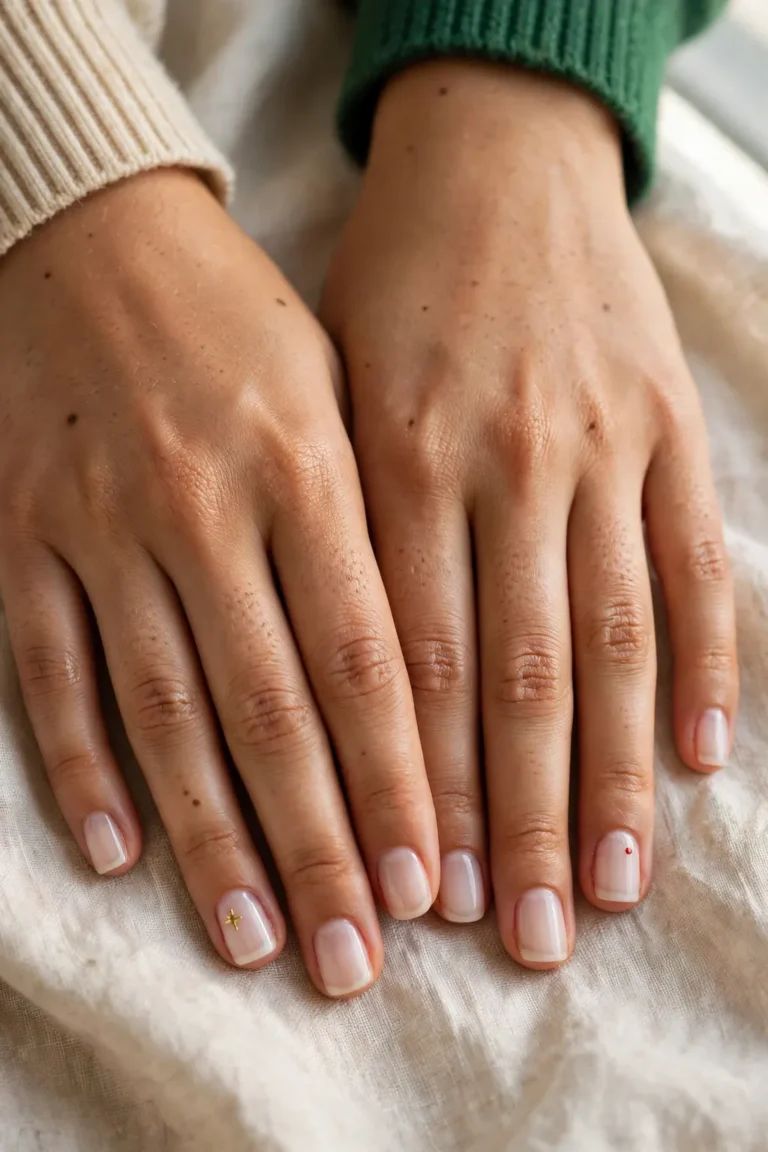
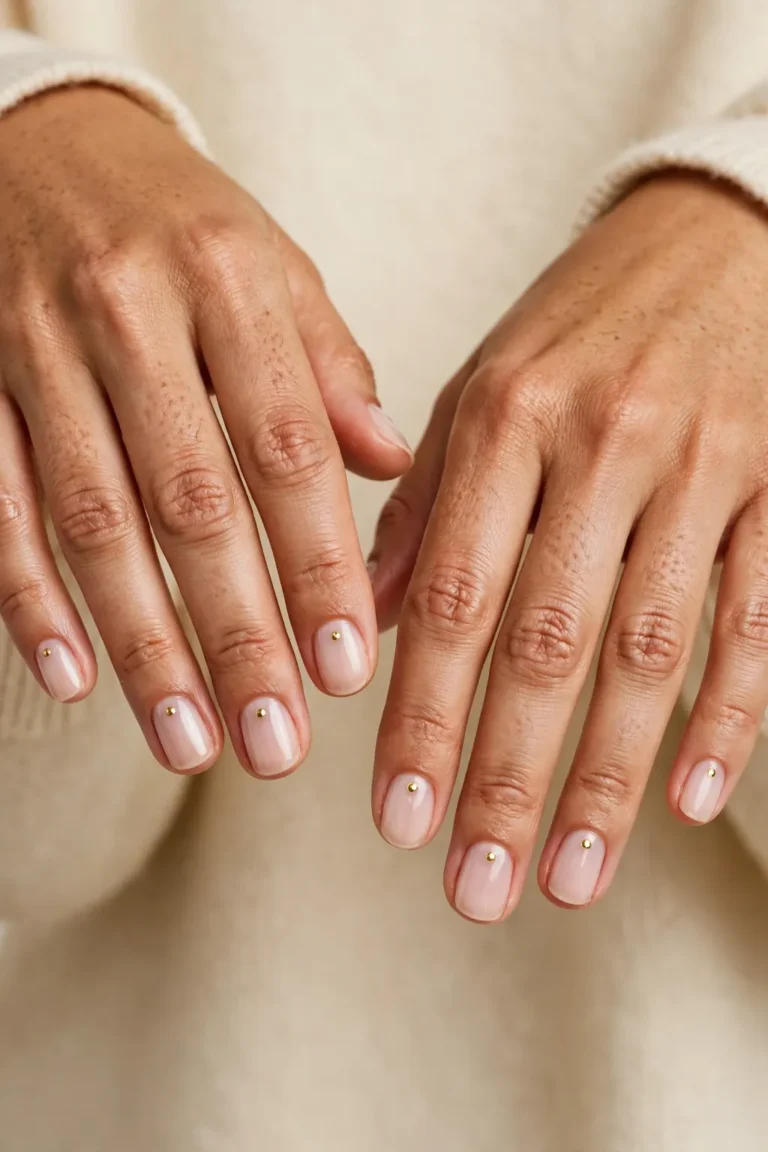
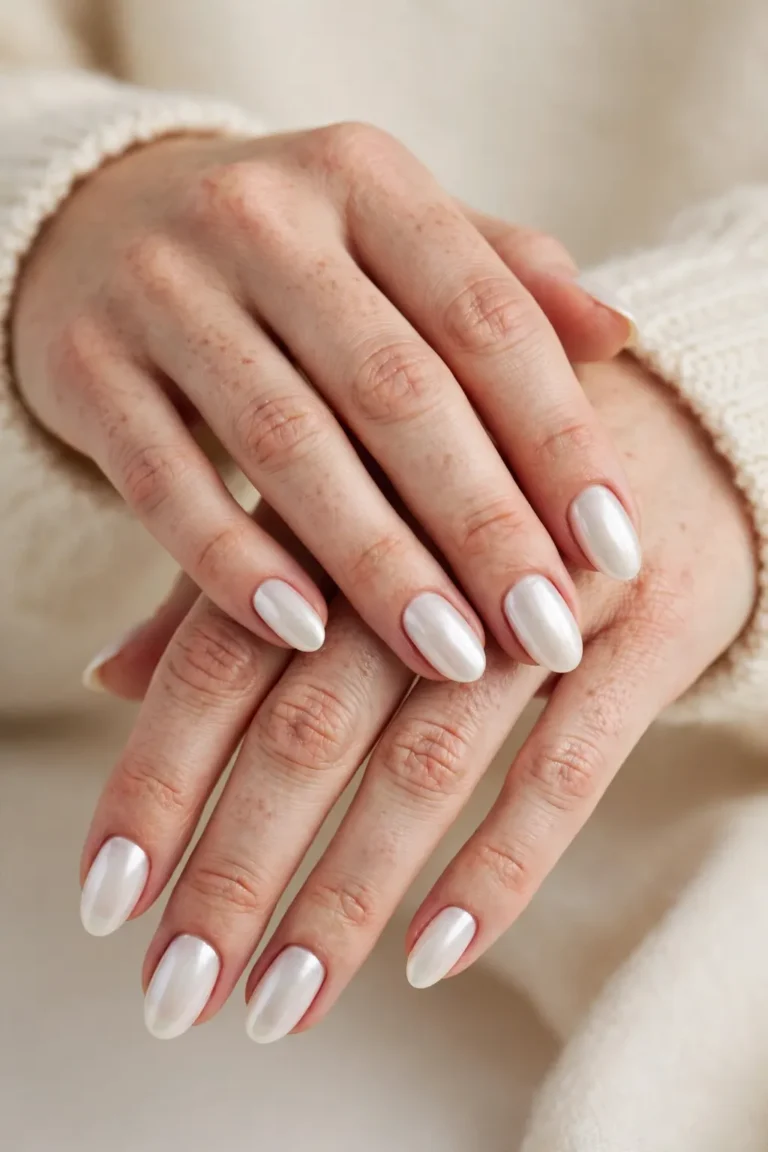
The lights are December’s winter-morning family: milky white is a sheer white that reads as clean and bridal; icy blue is a pale, frosted blue that reads as snow light; champagne is a soft, golden nude that reads as candlelight. Together they are the shades for the reader who wants a December manicure that looks light in a season of dark colours — the lights suit pale knitwear, silver jewellery and daytime events, and they are the family that photographs best in daylight, because their paleness catches the light rather than absorbing it. The honest trade-off is maintenance: the lights show every chip, every stain and every millimetre of regrowth, so they demand more care than the deeps. If you are willing to refresh the top coat and avoid staining foods and dyes for three weeks, the lights reward you with the cleanest manicure in the room.
Milky white is the most versatile of the three: sheer enough to suit every skin tone, pale enough to read as festive, and the shade that makes short nails look longer, because the eye travels the full length of a pale nail. Icy blue is the most seasonal: it reads as December in a way no other shade does, and it suits cool skin particularly well, where its coolness matches the hand. Champagne is the warmest light: a golden nude that suits warm skin and reads as understated luxury, the shade for the reader who wants a neutral that still looks like a choice. Pick by skin tone first — cool skin takes icy blue, warm skin takes champagne, every skin takes milky white — and by occasion second, because the lights are daytime shades that can feel underdressed at a black-tie evening.
Who should skip this version
Skip the lights if your December is hard on your hands — cooking, cleaning, gardening, or work that stains — because a milky white will pick up every dye it meets, from turmeric to hair colour, and the staining shows within days. Skip them too if you want a manicure you can forget about for three weeks: the lights are the highest-maintenance family in the dozen, and a reader who will not refresh the top coat or wear gloves will be happier with a deep. In both cases the honest fix is a light with more pigment — champagne rather than milky white, or a milky white with a chrome finish that hides the wear — and the full pale look saved for a week when the hands can stay clean.
Works best on: shapes and lengths
The lights suit short to medium nails best, because a pale shade on a very long nail can read as stark, while on a short nail it reads as clean and neat. They suit squoval and round shapes best, because the soft edge frames a pale colour the way a frame suits a watercolour, and they suit almond least, because a long, tapered pale nail can read as a claw rather than as a manicure. They suit fair and light-medium skin best, because the contrast is gentle, and deep skin takes them well too when the light has warmth — champagne over milky white, a sheer milky with a pink cast — because a warm light flatters a deep hand while a cold white can wash it out.
Maintenance schedule
A regular-polish light lasts two to four days before the free edge dulls; a gel light lasts two weeks with care, three with discipline. Refresh the top coat on day four and again on day ten, because the top coat is what keeps a milky white looking white rather than grey, and wear gloves for anything that stains — cooking with turmeric, dyeing hair, cleaning with coloured products — because a stained milky white cannot be cleaned, only removed. Keep cuticle oil on daily, because the lights draw the eye to the skin around the nail, and dry cuticles are what make a pale manicure look unfinished.
The Deeps: Emerald, Navy, Plum & Black
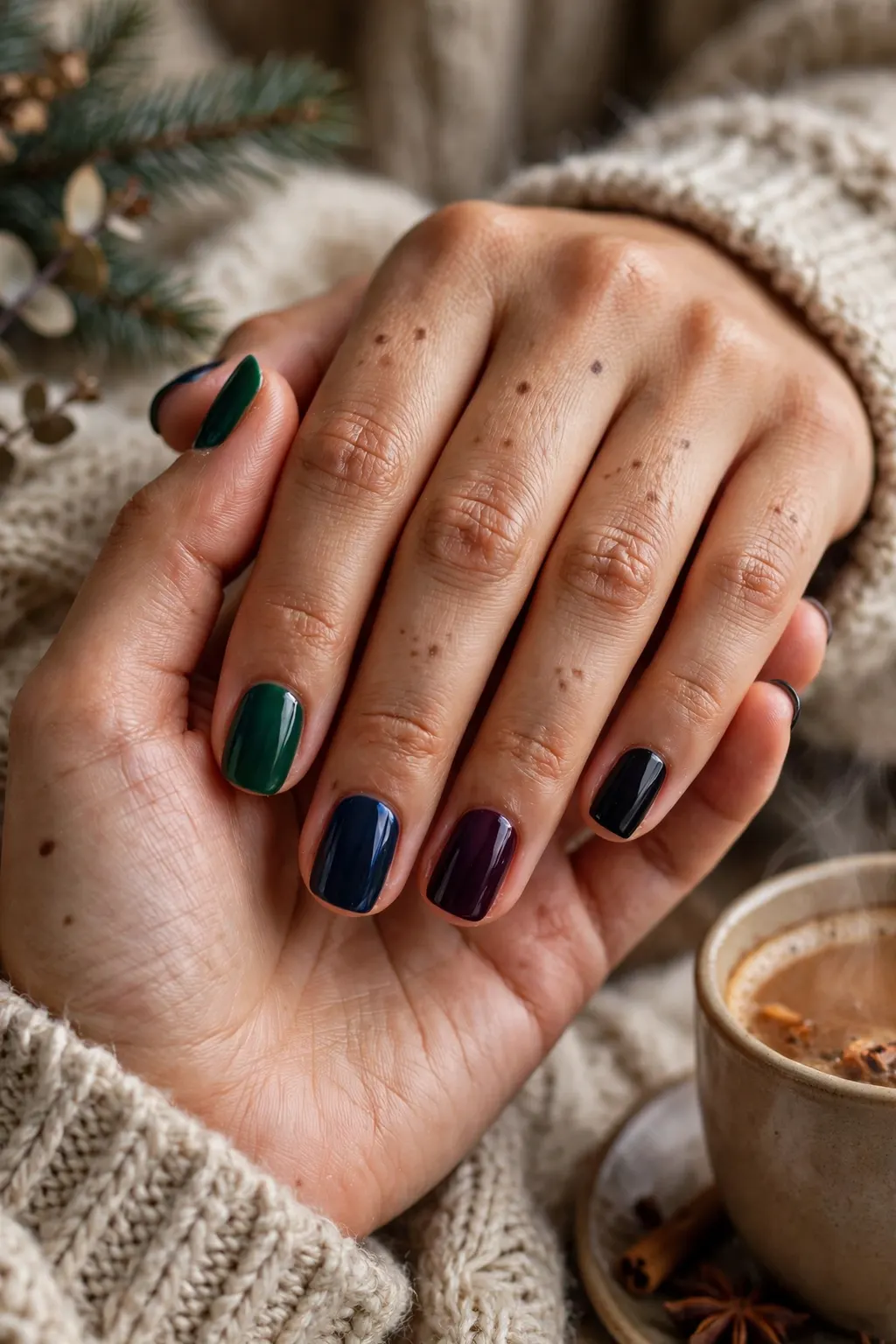
The deeps are December’s evening family: emerald is a jewel green that reads as the colour of a Christmas tree in candlelight; navy is a midnight blue that reads as black until the light catches it; plum is a dark wine-purple that reads as the most flattering dark on warm skin; and black is the thirteenth shade, the darkest possible nail, included here because it is the party-week choice for the reader who wants drama without colour. Together they are the shades for the reader who wants a December manicure that looks expensive after dark — the deeps suit black dresses, velvet, gold jewellery and candlelit rooms, and they are the family that hides wear longest, because a tiny chip in a dark shade reads as a shadow rather than a hole. The trade-off is staining and removal: the deeps tint the nail plate without a base coat, and they need a proper soak-off rather than a peel.
Emerald suits the reader who wants a green that reads as a jewel rather than as a novelty: it is the most festive deep, and the one that photographs best with gold. Navy suits the reader who wants the darkest blue without the harshness of black — it is the most versatile deep, and the one that suits the widest range of skin tones. Plum suits warm skin best, because its wine undertone matches the hand, and it is the most flattering deep on short nails, because its warmth keeps a dark nail from reading as severe. Black suits everyone in theory and fewer in practice: it demands neat cuticles, an even length and a perfect application, because black shows every flaw — but when it is done well, it is the most dramatic nail in the room.
Best for: nail shapes, lengths and skin tones
Emerald suits almond and oval nails best, because the length gives the jewel tone room to show its depth, and it suits medium to deep skin best, where the green reads as rich. Navy suits every shape and every skin tone, which is why it is the safe deep: on fair skin it reads as dramatic, on deep skin it reads as starlit, and on every skin in between it reads as correct. Plum suits short to medium nails and warm skin best, because its wine warmth flatters a warm hand and its depth flatters a compact nail. Black suits long, even nails and neat hands best, because it is the least forgiving shade in the dozen — if your nails are uneven or your cuticles are dry, black will show it, and a deep like navy or plum will be kinder.
The exact wording to show your nail tech
For emerald, say: “a deep jewel emerald, not a bright green — the Christmas-tree green, glossy, no shimmer.” For navy, say: “a midnight navy, almost black in dim light — blue, not black, when the light catches it.” For plum, say: “a dark wine plum, warm not purple — the burgundy end of plum, not the violet end.” For black, say: “a true black, glossy, not matte — two coats, full coverage, no grey at the edges.” In every case add: “base coat first, because dark colours stain, and top coat wrapped over the free edge.” The wording matters because salons stock several greens, blues and purples, and “jewel not bright” and “wine not violet” are the phrases that stop you leaving with the wrong deep.
How long it lasts and what it costs
A regular-polish deep lasts four to six days; a gel deep lasts two to three weeks, and the deeps are the longest-wearing family in the dozen, because chips hide best in dark colours. Cost is a standard manicure or gel set; the deeps add nothing, because they are single-colour applications — the only deep that can cost more is a black that needs three coats for a truly opaque finish, and even that is a small difference. Removal is the part to budget time for: dark gel needs a proper foil-and-soak removal, never peeling, because peeling takes the top layer of the nail with it and the damage shows for weeks.
Metallics for Party Week: Gold & Silver Chrome
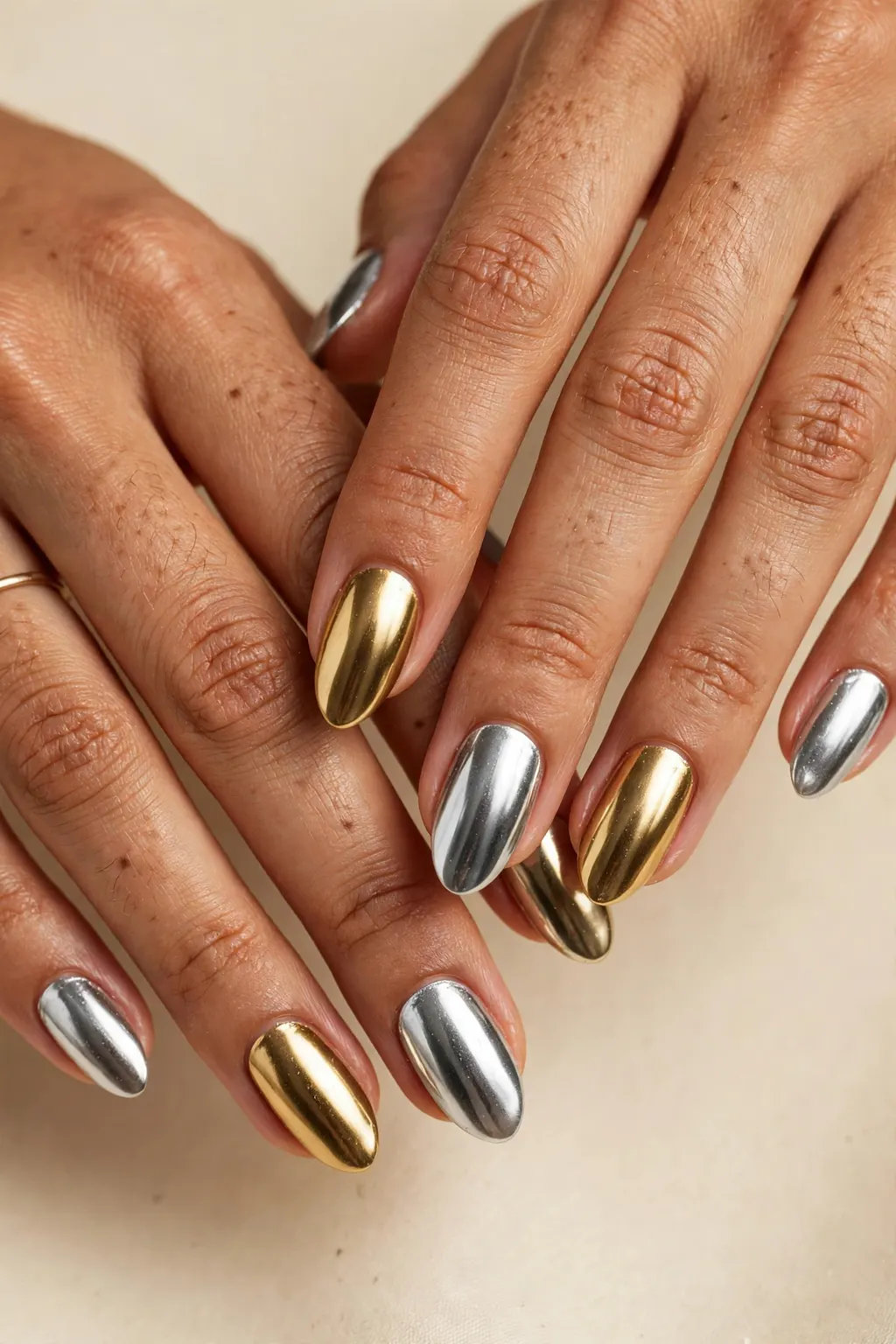
Metallics are not colours in the dozen — they are finishes laid over it, and they are the party-week answer for the reader who wants the most visible nails in the room. Gold chrome over a red or nude base reads as liquid gold, warm and festive; silver chrome over a milky or icy base reads as liquid mercury, cool and futuristic. Both are magnetic-powder or chrome-powder finishes: a dark base, a chrome powder rubbed in, a top coat to seal it. Both are the most photographed nails in December, and both are the highest-maintenance, because chrome shows every fingerprint, every scratch and every millimetre of regrowth. Wear them for party week, not for the whole month — book them for the week of the big event, enjoy them for seven to ten days, and then return to a solid shade.
Gold chrome suits warm skin and warm outfits: it pairs with red dresses, gold jewellery and candlelight, and it is the metallic that reads as Christmas. Silver chrome suits cool skin and cool outfits: it pairs with black dresses, silver jewellery and daylight, and it is the metallic that reads as New Year. The choice between them is the same as the choice between gold and silver jewellery — wear the metal you already wear, because a gold-chrome nail with silver rings will clash, and the clash is visible from across the room. And keep the rest of the hand quiet: chrome is the statement, so the outfit, the rings and the make-up should all be simpler than usual, or the whole look tips into noise.
Step by step
Prep the nails — file, push back the cuticles, wipe with remover — then paint a base coat and the base colour, because chrome needs a dark, smooth ground: black or dark red under gold chrome, milky white or dark navy under silver chrome, cured fully before the powder goes on. Then rub the chrome powder into the cured base with a sponge applicator, in small circles, until the surface turns to a mirror, because chrome is a powder, not a polish, and it only mirrors when it is rubbed in evenly — a patchy rub gives a patchy mirror. Then seal with a top coat, and seal it twice, because chrome without a seal rubs off on everything it touches, and a sealed chrome is the difference between a manicure and a mess. The whole point of the base-plus-powder-plus-seal routine is that each layer does one job, and the mirror only appears when every layer is right.
Common mistakes to avoid
The most common mistake is chrome on a bumpy base: chrome is a mirror, and a mirror shows every ridge, every bubble and every uneven edge, so a base that would pass under a solid colour will fail under chrome — the fix is a ridge-filling base and a perfectly smooth colour coat. The second is a single top coat, which leaves the chrome soft enough to scratch within a day; two top coats, wrapped over the free edge, are what make chrome last a week. And the third is chrome on all ten nails with chrome jewellery and a sequinned dress, which reads as a costume rather than as a manicure — the fix is one statement at a time, and chrome is the statement, so everything else goes quiet.
Products and tools that help
A dark base colour in the matching family, a chrome powder in gold or silver, a sponge applicator for rubbing it in, a glossy non-yellowing top coat — two coats of it — and a clean-up brush, because chrome powder gets everywhere, and a stray smudge on the skin catches the light. A peel-off base coat is worth keeping for at-home chrome experiments, because chrome is the hardest finish to remove cleanly and a peel-off base turns removal from a soak into a lift. And keep the chrome powder sealed between uses, because moisture turns it dull, and dull powder gives a dull mirror.
Shades by Skin Tone & Wardrobe
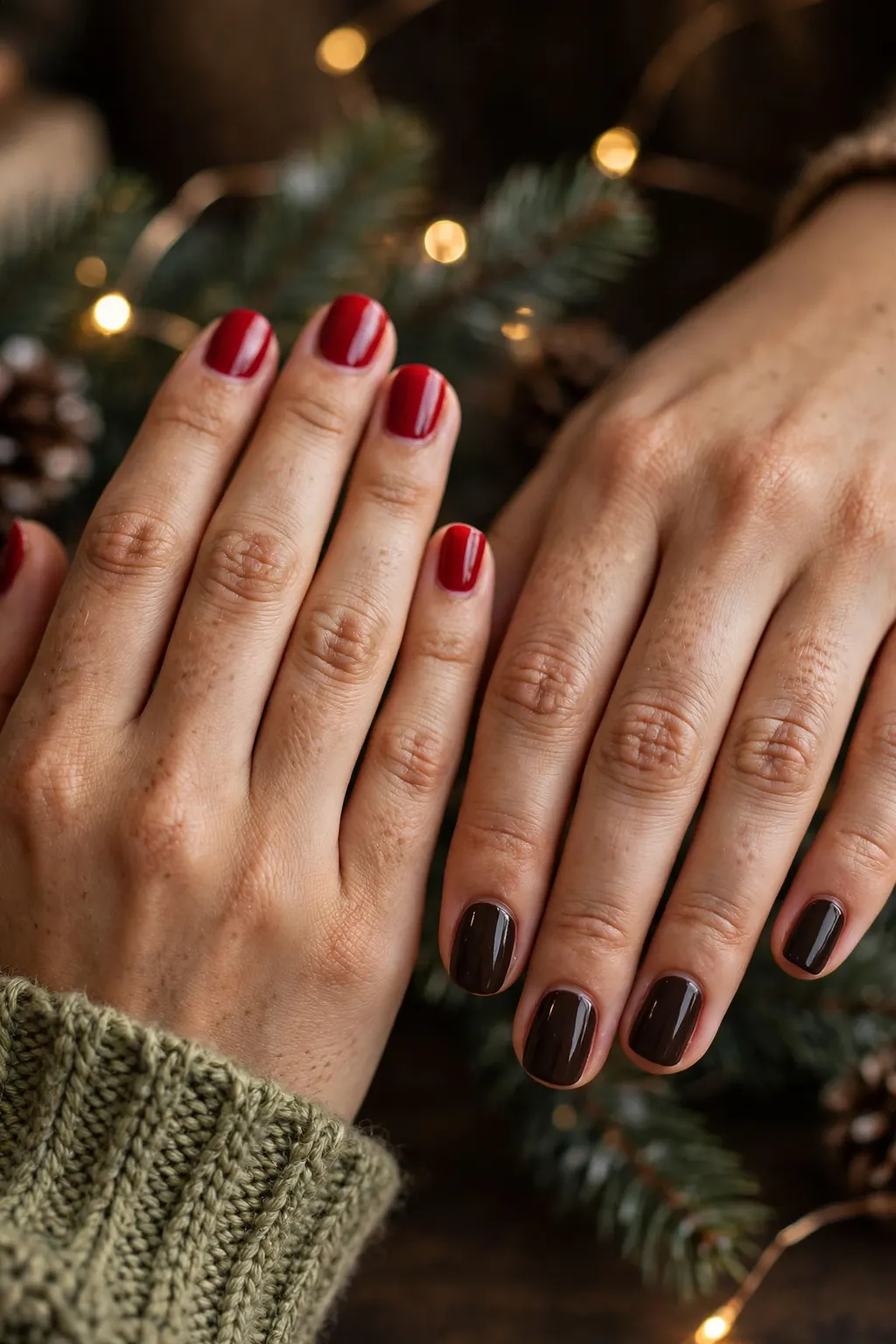
The fastest way to choose from the dozen is by skin tone, because undertone decides more than taste does. Fair skin takes classic red, cherry, milky white, icy blue, navy and plum — the shades with a cool or true undertone, which flatter a pale hand without washing it out. Light-medium skin takes everything in the dozen except the palest lights on their own — caramel, mocha, champagne and the reds are the safest, and the deeps are the most dramatic. Medium skin takes mocha, caramel, classic red, dark red, emerald and plum — the warm and the deep, which sit richly against a medium hand. Deep skin takes every shade in the dozen, and the deeps and metallics best of all: emerald, navy, plum, black, gold chrome and silver chrome all read as lit from within on a deep hand, while the lights need warmth — champagne over milky white, a sheer milky with a pink cast — to avoid washing out. The rule in one line: match the undertone, not the depth — cool skin takes cool shades, warm skin takes warm shades, and depth is a matter of occasion, not of skin.
Wardrobe decides the rest. If your December is mostly black, navy and charcoal, every shade in the dozen works, and the metallics work best of all, because a dark wardrobe is the background a metallic needs. If your December is mostly camel, cream and brown, the browns and the champagne are your family, and the reds are your accent — a camel coat with a caramel nail and a classic-red accent nail is the outfit that looks considered rather than matched. If your December is mostly red and green, the deeps are your family — emerald and navy against a red dress, plum against a green one — because a red nail against a red dress disappears, while a deep against it stands out. And if your December is mostly sequins and metallics, the solids are your family: a plain classic red or a plain espresso against a sequinned dress, because two statements in one outfit is one too many.
Who should skip this version
Skip the skin-tone map if you already know your undertone and your wardrobe — readers who have worn the same family for years do not need a map, they need the shade inside it, and the family sections above are the place for them. Skip it too if your December wardrobe is a single outfit for a single event, because then the right move is to match that outfit alone, and the family sections will do that faster than the map. The map is for the reader choosing a colour to live in for three weeks across many outfits, not for a single night.
Works best on: shapes and lengths
The skin-tone map works best as a starting point, not as a rule: it tells you which family to try first, and the trying is what confirms it. It works best on short to medium nails, because that is where undertone shows most clearly — on a short nail the shade is the whole design, so a mismatch is visible at once, while on a very long nail the shape distracts from the colour. It works on every shape, because undertone is a property of the hand, not of the nail, and the shape only changes how much of the shade you see. If the map’s first suggestion feels wrong on your hand, trust your eye over the map: hold the bottle against your hand in daylight, and if it flatters you, it is right, whatever the map says.
Maintenance schedule
A shade chosen by skin tone needs the same maintenance as any December shade: a top-coat refresh on day seven and day fourteen, cuticle oil daily, and gloves for washing up. The difference a good skin-tone match makes is that the manicure looks good for longer, because a flattering shade draws the eye to the colour rather than to the wear — a chip in a shade that suits you reads as a small flaw in a good manicure, while a chip in a shade that fights your hand reads as proof the colour was wrong. Book the appointment for the first week of December, refresh the top coat yourself at home mid-month, and the same shade carries you to New Year’s Eve.
What to Ask Your Nail Tech for December Nail Colors: Booking Before Slots Go
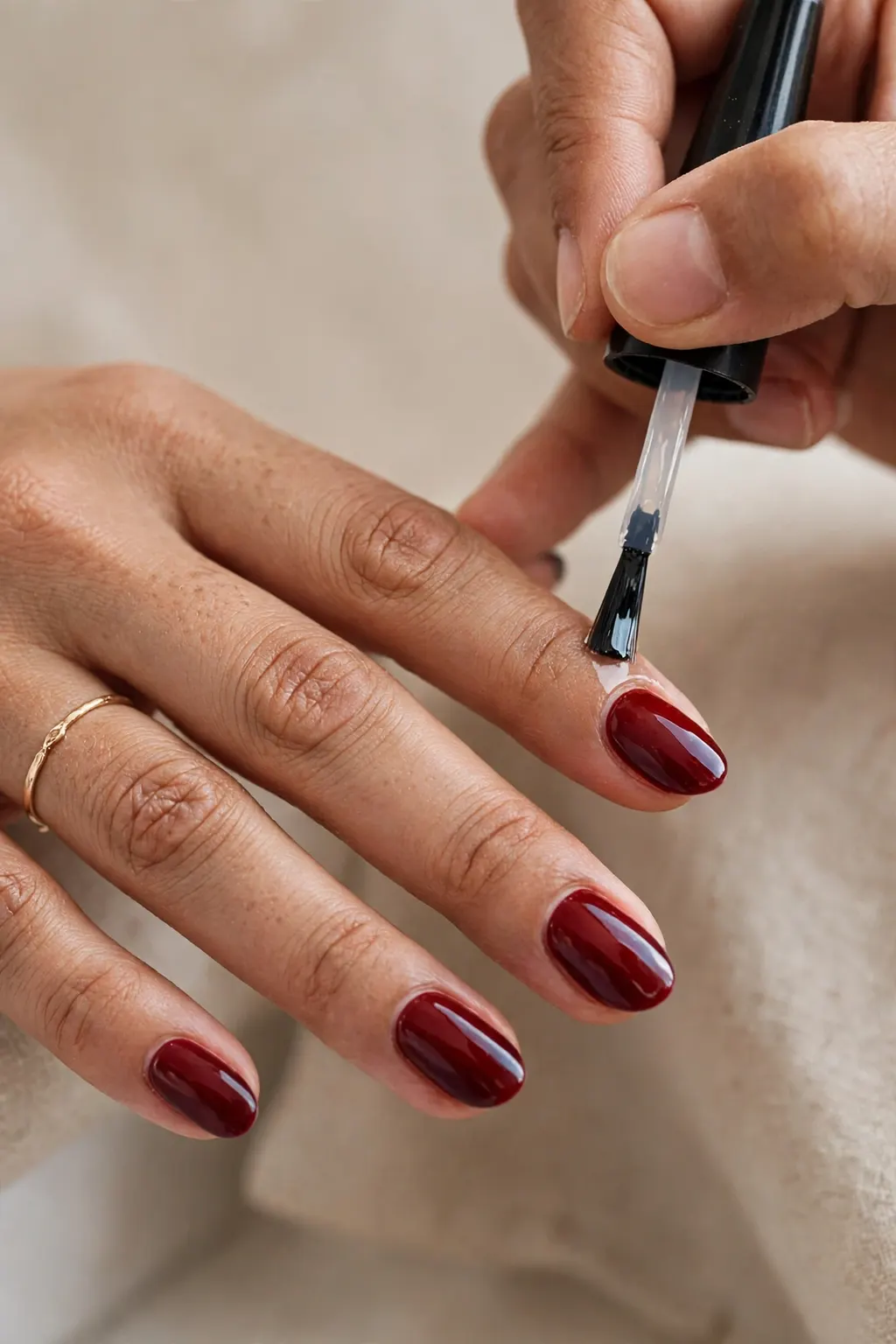
December is the month salons book out, and the booking is part of the manicure: the readers who get the shade they want are the ones who book in November, ask for the right slot, and arrive with a decision already made. Book for the first week of December, not the third, because a shade applied in week one can be maintained to New Year’s Eve, while a shade applied in week three has no time to settle and no slot for a fix if it chips. Ask for a morning appointment if you can, because the tech is freshest and the light is best for judging colour, and ask how long the appointment will take — a single-colour gel set is usually under an hour, a chrome finish adds fifteen minutes, and knowing the time stops you rushing the seal, which is the layer that decides whether the manicure lasts. And bring a reference photo, but bring one, not ten: a single photo of the shade on a hand like yours is a brief, and ten photos of ten different shades is a confusion.
The salon brief below is the whole conversation in one box — copy it, fill in your shade, and show it to your tech. It covers the shade, the finish, the base and the seal, which are the four things that decide whether a December manicure lasts three weeks or three days. If your tech disagrees with any of it, listen: a good tech knows your nails better than a guide does, and the brief is a starting point, not an order. But if your tech skips the base coat, rushes the seal, or suggests peeling a gel off rather than soaking it, that is the moment to speak up, because those three shortcuts are the ones that cost you the manicure and the nail underneath it.
Your December salon brief: “I’d like [shade] in a gel finish — [classic red / cherry / dark red / espresso / mocha / caramel / milky white / icy blue / champagne / emerald / navy / plum / black / gold chrome / silver chrome]. Base coat first, two thin coats of colour, glossy top coat wrapped over the free edge. My nails are [short / medium / long] and [almond / squoval / round / square], my skin is [fair / light-medium / medium / deep] with a [cool / warm / neutral] undertone, and I need it to last three weeks to New Year’s Eve. Please show me the shade on my hand in daylight before we start.”
Best for: nail shapes, lengths and skin tones
The booking advice suits every shape, length and skin tone, because it is about timing, not about the shade — but it matters most for the reader whose shade is a light or a metallic, because those are the finishes that need the most maintenance and the most careful application, and they are the ones that suffer most from a rushed appointment. It suits the reader who books one December appointment rather than several, because the whole point of booking early is to make one appointment do the work of two. And it suits the reader whose salon is popular, because the popular salons are the ones that book out first, and the first week of December is the slot that goes first of all.
The exact wording to show your nail tech
Book with this wording: “I’d like a gel manicure in [shade], single colour, glossy finish, for the first week of December — can I book a morning slot, and how long should I allow?” Then, in the chair, use the brief above. The booking wording matters because it tells the salon three things at once — the service, the timing and the finish — and a salon that knows all three will give you the right slot and the right amount of time. If the salon says the first week is full, ask for the waiting list rather than taking a third-week slot: a first-week cancellation is common, and a third-week appointment leaves no room for a fix.
How long it lasts and what it costs
A December booking made in November costs the same as any other booking — there is no December surcharge at most salons, though some charge more in the final week before Christmas, which is another reason to book early. The appointment itself is a standard manicure or gel set; the only additions are a chrome finish, which adds a small amount for the powder and the extra time, and a soak-off removal, which is usually a small separate charge. The real cost of booking late is not money but choice: the shade you want may be out of stock, the tech you want may be booked, and the slot you want may be gone — and a December manicure in the wrong shade is a manicure you will be looking at for three weeks.
One Shade, Three Weeks: Touch-Up & Gloss Strategy
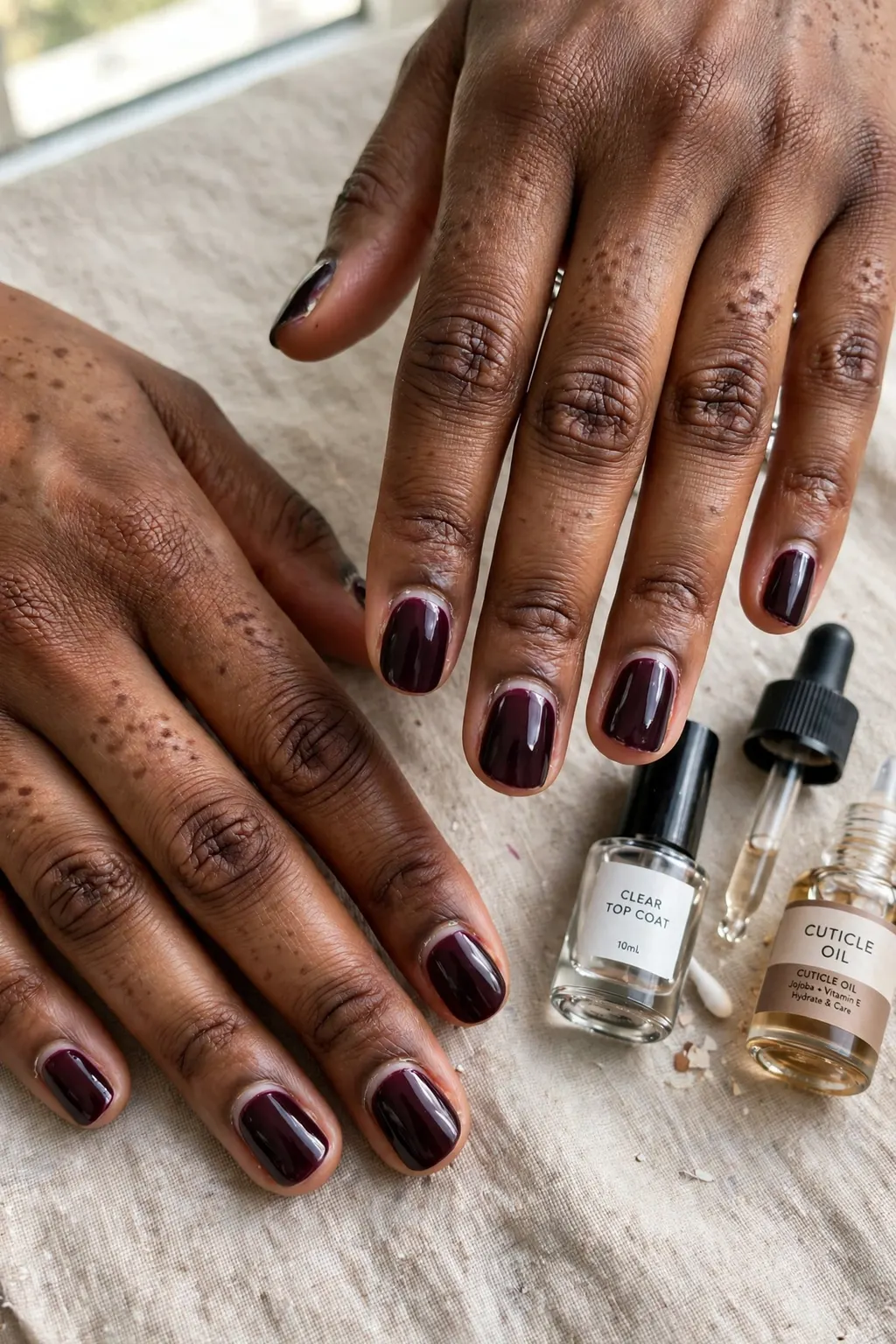
One shade for three weeks is a maintenance plan, not a hope: the manicure that lasts is the one with a schedule, and the schedule is simple. Day one is the salon: base coat, two thin coats, top coat wrapped over the edge. Day seven is the first refresh: a thin layer of glossy top coat over the whole nail, wrapped over the free edge, applied at home in two minutes. Day fourteen is the second refresh: the same again, plus cuticle oil massaged in, because by week two the cuticles are what make the manicure look tired. Day twenty-one is New Year’s Eve, and the shade should still be glossy, still even, and still the colour you chose — if it is not, the failure is almost always the seal, not the shade, and the fix is a top coat, not a new colour. The Coffee Nails guide covers the same three-week care for the brown family, from espresso to iced latte, and its touch-up advice applies to every shade in this dozen.
The other half of the plan is what not to do. Do not peel a gel manicure off, ever, because peeling takes the top layer of the nail plate with it, and the damage shows for weeks as a thin, flaky nail that will not hold a colour. Do not soak in hot water for long periods in the first day after the manicure, because heat and water lift a gel faster than a plain colour, and the lift starts at the free edge. Do not use your nails as tools — opening cans, scraping labels, prising lids — because a gel manicure is a coating, not armour, and the chip that follows is always at the worst possible moment. And do not skip the cuticle oil: it is the cheapest product in this whole guide and the one that makes the biggest difference, because oiled cuticles make a three-week-old manicure look a week old.
Step by step
Day one, in the salon: base coat, two thin coats of colour, two thin top coats, both wrapped over the free edge, and a fingertip check — run a finger over the finished nail, and if it feels rough or gritty, it needs another coat. Day seven, at home: wipe the nails with remover to take off any surface oil, paint one thin layer of glossy top coat, wrap it over the edge, and let it dry fully before touching anything. Day fourteen, at home: the same top-coat refresh, plus cuticle oil, massaged into each cuticle for a few seconds, because oiled cuticles are what make a manicure look fresh. Day twenty-one: no work needed — the shade should still be glossy and even, and if it is not, a final top coat on the morning of New Year’s Eve will carry it through the night.
Common mistakes to avoid
The most common mistake is skipping the day-seven refresh, because the manicure still looks good on day seven and the refresh feels unnecessary — but the refresh is what keeps it looking good on day fourteen, and by day fourteen without it the free edge has dulled and the colour has lost its gloss. The second is using a matte top coat for the refresh, which kills the gloss that makes a December shade read as festive — always refresh with a glossy top coat, never a matte one. And the third is peeling the manicure off at the end of the three weeks, which damages the nail plate and means the next manicure will not last either — soak it off, with foil and remover, and give the nails a day of oil before the next colour.
Products and tools that help
A glossy non-yellowing top coat for the refreshes, cuticle oil for daily use, a foil-and-soak removal kit for the end of the three weeks, and gloves for washing up, because water and detergent are the two things that age a manicure fastest. A ridge-filling base coat is worth having if your nails have ridges, because a smooth base is what makes a colour read as even for three weeks. And a small bottle of the same top coat in your bag is the most useful product in this whole guide: a chipped free edge touched up with top coat in the moment is a chip nobody notices, while the same chip left alone is the thing everyone sees.
Frequently Asked Questions
What is the most popular nail colour for December?
Classic red is the most popular December nail colour, and it has been for years: it suits every skin tone, matches every Christmas outfit, and is the shade most people picture when they picture a December manicure. After classic red, the next most popular are dark red and the browns — espresso and mocha — which are the shades for readers who want a December colour without the brightness of red. The lights and the deeps are the growing families, and the metallics are the party-week choice rather than the month’s most popular. If you want the shade that will look right everywhere in December, classic red is the answer.
Should I book my December nails in advance?
Yes — book in November for the first week of December, because salons book out for December and the first-week slots go first. A shade applied in week one can be maintained to New Year’s Eve with two at-home top-coat refreshes, while a shade applied in week three has no time to settle and no slot for a fix if it chips. When you book, ask for a morning slot if you can, bring one reference photo of the shade on a hand like yours, and confirm how long the appointment will take — a single-colour gel set is usually under an hour, a chrome finish adds fifteen minutes.
What nail colour goes with every Christmas outfit?
Classic red goes with every Christmas outfit, because it is the colour of the season itself: it suits black dresses, green dresses, gold jewellery, silver jewellery, knitwear and sequins, and it is the one shade that never clashes with a Christmas outfit, because it is part of the outfit’s palette. If red feels too bright for you, the next most versatile is espresso — a deep brown that reads as a neutral against every colour — and after that, milky white, which reads as clean against everything. The rule is to pick a shade from the season’s own palette — red, green, gold, black, white — and it will match, because the outfit is already drawn from the same colours.
Conclusion & Bottom Line
The twelve December nail colours are classic red, cherry, dark red, espresso, mocha, caramel, milky white, icy blue, champagne, emerald, navy and plum — four families of three, plus black and the two metallic chromes for party week. Pick a family by skin tone, pick a shade by occasion, book it in the first week of December, and keep it glossy with a top-coat refresh on day seven and day fourteen. One shade, chosen well and maintained simply, is the whole of December in a manicure.
Bottom line: pick your family by skin tone, book the first week of December, and let one good shade carry you to New Year’s Eve.