
Ghost Layers for Fine, Low-Density Hair: Invisible Movement Without Thinning Your Ends Further
Fine hair has a layering problem, and every reader with low-density hair knows it by feel: layers are supposed to add movement, but on fine hair they usually subtract the one thing the hair cannot spare — the ends. A normal layered cut takes weight out of the perimeter, and on thick hair nobody notices, because there is weight to spare; on fine hair the perimeter is the whole style, and once it goes see-through there is no movement left to enjoy, only a ponytail that reads as a wisp and ends that look thinner in every photograph. Ghost layers are the answer to that exact problem, and the name is the method: layers cut so far inside the hair, and so invisibly, that the surface never shows a layer line at all. The movement is there — the hair swings, separates and holds a bend — but the ends stay full, because nothing was ever taken from them. This guide is the guardrail version: what ghost layers are, where normal layers go wrong on fine hair, the cut that keeps the perimeter, ghost layers on bob, shoulder and long lengths, the styling that keeps the air at the root and nothing on the ends, the photo test that proves the cut worked, and the exact salon script — “internal layers only, keep my perimeter” — that stops a well-meaning stylist from turning a ghost cut into a normal one. Bustle Spring 2026 names ghost layers as the layering idea of the moment (plan fresh check, 7 Nov 2026), and the fine-hair guardrail version is unclaimed — this is it.
Quick answer: Ghost layers are internal, hidden layers cut inside the hair to add movement without touching the perimeter. Ask for “internal layers only, keep my perimeter” — the surface stays one length, the ends stay full, and the movement comes from underneath.

What Ghost Layers Are: Internal, Hidden, Weight-Shifting

A ghost layer is not a layer you can see. It is a shorter piece of hair hidden underneath the surface, cut at an angle inside the interior of the hair, so that when the top layer falls over it, the outline of the haircut looks like one clean length — and yet the hair moves. The mechanism is weight-shifting, not weight-removal: a normal layer removes hair from the outside of the shape, which is why the ends get thinner; a ghost layer removes a small amount of bulk from the inside, which lets the surface layer fall with a little more swing and a little less stiffness, while the perimeter — the bottom edge, the part the eye reads as fullness — is never touched. Think of it as the difference between taking a slice off the outside of a loaf and hollowing a little from the middle: the loaf looks the same from the outside in the second case, but it bends more easily in the hand.
The reason the technique matters most for fine, low-density hair is that fine hair has no bulk to hide a mistake in. On thick hair, a layer that is cut a fraction too short disappears into the mass; on fine hair, the same fraction shows as a shelf, a step, or a see-through end, and it shows in the first photograph. Ghost layers are forgiving in exactly the way fine hair needs: because the shorter pieces sit underneath, a small variation in length is invisible, and because the perimeter is untouched, the worst outcome of a cautious ghost cut is simply that the movement is subtle — never that the ends are ruined. That is the whole promise of the technique, and the test of whether a cut is really a ghost cut: after the cut, the ends should look exactly as full as before, and the hair should move more than before. If the ends look thinner, it was not a ghost cut, whatever the stylist called it.
📌 Save this before your appointment — a ghost layer is a shorter piece hidden underneath, never a step on the surface. If you can see the layer line, it is not a ghost layer.
Best for: hair types and face shapes
Ghost layers are best for fine hair of low to medium density, straight to wavy, at any length from a bob to long — the technique is about density, not length, and it works wherever the problem is “my hair will not move, but I cannot afford to lose any ends.” It suits straight hair best, because straight fine hair shows stiffness most, and wavy hair well, because the interior layers let the wave pattern separate instead of clumping into one heavy curtain. It suits every face shape, because the technique changes the interior, not the outline — the face-framing is decided separately, by the perimeter shape and the front pieces, and ghost layers do not interfere with either. It suits the reader whose hair is growing out, because the interior movement makes a grown-out cut look intentional rather than neglected, and the reader who has been burned by layers before, because the guardrail — perimeter untouched — is built into the request itself.
The exact salon wording
At the salon, the sentence is: “Ghost layers — internal layers only, please, hidden underneath. Keep my perimeter exactly as it is: no thinning at the ends, no layers on the surface, no texturising at the bottom.” Then add the two details that make the cut work: “Cut the interior pieces about an inch shorter than the surface, and keep them at least two inches up from the ends, so nothing shows through.” If the stylist reaches for thinning shears at the ends, that is the moment to stop them — thinning shears on the perimeter are the opposite of this cut, and a ghost cut never needs them. The wording matters because “layers” on its own is the most misunderstood request in the salon: said without the guardrail, it buys a normal layered cut, and the whole point of this article is that the guardrail is the cut.
Maintenance schedule
Ghost layers need almost no maintenance, which is part of their appeal: the interior pieces grow out invisibly, because they are hidden under the surface, and there is no shelf to grow through and no step to blend away. The trim schedule is the normal one for the length — about every eight to ten weeks for a bob, every ten to twelve for longer hair — and the trim is a perimeter dusting only, a quarter inch off the ends, with the interior left alone until the movement fades, which takes two or three trims. The maintenance that does matter is styling, not cutting: the movement ghost layers create is activated by root lift and by keeping product off the ends, and the styling section of this guide covers both. A ghost cut that is styled flat, with heavy product on the ends, looks like no cut at all — the movement is there, but it needs air at the root to show.
The Fine-Hair Risk: Where Normal Layers Go Wrong

Normal layers go wrong on fine hair in a specific, predictable way, and it is worth naming the mechanism, because once you see it you can spot it in the chair before it happens. A normal layer is cut by lifting a section of hair away from the head and cutting it shorter than the section below it, and the shorter piece falls on top of the longer piece — the layer line is on the surface, by design. On thick hair, that surface step is hidden by the mass underneath it; on fine hair, there is no mass underneath it, so the step shows, and worse, the ends below the step are now carrying the whole visual weight of the hair with less hair in them than before. The result is the two things fine-haired readers complain about most: ends that look see-through in photographs, and a ponytail that looks thinner than it did before the cut, because the layers took hair out of the tail.
The second failure is subtler and slower: normal layers on fine hair collapse. The layers were cut to create volume, but volume on fine hair comes from the root, not from the ends, and a layered end that has no weight in it cannot hold a bend — it falls flat within an hour, and the hair looks both thinner and flatter than it did as one length. That is why so many fine-haired readers say layers “did nothing” or “made it worse”: the layers removed the ends, which were the only part of the hair that had any presence, and gave back movement that the hair could not hold. Ghost layers invert the trade: they leave the ends alone, so the hair keeps its presence, and they put the movement where it can be held — inside, near the root and the mid-lengths, where the surface layer presses the interior pieces into a bend that lasts.
📌 Save this before you say yes to layers — on fine hair, a surface layer takes from the ends and gives back movement the hair cannot hold. The risk is not the layers; it is where they are cut.
What it looks like in real life
In real life, a bad normal-layer cut on fine hair looks like this: in the mirror at the salon, under bright lights, it looks fine — the layers are freshly blow-dried, the ends are curled under, and the movement is visible. At home, on day two, the hair is flat, the ends are wispy, and the ponytail is a third thinner than it was. In photographs, the ends go translucent against a light background, and the hair reads as thin even when it is not. The 30 Hairstyles Ideas for Fine Hair guide shows the styles that work with a full perimeter, and the contrast is the lesson: the styles that flatter fine hair are the ones that protect the ends, and a layering technique that thins the ends is working against every one of them. If your last layered cut left you with a thinner ponytail, that is the diagnosis — the layers were cut on the surface, and the ends paid for them.
Variations worth trying
If you already have a normal layered cut and you like the movement but not the thin ends, the variation worth trying is not another cut — it is a grow-out with a ghost correction: at the next appointment, ask for the perimeter to be left alone entirely and for any new interior work to be ghost layers only, and let the surface layers grow out under the surface length over two trims. If your hair is very fine and very straight, the variation worth trying is fewer, longer interior pieces — two or three long ghost layers rather than many short ones — because many short interior pieces can make straight fine hair look choppy from underneath, while long ones give a single clean swing. And if your hair is fine but wavy, the variation is ghost layers cut on dry, natural-wave hair, so the stylist can see where the wave separates and place the interior pieces in the wave’s own gaps, instead of cutting blind on wet hair and hoping the wave agrees.
When to skip it
Skip ghost layers when your hair is already very short — a pixie or a chin-length bob with almost no interior to hide in — because there is nowhere for the shorter pieces to hide, and a ghost layer with no cover is just a visible layer. Skip them if your hair is extremely thick as well as fine in texture (fine strands, high density): thick hair does not need the guardrail, and normal layers will give you more movement for less fuss. And skip them if what you actually want is a visible change — a new shape, a new silhouette, a cut people notice — because ghost layers are deliberately invisible, and a reader who wants a visible change will be disappointed by a cut designed to look like no cut at all. The bob section below is the honest alternative for the reader who wants movement and a visible shape at the same time.
The Guardrail Cut: Perimeter Stays, Interior Moves

The guardrail cut is the technique in its simplest form, and it has exactly two rules: the perimeter stays, and the interior moves. The perimeter is the bottom edge of the haircut — the line the eye reads as the hair’s fullness — and in a guardrail cut it is cut blunt, in one length, with no thinning, no texturising and no feathering at the bottom two inches. The interior is everything above that bottom two inches, and there the stylist cuts short, hidden layers: sections lifted from underneath, cut an inch or two shorter than the surface, and dropped back under the top layer so they disappear. The result is a haircut with two behaviours at once: from the outside it reads as one length, full to the ends; from the inside it has the movement of a layered cut, because the shorter interior pieces push the surface layer into a bend every time the head moves.
The reason the two-inch rule matters is that it is the distance that keeps the interior pieces hidden. Cut an interior piece closer than two inches to the ends, and its tip can poke through the surface layer, especially when the hair is pulled back or blown out — and a tip poking through reads as a split end, not as movement. Cut it further up, and the piece is safely buried, and the only thing it does is lift. The stylist’s check is simple and you can ask for it in the chair: after the cut, they should be able to run a comb through the surface layer from root to end without catching a single shorter piece — if the comb catches, a piece is too close to the surface, and it needs to go further inside. That comb test is the whole quality control of the cut, and it takes ten seconds.
📌 Save this before the scissors — perimeter blunt, interior hidden, two inches clear at the ends. If the comb catches a short piece on the surface, the ghost has escaped.
Who it suits best
The guardrail cut suits the reader who has been afraid of layers for years, because it is the first layered cut that cannot thin the ends — the guardrail is not a promise, it is a physical fact of where the scissors do not go. It suits straight fine hair best, because straight hair shows the perimeter most clearly, and it suits the reader who wears her hair down most days, because the movement shows in the swing of down hair and the fullness shows in the ends. It suits every face shape, for the same reason ghost layers always do: the outline is untouched, so the face-framing is whatever the perimeter shape already is. And it suits the reader on a budget, because a guardrail cut grows out gracefully — the interior pieces grow invisibly, the perimeter needs only a dusting, and the cut looks good for a full twelve weeks, not six.
How to ask for it (or do it at home)
At the salon, the sentence is: “A guardrail cut — blunt perimeter, no thinning at the ends, and ghost layers inside only, at least two inches up from the bottom. Comb-test it before I leave: the comb should run through the surface without catching.” Then add the one detail that prevents the most common error: “No layers on the front pieces either, unless we agree them separately” — because front pieces are surface by definition, and a ghost cut with layered front pieces is a layered cut wearing a disguise. Do not try this cut at home: the interior work is done by feel, with the hair lifted and the shorter pieces cut blind under the surface, and a home attempt almost always cuts the surface by mistake. The home version of this article is the styling section, not the cutting section — the cut belongs to the salon, and the script above is how you buy exactly it.
Styling and upkeep
A guardrail cut is styled the same way it is cut: air at the root, nothing on the ends. Rough-dry the hair upside down for root lift, then smooth the surface with a round brush only at the mid-lengths, never pulling the ends, because the ends are the fullness and they need no help. The upkeep is a perimeter dusting every ten to twelve weeks and nothing else — no interior re-cut until the movement fades, which takes at least two dustings. The mistake to avoid is over-styling: a guardrail cut that is curled, waved and sprayed into submission hides the very movement it was cut for, and the reader who irons it straight every morning has bought a cut she is styling away. Let it swing.
Ghost Layers on a Bob-Length Base

The bob is where ghost layers do their most visible work, because a bob has the least hair to hide in and the most shape to lose. A one-length bob on fine hair is a beautiful cut and a stiff one: it swings as a single slab, it flips as a single slab, and after an hour it sits as a single slab, because there is nothing inside it to make it move in parts. Ghost layers change the behaviour without changing the shape: two or three long interior pieces, cut just under the surface and kept well clear of the ends, let the bob’s surface break into a soft bend when the head turns, while the bottom edge stays the blunt line that makes a bob a bob. The reader who has always thought her bob was “too heavy” or “too flat” is usually describing this exact problem — not too much hair, but hair with no interior movement — and the ghost version is the fix that does not cost her the line.
The technique on a bob is more careful than on long hair, because the interior is shorter and the margin for error is smaller. The stylist lifts the top layer, cuts the interior pieces only in the crown and the mid-lengths, and never within two inches of the ends or the front — the front pieces of a bob are the frame, and layering them is how a bob turns into a shag by accident. The check in the chair is the same comb test, plus a second one specific to bobs: shake the head gently and watch the bottom edge. If the edge stays one clean line while the surface moves, the cut is right; if the edge breaks into separate points, an interior piece is too close to the bottom, and it needs to be taken further up. A bob that passes both tests will hold its shape for the full ten weeks between trims, and it will move on day one and on day sixty alike.
📌 Save this before your bob appointment — the bob’s line stays blunt, the movement lives underneath. If the bottom edge breaks into points, a ghost has escaped to the ends.
The technique, step by step
The stylist’s sequence is worth knowing, because it tells you what to watch for. First the perimeter is cut blunt, dry or damp, in one length, and checked from behind — this is the line, and everything else serves it. Then the top layer is lifted and clipped away, and the interior is cut in long, vertical sections, each piece about an inch shorter than the surface above it, working from the crown down to the mid-lengths and stopping two inches above the ends. Then the top layer is dropped, the hair is dried, and the comb test is run: the comb should travel the surface without catching. If it catches, the stylist goes back inside and moves the offending piece further up — never shorter at the ends, always further inside. The whole interior takes about ten minutes, and a stylist who rushes it is a stylist who will cut the surface by mistake, so the appointment is not the one to hurry.
Common mistakes to avoid
The first mistake is cutting the interior too short: on a bob, an interior piece cut more than two inches shorter than the surface will not stay hidden, because the bob is too short to bury it, and it will show as a step when the hair is tucked behind the ear. The second is layering the front pieces — the pieces that frame the face are surface by definition, and ghost layers do not belong there; if you want face-framing, ask for it as a separate, named decision, not as part of the ghost work. The third is texturising the ends afterwards “to blend it”: there is nothing to blend in a ghost cut, the surface is one length by design, and texturising the ends undoes the guardrail in the last thirty seconds of the appointment. If the stylist reaches for the texturising shears at the end, that is the moment to say the perimeter stays blunt.
Products and tools that help
A bob with ghost layers needs almost nothing: a light root-lift spray or mousse at the roots only, applied to damp hair before drying, is the one product that matters, because root lift is what activates the interior movement. A round brush used only at the mid-lengths, never dragged through the ends, is the one tool — the ends are the fullness and they need no shaping. A light shine spray, used from arm’s length on the surface only, is the optional third, because shine shows the swing. What the cut does not need is heavy styling cream, wax or texturising spray on the ends: those products add weight exactly where the cut removed the need for it, and they make the interior pieces stick to the surface instead of moving under it. The product rule for the whole article is the styling rule: air at the root, nothing on the ends.
Ghost Layers on Shoulder and Long Fine Hair

On shoulder-length and long fine hair, ghost layers solve a different problem from the bob’s: not stiffness, but weight. Long fine hair is heavy for its density — the length pulls the roots flat, the mid-lengths hang in one curtain, and the ends, carrying all of that weight, look thinner than they are. Normal layers are the usual answer, and they are the usual mistake: they take weight out of the curtain by taking hair out of the ends, and long fine hair with thin ends is the saddest version of the problem, because the length is the whole point and the ends are now the weakest part of it. Ghost layers take the weight out from the inside instead: shorter interior pieces, cut through the mid-lengths and kept clear of the bottom two inches, let the curtain break into movement — the hair separates when it swings, holds a bend when it is curled, and falls back into one length when it is still — while the ends stay as full as they were on the day the hair was one length.
The placement is different from the bob’s, because the canvas is longer. On long hair, the interior pieces are cut in longer, more vertical sections, following the fall of the hair, and they are distributed through the mid-lengths rather than concentrated at the crown — the crown on long hair does not need help, it is the middle of the curtain that hangs dead. The stylist should be able to show you the effect before you leave: lift the surface layer and let it fall, and the hair should drop with a visible swing rather than a single flat fall. If it falls flat, the interior pieces are too few or too long; if it falls in separate points, one is too close to the ends. The sweet spot is a fall that looks like one length and moves like layered hair, and it is worth the extra five minutes in the chair to find it.
📌 Save this before you grow it out — long fine hair does not need fewer ends, it needs less weight in the middle. Ghost layers take the weight from inside, where nobody can see it.
Best for: hair types and face shapes
Ghost layers on long fine hair are best for straight and wavy hair past the shoulders, low to medium density, where the complaint is “it hangs” rather than “it is thin” — the hair has length, it just has no life in it. They suit every face shape, as always with this technique, because the outline is untouched. They suit the reader who is growing her hair out, because the interior movement makes a grown-out length look deliberate, and the reader whose hair is fine and thinning — the Hair Thinning on GLP-1 Medication? 9 Cuts That Make Diffuse Shedding Look Fuller guide covers the cuts that make diffuse shedding look fuller, and ghost layers are the layering technique that belongs with those cuts, because it is the only one that never costs the reader any ends. If your hair is fine, long and shedding, this is the layering to ask for, and the guardrail is doubly important: every end matters more when there are fewer of them.
The exact salon wording
At the salon, the sentence is the same as the guardrail cut’s, with one addition for length: “Ghost layers — internal layers only, keep my perimeter exactly as it is — and cut the interior pieces long and vertical, through the mid-lengths, so the curtain breaks into movement without losing any ends.” Then add the check: “Show me the drop before I leave — lift the surface and let it fall, and it should swing, not fall flat.” If the stylist suggests taking length off the ends “to make the layers work”, that is the old logic talking — ghost layers do not need the ends shortened, and a stylist who insists on it is selling a normal layered cut under the ghost name. The length is the point; the interior is the work.
Maintenance schedule
Long ghost layers need the least maintenance of any cut in this guide: the interior pieces are long, so they grow out invisibly, and the perimeter needs only a dusting every twelve weeks. The maintenance that matters is the styling, and it is the same rule as everywhere else in this article: root lift, nothing on the ends. On long hair, the one extra habit is worth naming: do not brush the interior movement out. A paddle brush dragged through the whole length from root to end presses the interior pieces flat against the surface and erases the swing for the day; brush the surface gently, or finger-comb the mid-lengths, and let the interior do its work. The cut is designed to move on its own — the reader’s job is to stop ironing it flat.
Styling: Air at the Root, Nothing on the Ends

The styling rule for ghost layers fits in the heading, and it is the only styling rule in this article, because it is the only one the cut needs: air at the root, nothing on the ends. The movement ghost layers create lives at the root and in the mid-lengths — the interior pieces lift the surface when the roots have air under them, and they fall flat when the roots are pressed down. So the whole styling routine is built around the roots: rough-dry upside down, or with a round brush lifting at the crown, until the roots are dry and lifted, and then leave the ends alone. The ends are the fullness, and they need no product, no heat and no shaping — a ghost cut styled with heavy product on the ends is a ghost cut styled away, because the product glues the interior pieces to the surface and the swing disappears.
The routine, in order, takes about ten minutes. On damp hair, apply a light root-lift spray or mousse at the roots only — not through the lengths, not on the ends. Rough-dry upside down until the roots are about eighty percent dry, then flip up and smooth the surface with a round brush at the mid-lengths only, lifting at the root with each pass and letting the ends fall free. If the hair needs a bend, add it at the mid-lengths with a large-barrel iron, one or two bends, and leave the last two inches straight — the straight ends are the fullness, and a bend in the ends is a bend that thins them visually. Finish with a light shine spray from arm’s length, on the surface only. That is the whole routine, and it is the routine for every length in this guide, from the bob to long hair, because the physics is the same at every length: air at the root makes the interior move, and nothing on the ends keeps the perimeter full.
📌 Save this routine — root lift only, mid-lengths only, ends left alone. The cut does the moving; your job is to give it air and get out of the way.
What it looks like in real life
In real life, a ghost cut styled this way looks like hair that is simply healthy and alive: it swings when the head turns, it separates into soft movement instead of hanging as one curtain, and the ends read as full in every photograph, because they are. In a café, in daylight — the real-life test for any cut — the movement shows without any styling visible: nobody can see product, heat or effort, only hair that moves. The version to avoid is the over-styled one: a ghost cut with curled ends and heavy spray reads as a normal layered cut, because the ends are doing the work the interior was cut to do, and the reader has paid for a guardrail cut and then styled it like the cut it was meant to replace. If your ghost cut looks like nothing happened, check the styling first: flat roots and product on the ends will hide any ghost cut, however well it was cut.
Variations worth trying
If your hair is very straight and the root lift does not hold, the variation worth trying is a Velcro roller at the crown for five minutes while you do your makeup — one roller, at the root only, gives the lift without any heat on the ends. If your hair is wavy, the variation is to style it on its natural wave: scrunch a light mousse into the roots, let the mid-lengths air-dry, and let the interior layers separate the wave pattern instead of fighting it. And if you wear your hair up most days, the variation is to let the ghost layers work in the ponytail: a low ponytail on ghost-layered hair swings more than a ponytail on one-length hair, because the interior pieces move inside the tail, and the tail itself stays full, because the ends were never thinned.
When to skip it
Skip the root-lift routine when your hair is already very voluminous at the root — some fine hair is flat, but some is naturally airy, and root lift on already-airy hair makes the crown look puffy rather than lifted. Skip the shine spray if your hair goes greasy quickly: shine spray on the surface is optional, and on hair that oils fast it is the first thing to drop. And skip the whole styling section’s advice on one day a week: let the hair air-dry with nothing in it, and see what the cut does on its own. A good ghost cut should still move with no styling at all — if it does not, the cut needs adjusting at the next appointment, not more product.
The Photo Test: Movement You Can See, Ends You Can’t See Through
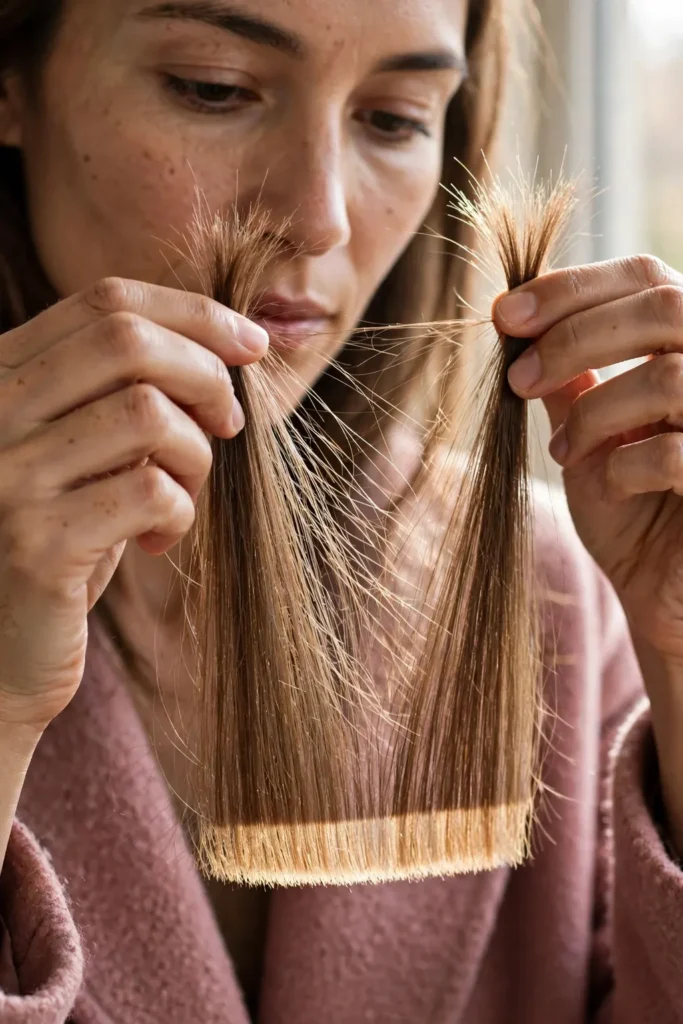
The photo test is the only honest test of a ghost cut, and it is the test to run the day after the appointment, not in the salon mirror. The salon mirror lies twice: the lighting is bright and flattering, and the hair is freshly blow-dried, which makes any cut look good for an hour. A photograph in normal light, taken by someone else, tells the truth — and the truth has two parts, which is why this test has two checks. First, the movement: take a photograph mid-turn, head turning, hair swinging, and look at whether the surface breaks into soft movement or hangs as one slab. A ghost cut should show movement in the photograph — not a dramatic wave, but a visible swing, a separation, a bend that was not there before the cut. Second, the ends: take a photograph with the hair against a light background — a window, a white wall, a bright sky — and look at whether the ends read as a solid line or as a translucent edge. A ghost cut should show solid ends, because the perimeter was never touched; if the ends go see-through against the light, the cut took from the perimeter, whatever it was called.
Run both checks on the same day, in the same light, and keep the photographs. If the cut passes both, it is a ghost cut, and the photographs are the record to show the stylist next time — “this, again, exactly this.” If it fails the movement check but passes the ends check, the cut was too cautious: the interior pieces were too long or too few, and the next appointment needs more interior work, not less. If it fails the ends check, the cut was not a ghost cut at all, and the next appointment is a repair, not a repeat: the perimeter needs to grow back, and no further interior work should be cut until it has. The photographs are the evidence either way, and they are worth more than any opinion in the chair, because the chair is where the cut was sold and the photograph is where it lives.
📌 Save this test — one photo mid-turn for movement, one photo against the light for the ends. A ghost cut passes both; a normal layered cut fails the second.
Who it suits best
The photo test suits every reader, because it is the test that separates a ghost cut from a normal one without needing any technical knowledge — no vocabulary, no trust, just two photographs. It suits the reader who has been disappointed by layers before, most of all, because it gives her a check she can run herself, in her own light, the day after the appointment, instead of discovering the thin ends three weeks later in a holiday photograph. It suits the reader who is choosing between stylists, because the photographs from the last cut are the brief for the next one — “movement like this, ends like this” — and a stylist who can see the target can hit it. And it suits the reader who is nervous about asking for something new, because the test is the safety net: even if the cut is wrong, the photographs catch it on day one, while the ends are still long enough to grow back quickly.
How to ask for it (or do it at home)
The photo test is a home test, and the routine is simple: the day after the appointment, ask someone to take two photographs — one of you turning your head, hair swinging, in normal indoor light, and one of the ends against a bright window or a white wall. No flash, no filter, no special angle: the point is normal light, because normal light is where the hair lives. Compare them against the two checks above, and keep them in your phone. At the next appointment, show the stylist the movement photograph first — “this is what I want more of” or “this is what I want to keep” — and the ends photograph second, because the ends are the guardrail and the stylist needs to see that they held. The photographs are the salon script in picture form, and they survive the appointment better than any sentence.
Styling and upkeep
The photo test is also a styling check, and it is worth running it twice: once on the day after the appointment, styled the salon’s way, and once a week later, styled your way, with the root-lift routine from the previous section. If the movement shows in the salon’s styling but not in yours, the cut is fine and the styling needs the root lift; if it shows in neither, the cut needs more interior work at the next appointment. The upkeep is the same as the cut’s: a perimeter dusting every ten to twelve weeks, interior work only when the movement fades, and the photographs kept as the record of what “right” looks like for your hair. A ghost cut that passes the photo test twice — in the salon’s hands and in yours — is a cut worth repeating exactly.
Salon Script: ‘Internal Layers Only, Keep My Perimeter’

This section is the whole article in one sentence, and it is the section to screenshot before the appointment: “Internal layers only, keep my perimeter.” Everything else in this guide is the explanation of that sentence — why the layers are internal, why the perimeter is the guardrail, what the two-inch rule is, what the comb test checks, what the photo test proves — but the sentence itself is the order, and it is written to be said exactly as it stands, without softening. The reason it is written that way is that salon language drifts: “layers” on its own buys a normal cut, “just a few layers” buys a normal cut with an apology, and “layers, but keep it full” buys a normal cut with a contradiction the stylist has to resolve in the chair — and they will resolve it the way they always do, on the surface. “Internal layers only, keep my perimeter” leaves nothing to resolve: the layers are internal, the perimeter is kept, and the stylist who hears it knows the cut you want before you sit down.
Say it at the start of the appointment, before the consultation drifts into chat about holidays and colour, and say it again when the scissors come out — “internal only, perimeter stays” — because the moment the scissors are in the hair is the moment the guardrail matters. Bring the photographs from the photo test, if you have them, and bring this article’s guardrail section on your phone: a stylist who can see the two-inch rule and the comb test will cut the cut you want, and a stylist who argues with the script is a stylist telling you they do not cut this way — which is useful information, and the right response is to thank them and book elsewhere, not to negotiate the guardrail away. The cut is only a ghost cut if the perimeter stays, and the script is how you buy exactly that.
📌 Save this script — “Internal layers only, keep my perimeter.” Say it at the start, say it again when the scissors come out, and do not negotiate the guardrail away.
The technique, step by step
The appointment, in order: consultation first, with the script said out loud and the photographs shown; perimeter cut second, blunt, in one length, checked from behind; interior work third, top layer lifted, interior pieces cut an inch or two shorter, at least two inches up from the ends, working from the crown down; comb test fourth, run through the surface before drying, and any catching piece moved further inside; drying and styling fifth, with root lift only; photo check sixth, before you leave — turn your head, watch the surface move, check the bottom edge stays one line. The whole appointment takes no longer than a normal layered cut, and the difference is not time but attention: the stylist’s attention is inside the hair, not on its surface, and yours is on the guardrail. If any step is skipped — especially the comb test — ask for it: it takes ten seconds, and it is the difference between a ghost cut and a hope.
Common mistakes to avoid
The first mistake is softening the script: “layers, but not too many” is not the script, and it buys the normal cut. The second is letting the consultation drift into a different cut — a stylist who suggests “a few face-framing layers as well” is suggesting a second, visible cut on top of the ghost one, and the answer is to agree it as a separate decision, later, not folded into this appointment. The third is not checking the comb test: a ghost cut that is never comb-tested is a ghost cut on trust, and trust is not a technique. The fourth is tipping the appointment with silence: if the cut is wrong, say so in the chair, politely, with the photo test as the evidence — “the ends look thinner than when I came in” — because a stylist who knows on the day can adjust on the day, and a stylist who hears about it three weeks later can only apologise.
Products and tools that help
The salon script needs no products, but the appointment does need two things from you: clean, dry hair, washed the morning of, so the stylist can see the hair’s real fall and density — wet hair hides both, and a ghost cut planned on wet hair is planned blind — and a photograph of your hair on a normal day, not a salon day, so the stylist can see what the cut has to live with. Bring the photograph of the ends against the light, if you have one from a previous cut: it shows the stylist the guardrail in your own hair, better than any sentence. And bring the script written down, on your phone, because the sentence is short and the appointment is long, and the written sentence survives the chat better than the remembered one.
Frequently Asked Questions

What are ghost layers in a haircut?
Ghost layers are internal, hidden layers cut inside the hair to add movement without changing the outline. Shorter pieces are cut underneath the surface layer, at least two inches up from the ends, so the top layer falls over them and the haircut reads as one length — full at the ends — while the hair swings and separates more than one-length hair does. The technique is also called invisible layers or hidden layers, and the test is simple: after the cut, the ends should look exactly as full as before, and the hair should move more than before.
Are layers bad for fine thin hair?
Normal surface layers are often bad for fine, low-density hair, because they remove hair from the perimeter — the ends — which is the one place fine hair cannot spare it, and the movement they give back is movement the hair cannot hold. Ghost layers are the exception, because they never touch the perimeter: the layers are cut inside, the ends stay full, and the movement comes from underneath. So the honest answer is that layers are not bad for fine hair — surface layers are, and ghost layers are the version designed for exactly this hair.
How do ghost layers differ from normal layers?
Normal layers are cut on the surface: a section is lifted and cut shorter than the section below it, so the layer line is visible and the ends below it are thinner. Ghost layers are cut inside: the shorter pieces sit underneath the surface layer, the layer line is invisible, and the ends are never touched. The difference shows in the photograph test — a normal layered cut fails the ends-against-the-light check, because the ends go see-through, while a ghost cut passes both checks: movement you can see, and ends you cannot see through.
Conclusion: Ghost Layers for Fine, Low-Density Hair — Your Next Step

Fine hair does not need fewer ends. It needs less weight in the middle, movement it can hold, and a perimeter that stays full — and ghost layers are the only layering technique that gives all three at once, because they are the only one that never touches the ends. The guardrail is the cut: blunt perimeter, interior pieces hidden at least two inches up, comb-tested before drying, photo-tested the day after. The styling is the support: air at the root, nothing on the ends. And the salon script is the order: “Internal layers only, keep my perimeter.” Say it at the start of the appointment, say it again when the scissors come out, and check the photographs the next day — movement you can see, ends you cannot see through. If your last layered cut left you with a thinner ponytail, this is the cut that fixes the lesson instead of repeating it: the movement, without the cost.
The bottom line: ask for internal layers only, keep your perimeter — and let the photo test, not the salon mirror, judge whether the cut worked. For more fine-hair and layering guides, start at AboutSuperstars.