Holiday Party Nails: Christmas French Tips, Bows & Desk-to-Dinner Looks
Christmas party nails are the hardest manicure brief of the year, and every reader who has ever sat at her desk on party day knows why: the nails have to do two jobs that pull in opposite directions. At 3pm they have to look appropriate in a meeting — neat, short enough to type, festive enough to notice but not so festive that they read as a costume. At 8pm, under evening light, in a dress, they have to look like party nails — the same manicure, the same ten nails, with nothing changed except the light and the outfit. Most party nails fail one of the two jobs: the desk-safe ones disappear in the evening, and the evening ones look wrong at the desk. This guide is the manicure that does both — Christmas French tips that are office-safe by day and festive by night, bows that read as grown-up rather than coquette costume, velvet and cat-eye finishes that come alive in evening light, gold foil and fine glitter used as accents rather than coverage, deep after-dark colours, one set matched to the dress code, and the morning-after reset that makes the same set last through two weeks of parties. ‘Holiday nails’ searches rose 1,000% month-on-month in Pinterest Trends (via Market With Miranda, 7 Oct 2026 — second-hand Trends data), inside ‘christmas nails’ at 11,000,000 searches a month (Pinsearch Nov 2026) — and the demand is for exactly this: one manicure, several parties, no second appointment. For more Christmas and holiday nail ideas, start at AboutSuperstars.
Quick answer: The best holiday party nails are one set that works at your desk and at the party: Christmas French tips, a grown-up bow accent, or velvet and cat-eye finishes. Book one set, keep the tips short and the glitter as an accent, and it lasts two weeks of parties.
Christmas Party Nails That Still Work at Your Desk

The desk test is the first test any party manicure has to pass, and it is a practical test, not a style test: can you type with them, can you shake a hand without thinking about them, and would they look out of place in a meeting at 3pm? A manicure that fails the desk test is a manicure you will be self-conscious about for the whole working day before the party, and a manicure you are self-conscious about is a manicure that photographs badly, because the hands in the photographs are the hands of someone hiding them. The desk-safe party nail has three properties: a short to medium length, so typing is comfortable and the nails do not click on the keyboard; a shape with no sharp points, so handshakes are easy and the nails do not catch on sleeves; and a design that reads as polished from a distance of a metre, because that is the distance a colleague sees them from, and only reveals its festive detail up close. Christmas French tips pass all three. So does a single bow accent on an otherwise plain set. So does a deep colour worn short. What fails is length first — long stiletto party nails at a desk are a costume — and glitter coverage second, because full glitter reads as evening from any distance, while a glitter accent reads as festive only when someone is close enough to see it.
The trick is to design the set backwards from the evening, not forwards from the desk. Decide what the nails should look like at 8pm — the French tip with a gold line, the bow on the ring finger, the velvet finish catching the light — and then check each element against the desk: is it short enough, is it neat enough, is it quiet enough at a metre? If an element fails the desk check, do not remove it — shrink it. A bow that is too big becomes a smaller bow, or a bow on one nail instead of five. A glitter tip that is too loud becomes a glitter line at the smile line instead of a glitter tip. The set that survives both checks is the set in this guide, and the sections below are its pieces: the French, the bow, the velvet, the foil, the deep colours, the dress-code match, and the reset that keeps them all alive for a fortnight.
📌 Save this before your appointment — design backwards from 8pm, then shrink what fails the desk. A party nail that works at 3pm and 8pm is a smaller version of the evening nail, not a different one.
Who should skip this version
Skip the desk-to-dinner set if your workplace has a strict dress code that forbids visible nail art altogether — a French tip is usually safe, but a bow or a gold line may not be, and the honest answer is to wear the plain version to work and add the accent at home before the party, with a fine brush and a steady hand. Skip it if your nails are very short and bitten, because the French tip needs a visible free edge to read as French, and on a bitten nail the tip line sits on the skin rather than the nail. And skip the whole idea if you have only one party and it is black tie: a single black-tie event deserves a full evening set, not a compromise — the desk-to-dinner set is for the reader with several parties and one appointment, and if there is only one party, the compromise is the wrong trade.
Works best on: shapes and lengths
The desk-to-dinner set works best on short to medium lengths — the free edge no longer than about a quarter of the nail bed — in squoval, round or soft almond shapes, because those shapes type comfortably and do not catch. It works best on natural nails and on gel, equally: gel holds the French line crisper for two weeks, but a well-applied regular polish on short nails will survive a fortnight of desk work if it is topped up with a clear coat at day seven. It works on every skin tone, because the palette in this guide — nude bases, white and gold tips, deep oxblood and emerald — is chosen for range, and the skin-tone section in the French chapter covers which base suits which tone. And it works best on the reader who types all day, because the set was designed around her: short, neat, quiet at a metre, festive up close.
Maintenance schedule
A desk-to-dinner set lasts two weeks with one piece of maintenance: a clear top coat at day seven, applied at home in two minutes, which refreshes the shine and seals the tip line before it can lift. The French tip is the part that wears first — typing wears the very edge of the tip, so check the tips on day five and day ten, and if a tip has chipped, file it smooth and seal it rather than picking at it. The bow, if it is a painted bow rather than a 3D charm, needs no maintenance at all; a 3D bow needs a drop of top coat over it every three days to keep it anchored. The full reset — removal, care and re-application — is covered in the last section, and the two-week plan is the point: one appointment, two weeks, several parties, no second booking.
Christmas French Tips: The Office-Safe Festive Look
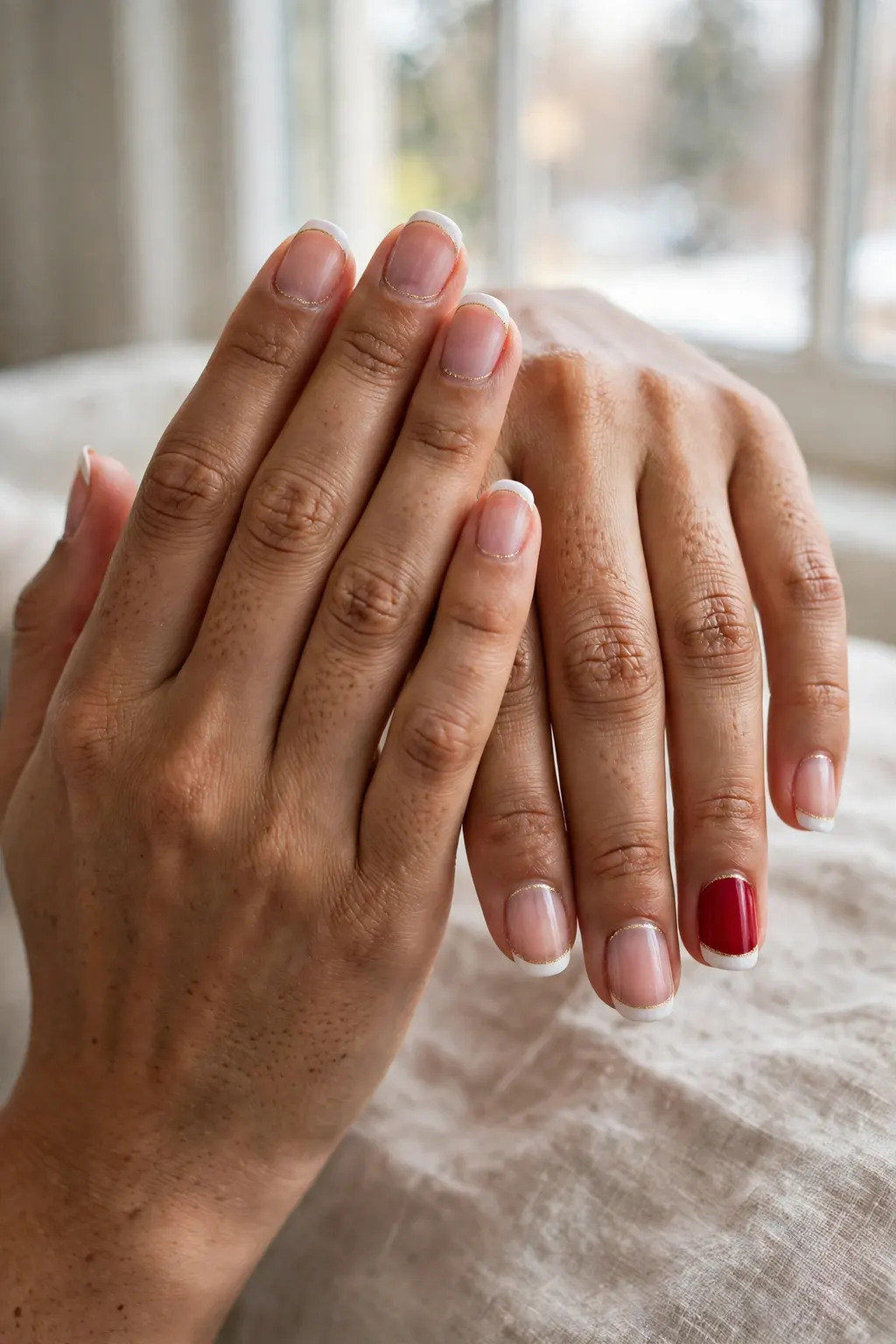
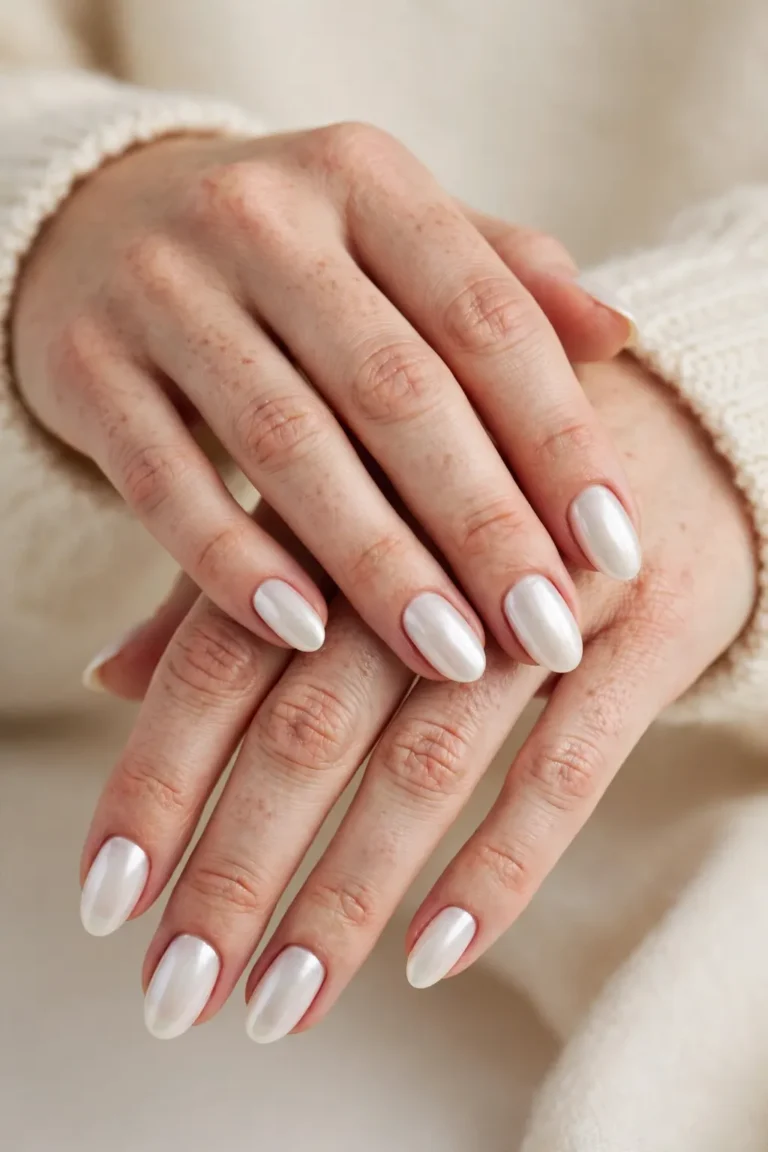
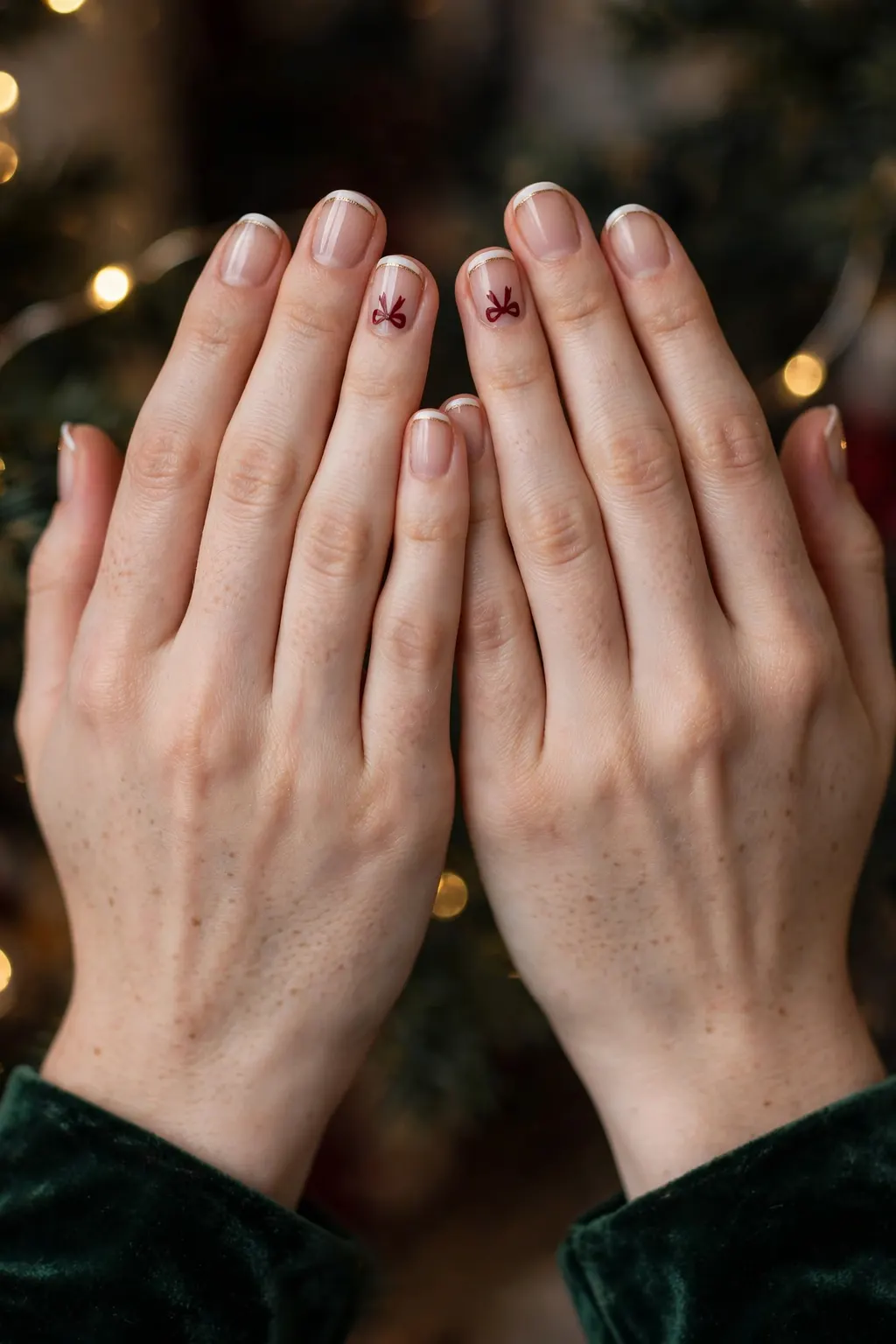
The Christmas French tip is the most office-safe festive nail there is, and the reason is that it is a French tip first and a Christmas nail second. The base is a sheer nude, the tip is white, and the festive part is a single quiet detail: a hairline of gold at the smile line, a red tip instead of a white one on the ring finger, or a dusting of fine glitter just at the very edge. From a metre away, at a desk, it reads as a neat French manicure — the most workplace-accepted nail design in existence — and up close, at the party, the gold line or the red tip is the detail that says Christmas without saying it loudly. The Christmas Nails flagship guide covers the full Christmas range, and its French variations are the starting point for this section: the office-safe version is the same design with the festive element shrunk to one detail per nail, or one nail in five.
The technique that makes it work is the tip width. A classic French tip is about a third of the nail; a Christmas French tip for the office is thinner — a fine, clean line, about the width of the free edge and no more — because a thin tip reads as precise and a wide tip reads as a statement. The gold hairline, where it is used, is drawn with a fine brush along the smile line, not painted over the tip: it should read as jewellery, a line of gold where the white meets the nude, and if it reads as a stripe, it is too wide. The red accent tip, where it is used, goes on one nail only — the ring finger is the classic choice — because one red tip is a detail and five red tips are a different manicure. The glitter, where it is used, is fine glitter, pressed into the very edge of the tip while the top coat is wet, so it reads as frost rather than sparkle.
📌 Save this before the French — thin tip, one festive detail, gold as a hairline. From a metre it is a neat French; up close it is Christmas.
Best for: nail shapes, lengths and skin tones
Christmas French tips are best on short to medium nails in squoval or round shapes, because the tip line follows the shape of the free edge and a squoval or round edge gives a clean, even line. They suit every skin tone, with the base doing the matching: fair skin takes a sheer pink-nude base, medium skin a warm beige-nude, deep skin a rich caramel-nude — the tip stays white in all three, because the white is the constant and the base is the variable. They suit the reader with a short nail bed best of all, because the thin tip makes the nail look longer without adding length, and the reader whose hands are on show at work — presenting, shaking hands, typing in front of clients — because the French is the design that never needs explaining.
The exact wording to show your nail tech
At the salon, the sentence is: “A Christmas French — sheer nude base, thin white tips, and a hairline of gold at the smile line on every nail, or a red tip on the ring finger only. Thin tips, please — about the width of the free edge, not a third of the nail.” Then add the two details that make it office-safe: “Keep the glitter to the very edge of the tip, fine glitter only, no chunky pieces” and “Matte top coat or glossy?” — glossy is the party choice, because it catches the light, and matte is the desk choice, because it reads as quieter; for a desk-to-dinner set, glossy is the right call, because the party is the point and the desk has already accepted the French. If the tech suggests a wider tip or a full glitter tip, that is a different design — lovely, but not this one — and the answer is to keep the thin tip and the single detail.
How long it lasts and what it costs
A gel Christmas French lasts the full two weeks, with the tip line holding because the tip is thin and the top coat seals it; a regular-polish version lasts about seven to ten days before the tip edge starts to wear, and the day-seven top coat in the maintenance schedule is what carries it to fourteen. The cost is a standard gel French set — the gold hairline adds a small detail charge at most salons, and the single red accent tip adds nothing, because it is one nail of polish rather than a design. No invented prices are quoted here, because prices vary by salon: ask for the French set price and the detail price separately, and the total is the sum, not a surprise. The value is in the two weeks: one set, several parties, and a tip line that still reads as neat on day fourteen.
Bow Details: Coquette, But Grown-Up
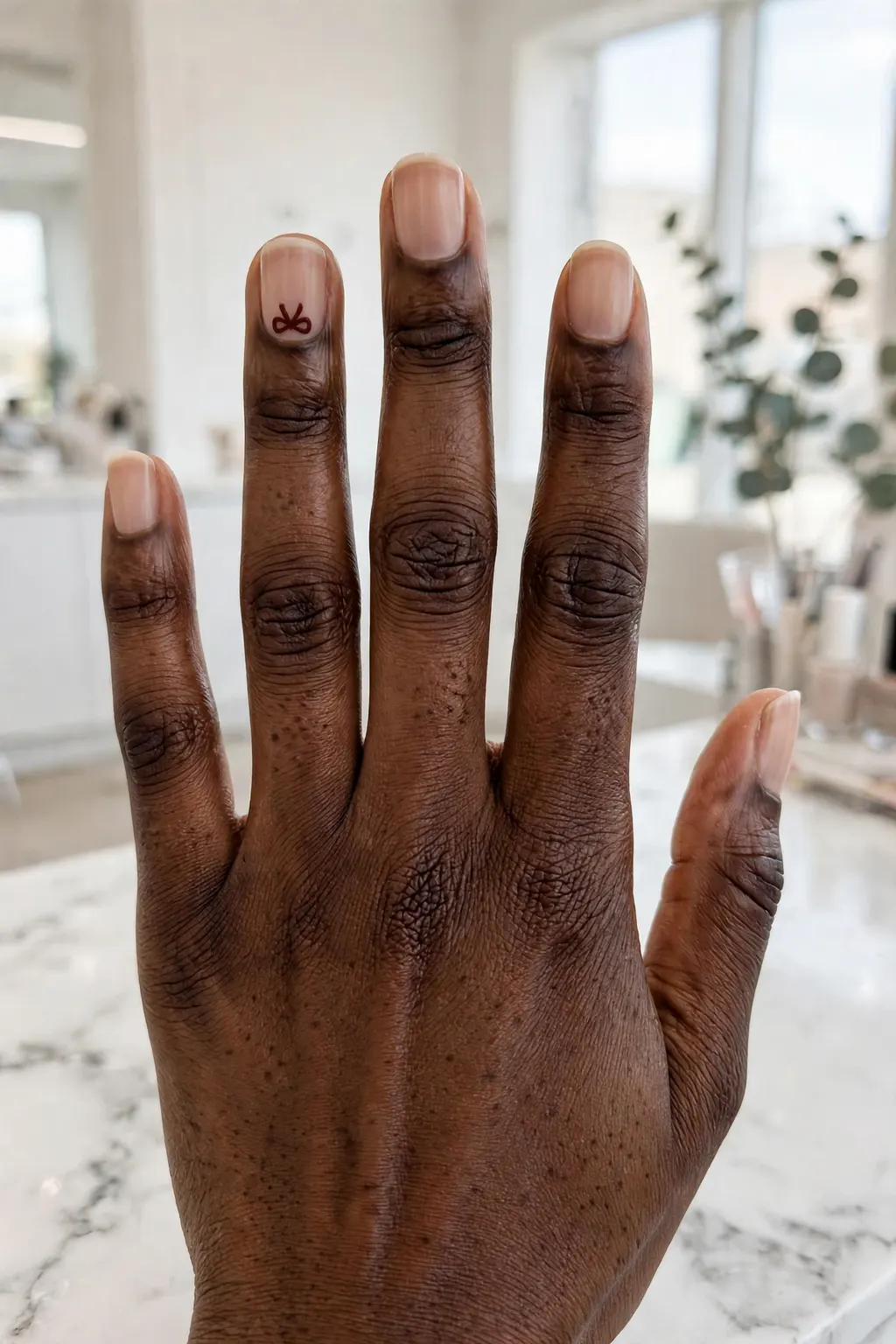
The bow is the riskiest detail in this guide and the most rewarding when it is done right, because the line between a grown-up bow and a costume bow is thin, and it is drawn by size, number and placement. A grown-up bow is small — about the width of the nail, never wider — painted, not stuck on, and placed on one or two nails only, usually the ring fingers. A costume bow is large, three-dimensional, on every nail, and reads as a gift tag rather than a manicure. The difference is not taste, it is arithmetic: one small painted bow is a detail, five large 3D bows are a theme, and the desk-to-dinner set needs a detail. The coquette trend that drives bow nails is real — bows are the party detail of the season — but the grown-up version is the one that survives a meeting, and the version in this guide is the one to ask for.
The placement matters as much as the size. A bow at the base of the nail, near the cuticle, reads as jewellery — it sits where a ring sits, and the eye reads it as an accessory. A bow in the centre of the nail reads as a sticker, and a bow at the tip reads as a cartoon. The colour matters too: a bow in the same colour family as the base — a deep red bow on a nude base, a gold bow on a deep green base, a white bow on a red base — reads as deliberate, while a bow in a clashing colour reads as a toy. And the finish matters most of all: a painted bow with a glossy top coat reads as grown-up, a 3D charm bow reads as dress-up, and for a desk-to-dinner set the painted bow is the right call every time, with the 3D version saved for the single black-tie night.
📌 Save this before the bow — small, painted, one or two nails, at the base. A bow that reads as jewellery is grown-up; a bow that reads as a gift tag is not.
Step by step
The painted bow, in order: base coat, two coats of the nude base, and let it dry fully — a bow painted on a tacky base will drag. Then, with a fine brush, two small loops at the base of the nail, meeting in the centre, with two short tails below them — the loops are the bow, the tails are what make it read as a bow rather than a flower. Then a dot of the accent colour in the centre, where the loops meet, to anchor it. Then let it dry completely, and seal it with two coats of top coat, because the top coat is what turns a painted detail into a smooth, grown-up finish. The whole bow takes about two minutes per nail, and the two nails — usually the ring fingers — are the only ones that get it. The rest of the set stays plain, and the plain nails are what make the bow read as a detail rather than a theme.
Common mistakes to avoid
The first mistake is size: a bow wider than the nail reads as a sticker, and the fix is to draw it smaller than you think — the loops should fit comfortably inside the nail with space on both sides. The second is number: bows on more than two nails stop being a detail, and the fix is to choose the ring fingers and stop there. The third is placement in the centre: a centre bow reads as a cartoon, and the fix is to move it to the base, where it reads as jewellery. The fourth is the 3D charm on a desk day: a charm catches on sleeves, on keyboards, on everything, and the fix is the painted bow for the working week, with the charm — if you must have it — added at home before the single evening party, and removed the next morning.
Products and tools that help
A fine detail brush is the one tool that matters — a striper brush or a small liner brush, clean and dry, because a bow drawn with a polish brush is a bow drawn with a mop. A dotting tool, or the end of a bobby pin, is the second, for the centre dot. A quick-dry top coat is the third, because the bow needs two coats of top coat to look smooth, and the drying time between them is when most bows get smudged. The base colour and the bow colour are the only products: a sheer nude base, a deep red or gold bow, and a glossy top coat. No stickers, no charms, no stamping plates are needed for the grown-up version — the painted bow is a brush, a dot and patience, and the patience is the product that matters most.
Velvet & Cat-Eye Finishes for Evening Light
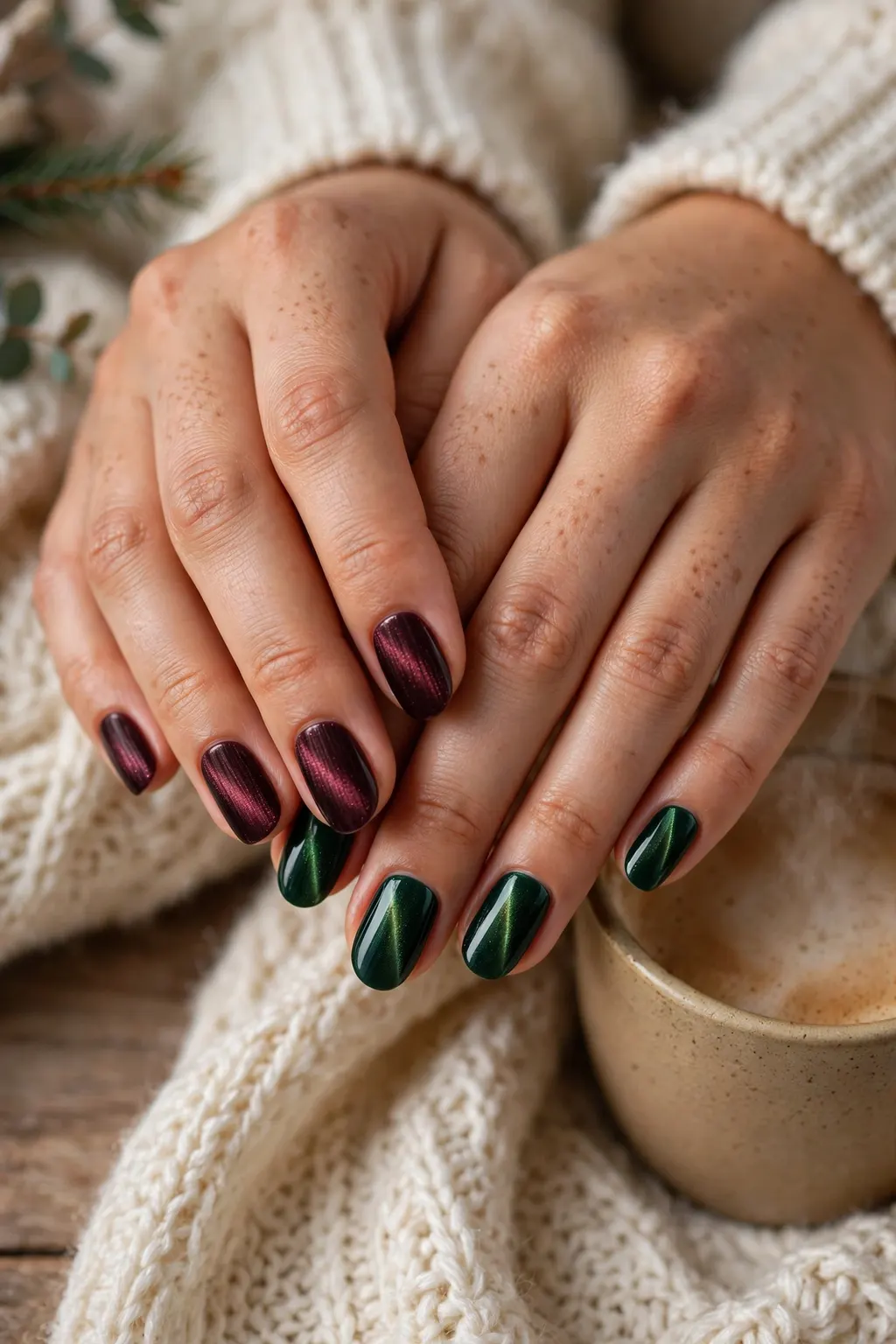
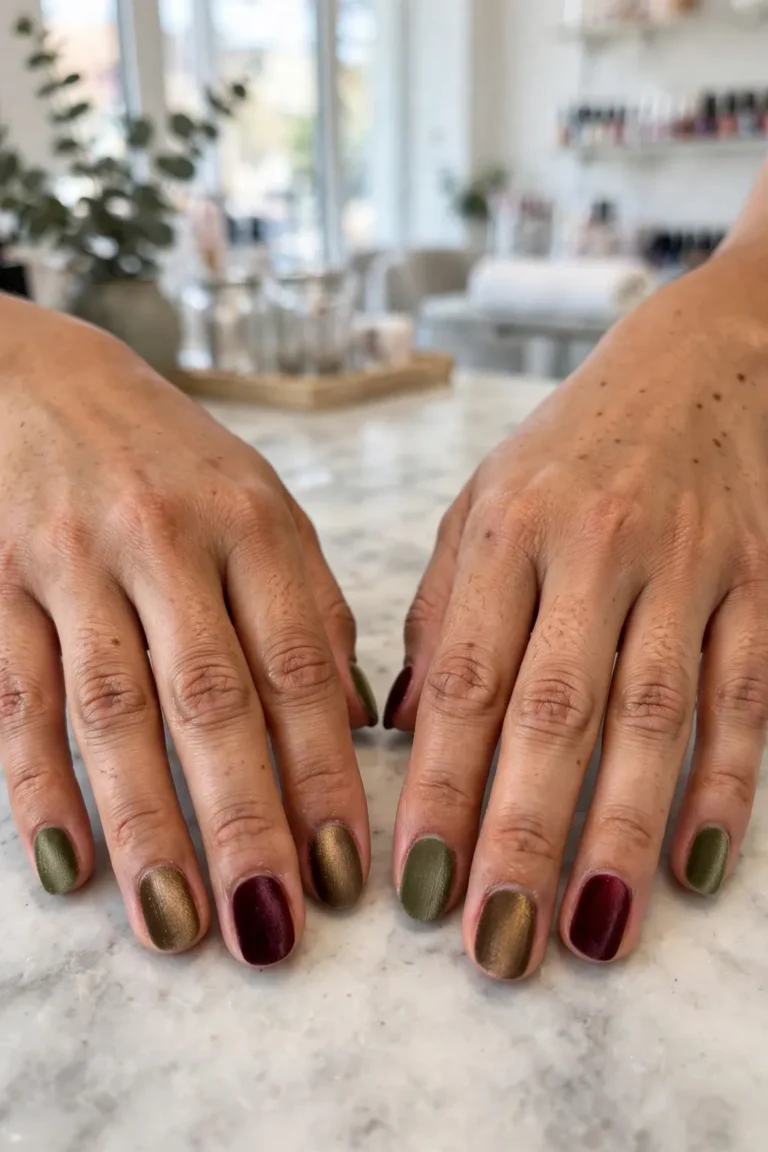
Velvet and cat-eye finishes are the evening-light specialists of this guide: they are quiet in daylight and alive after dark, which is exactly the desk-to-dinner behaviour the set needs. A velvet finish is a magnetic polish with a soft, brushed shimmer — in office light it reads as a deep, slightly luminous colour, and under evening light it glows, the shimmer shifting as the hand moves. A cat-eye finish is the sharper version: a magnetic line of light that runs down the nail, moving as the hand turns, like the slit of a cat’s eye. Both are made the same way, with a magnet held over wet magnetic polish, and both are the finishes that make a plain deep colour into a party nail without adding any decoration at all — no glitter, no bow, no tip, just light moving in the polish.
The desk test for these finishes is easy to pass, because in daylight they are simply deep colours: a velvet burgundy reads as burgundy, a cat-eye emerald reads as emerald, and neither looks decorated from a metre away. The evening test is where they earn their place: under a chandelier, a candle, a phone flash, the magnetic shimmer comes alive, and the nails look finished in a way a flat colour does not. The colours that work best are the deep ones — oxblood, emerald, midnight, burgundy — because the magnetic effect needs depth to show against, and on a pale colour it washes out. The shape that works best is short almond or squoval, because the magnetic line follows the shape of the nail, and a short nail gives a short, clean line. And the maintenance is nothing: the finish is in the polish, not on top of it, so there is no decoration to chip and no tip to wear.
📌 Save this before the magnet — deep colour, short nail, magnet held still. Velvet glows in evening light; cat-eye moves with your hand. Both are quiet at the desk.
Who should skip this version
Skip velvet and cat-eye if your workplace lighting is very bright and very white — under harsh office fluorescents, a cat-eye line can read as a stripe rather than a shimmer, and the desk test fails on a technicality. Skip them if your nails are very short, because the magnetic line needs a little length to travel, and on a very short nail the line has nowhere to go. And skip the cat-eye specifically if you hate the feeling of being looked at: the moving line of light draws the eye, and a reader who wants her nails to go unnoticed at work will notice the line being noticed. The velvet finish is the quieter of the two, and the one to choose if the cat-eye feels too much.
Works best on: shapes and lengths
Velvet and cat-eye work best on short to medium nails in almond, squoval or round shapes, in deep colours — oxblood, emerald, midnight, burgundy, black cherry — because the depth is what the magnet works against. They work on every skin tone, because the colour is the variable and the finish is the constant: fair skin takes a deep emerald or burgundy, medium skin an oxblood or midnight, deep skin a black cherry or emerald, and the magnetic shimmer reads the same on all of them. They work best on gel, because the magnet needs a wet, even layer and gel gives the most even one, but a magnetic regular polish works too if the magnet is held steady for the full count. And they work best on the reader who has several evening parties and one desk: the finish is the whole design, so there is nothing to touch up between parties except the top coat.
Maintenance schedule
A velvet or cat-eye set in gel lasts the full two weeks with no maintenance beyond the day-seven top coat, because there is no decoration to maintain — the finish is in the polish. A regular-polish version lasts about ten days before the shimmer dulls under the top coat, and the day-seven top coat refreshes it. The one thing to avoid is filing the free edge after the set is done: filing disturbs the magnetic pattern at the very edge, and the line will break where the file touched it. If a nail chips, seal it with top coat and leave it — do not file the chip smooth, because the file will take the finish with it. The reset, when it comes, is a normal removal: soak, lift, care, re-apply.
Gold Foil & Fine Glitter Accents
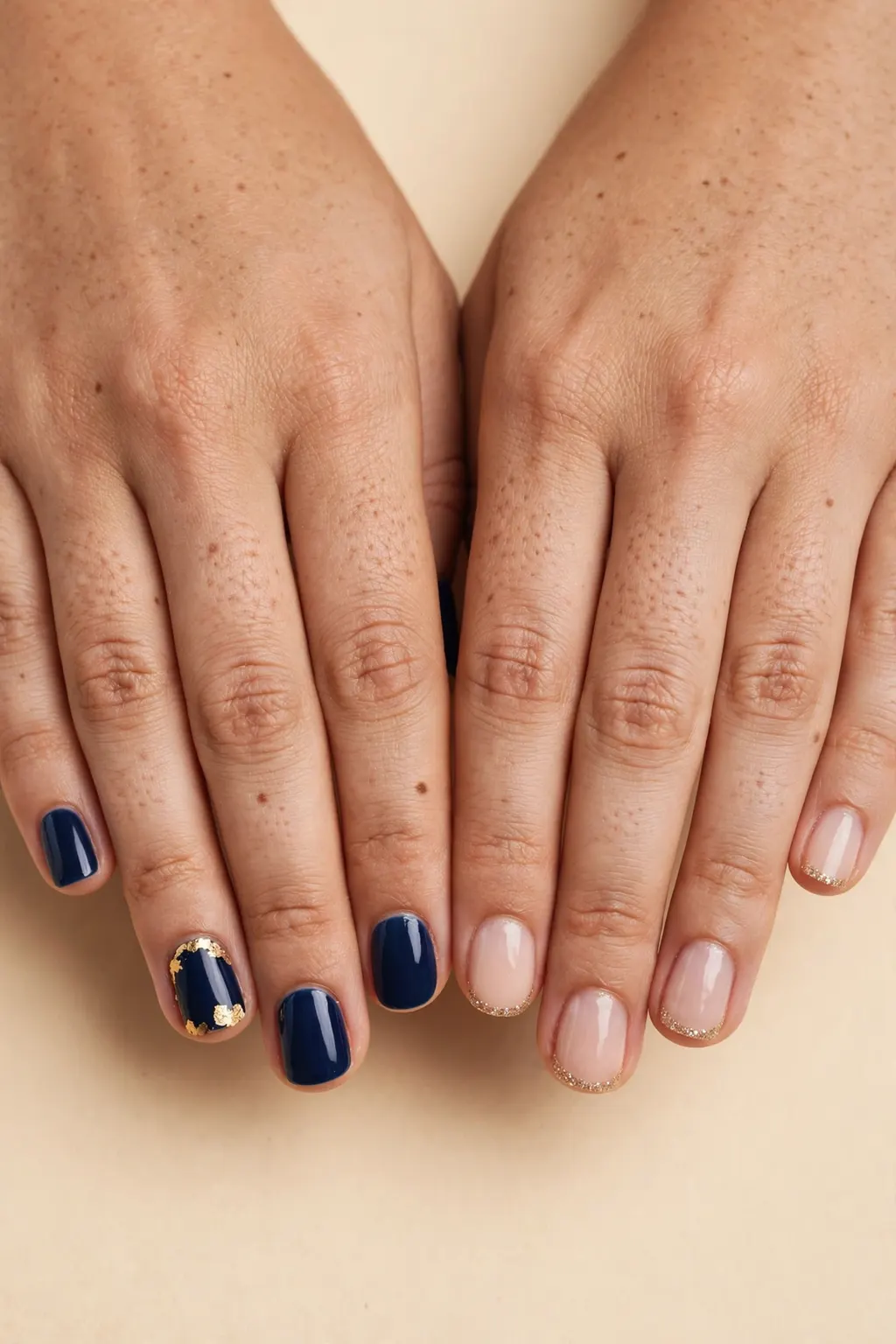
Gold foil and fine glitter are the accents of this guide, and the word that matters is accents — not coverage. Full glitter nails are evening nails, and they fail the desk test outright: from a metre away they read as a disco, and no amount of shortening fixes it, because the problem is not the length, it is the coverage. An accent is different: a gold foil edge on one nail, a fine glitter line at the smile line, a dusting of gold at the cuticle — a small amount of shine, placed deliberately, that reads as festive up close and as polished from a distance. The rule for accents is the same as the rule for bows: one detail, one or two nails, and the rest of the set plain. The plain nails are what make the accent read as an accent.
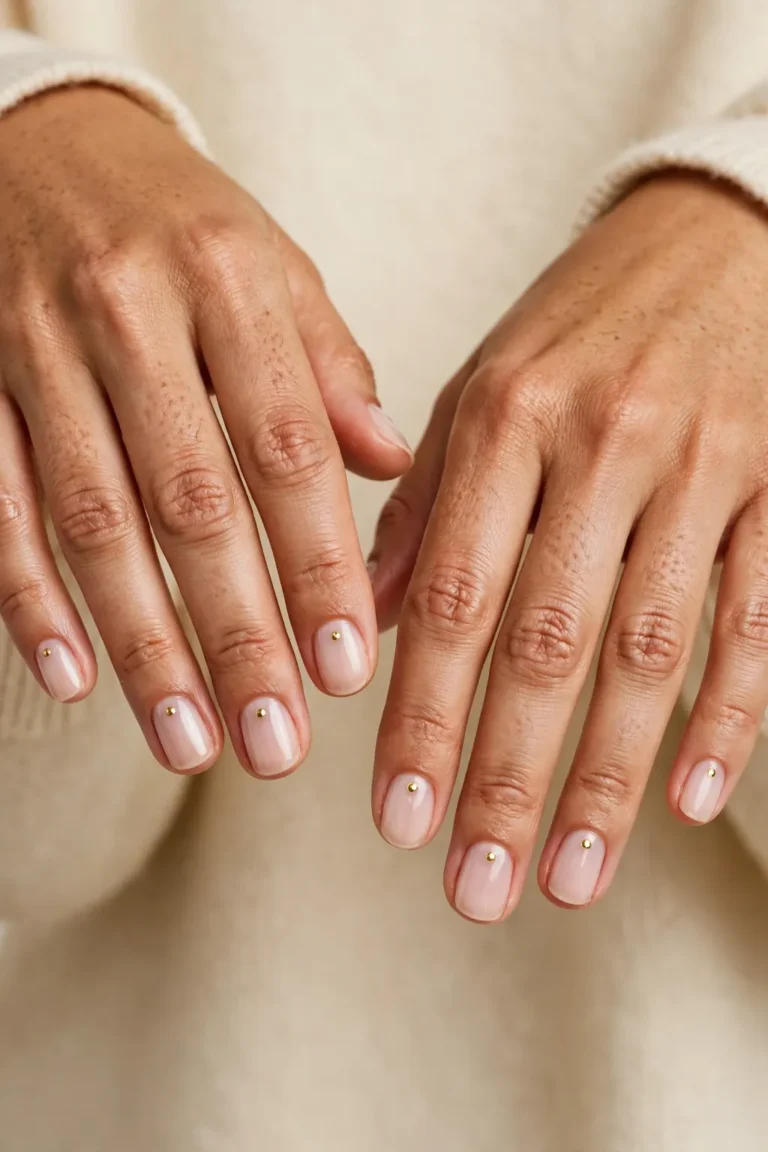
The foil technique is simple and forgiving: a thin layer of foil adhesive on the chosen area, a piece of gold foil pressed on and lifted off, leaving a broken, organic edge of gold — the broken edge is the point, because a perfect gold shape reads as a sticker and a broken edge reads as leaf. The glitter technique is the same logic: fine glitter, pressed into the top coat while it is wet, only at the edge or the line, never across the whole nail. The colours that take gold best are the deep ones — oxblood, emerald, midnight, burgundy — because gold on a deep colour reads as jewellery, while gold on a pale colour reads as a smudge. And the placement that works best is the edge: a gold foil tip on one nail, a glitter smile line on the French, a gold cuticle line on the ring finger. The edge is where the light catches it, and the light is what the accent is for.
📌 Save this before the gold — accent, not coverage. One foil edge, one glitter line, two nails at most. The plain nails are what make it read as gold, not glitter.
Best for: nail shapes, lengths and skin tones
Gold foil and fine glitter accents are best on short to medium nails in squoval or almond shapes, because the accent needs a clean edge to sit on, and a squoval or almond edge gives it one. They suit every skin tone, because gold is the most forgiving metallic: fair skin takes a pale gold, medium skin a true gold, deep skin a deep antique gold, and the accent reads as warm on all three. They suit the reader with a deep-coloured set best of all — oxblood, emerald, midnight — because the gold sits on the dark the way jewellery sits on a dark dress. And they suit the reader who wants one festive detail without committing the whole set to it: the accent can be added to a plain set the night before the party, and removed the next morning, without touching the rest of the manicure.
The exact wording to show your nail tech
At the salon, the sentence is: “Gold foil accent — a broken gold edge on the ring fingers only, over the deep colour, and fine glitter at the smile line of the French on the other hand, if we are doing the French. Accent only, please — no full glitter nails.” Then add the two details that keep it grown-up: “Fine glitter, not chunky — the pieces should read as frost, not as confetti” and “Seal it with two coats of top coat, because the foil edge lifts if it is not sealed.” If the tech suggests a full gold nail or a full glitter nail, that is a different design — lovely for a single evening, wrong for a desk-to-dinner set — and the answer is to keep the accent where it is: one edge, one line, two nails.
How long it lasts and what it costs
A gel foil accent lasts the full two weeks if it is sealed with two coats of top coat, because the seal is what holds the foil down; a foil accent with one coat will lift at the edge by day five, and the fix is the second coat, applied at the appointment, not later. A fine glitter accent lasts as long as the top coat does — about ten days in regular polish, the full two weeks in gel. The cost is a standard set plus a small accent charge for the foil, and the glitter line is usually included in a French set price; no invented prices are quoted here, because prices vary by salon, and the accent is the cheapest festive detail in this guide — cheaper than a bow, cheaper than a second colour, and the one that photographs best under evening light.
Christmas Party Nails in Deep Colours for After-Dark: Oxblood, Emerald, Midnight
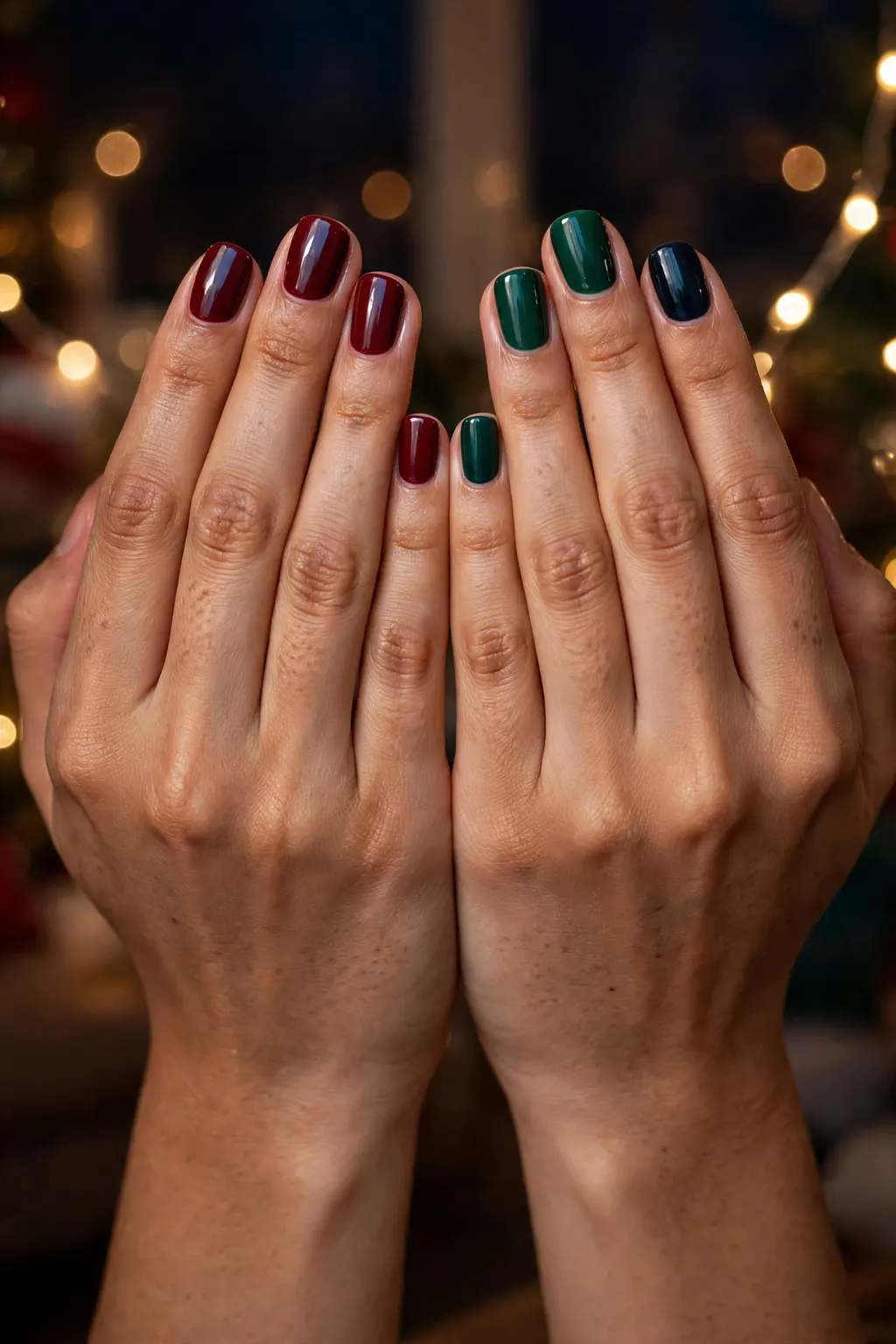
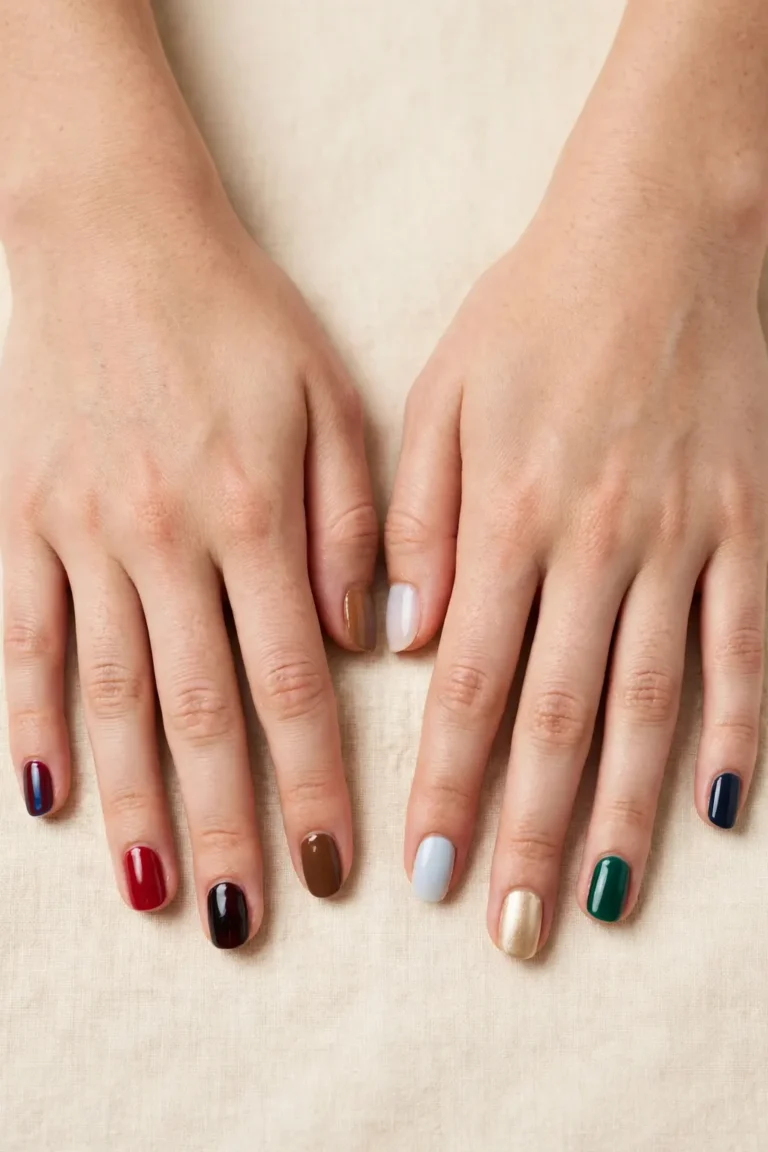
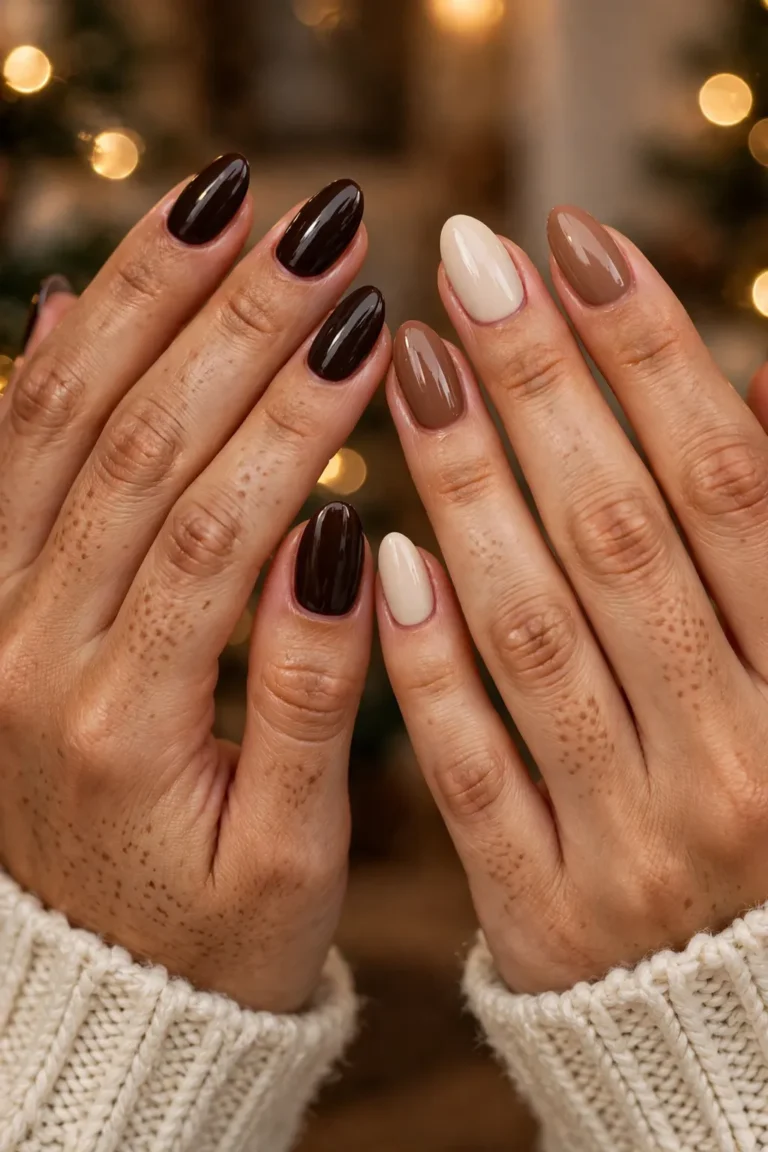
Deep colours are the after-dark half of the desk-to-dinner set, and they work because a deep colour is two colours at once: at the desk, in daylight, it reads as a dark, polished, professional manicure — oxblood reads as a deep red, emerald as a deep green, midnight as a very dark blue — and in the evening, under low light, it reads as a party colour, because the depth is what the light plays on. The three colours in this section are chosen for that double behaviour, and for their range across skin tones: oxblood, the blue-toned deep red that suits cool skin and reads as wine in the evening; emerald, the deep green that suits warm skin and reads as jewel in the evening; midnight, the near-black blue that suits every skin tone and reads as the darkest, most evening colour of the three. The Red Christmas Nails guide covers the red family in full, and its deep reds are the starting point for oxblood here — the difference is the depth: oxblood is a red that has gone almost black, and that almost-black is what makes it an evening colour.
The shape for deep colours is short. A deep colour on a long nail reads as dramatic, and dramatic is the wrong note for a desk; a deep colour on a short nail reads as polished, and polished is the note the set needs. Squoval or round, short to medium, with a glossy top coat — the gloss is what makes the depth show, and a matte top coat on a deep colour reads as flat, which wastes the colour. The application that matters is the edges: deep colours show every wobble at the cuticle, so the tech should use a clean-up brush at the edges, and the reader should check the cuticle line before leaving — a deep colour with a clean edge reads as expensive, and a deep colour with a wobbly edge reads as a home attempt, whatever it cost.
📌 Save this before the deep colour — short, squoval, glossy, clean edges. A deep colour on a short nail is professional by day and party by night; on a long nail it is only the second.
Step by step
The deep-colour application, in order: base coat, and let it dry fully, because a deep colour on a tacky base will drag and streak. Then two thin coats of the deep colour, not one thick one — a thick coat of oxblood or midnight will pool at the cuticle and streak at the tip, and two thin coats are what give the even depth. Then a clean-up pass at the cuticle with a small brush dipped in remover, to sharpen the edge — this is the step that makes the colour read as expensive, and it takes thirty seconds. Then two coats of glossy top coat, because the gloss is the finish that shows the depth. The whole application takes no longer than any other colour, and the difference is in the thinness of the coats and the clean-up at the end — the two things that separate a salon deep colour from a home one.
Common mistakes to avoid
The first mistake is one thick coat: deep colours streak, pool and take forever to dry in one thick coat, and the fix is always two thin ones. The second is skipping the clean-up: a deep colour with polish on the skin reads as messy from a metre away, and the fix is the small brush at the cuticle before the top coat. The third is matte top coat on a deep colour for a party set: matte flattens the depth, and the fix is glossy, because the gloss is what the evening light plays on. The fourth is choosing the wrong deep colour for the skin tone — a warm brick red on cool skin, or a blue-toned oxblood on warm skin — and the fix is the skin-tone matching in the French section applied here too: cool skin takes blue-toned depths, warm skin takes warm ones, and midnight takes everyone.
Products and tools that help
A good base coat is the one product that matters for deep colours, because a deep colour without a base coat will stain the nail — oxblood and midnight are the worst stainers in this guide, and the base coat is the barrier. A small clean-up brush is the one tool, for the cuticle edge. A glossy top coat is the finish, applied in two coats. And a bottle of the same colour at home is the quiet fourth product: a deep colour chips visibly, because the chip shows the pale nail underneath, and a single drop of the same colour on a chip, sealed with top coat, is a repair that lasts the rest of the fortnight. The reader who buys the bottle with the set is the reader whose deep colour still looks neat on day fourteen.
Party Looks by Dress Code: Office Party to Black Tie
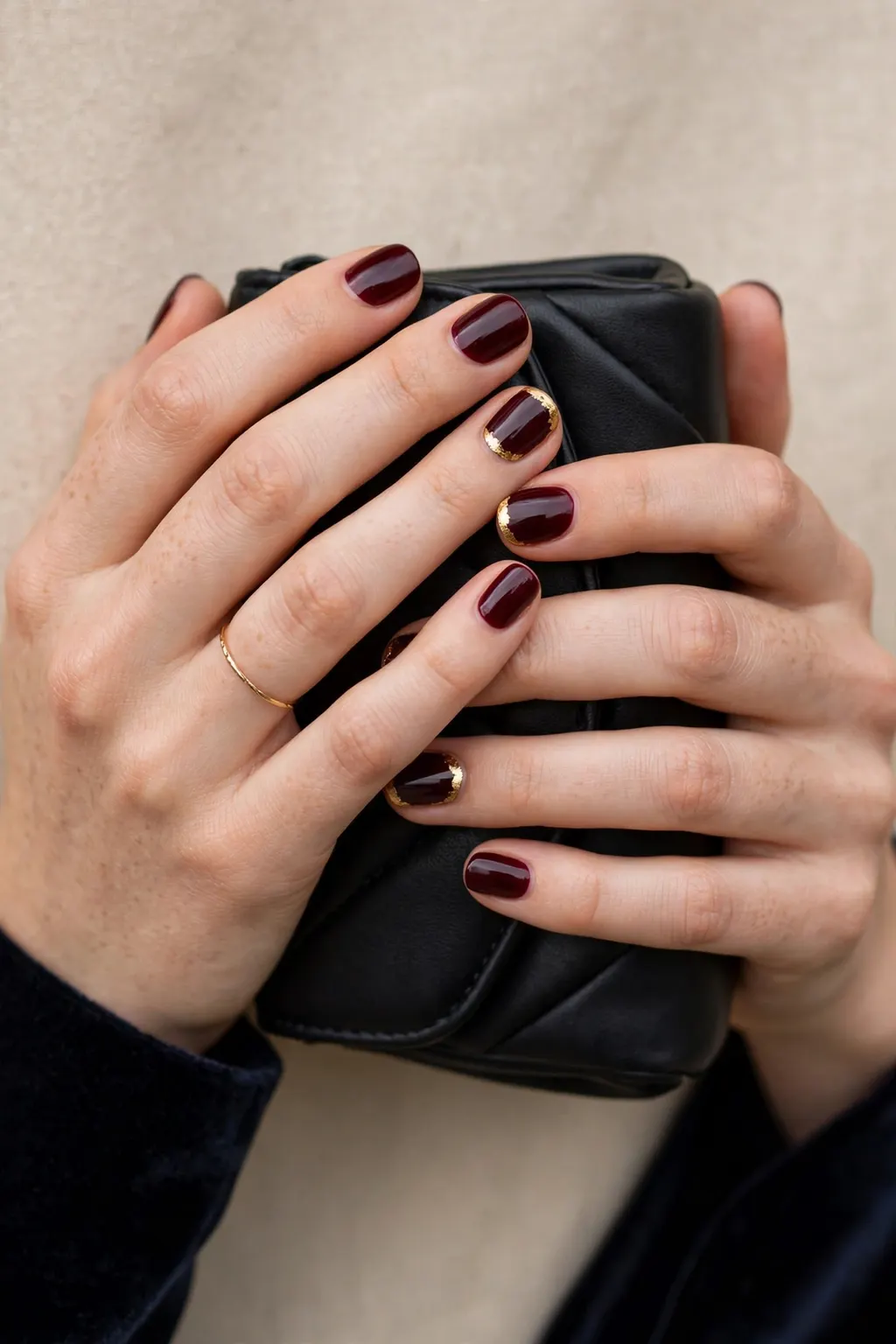
The dress code is the decision that organises the whole set, because the same ten nails have to match the outfit, and the outfit changes with the party. The guide below is the matching table: for each dress code, the set that fits it, built from the pieces in the sections above. The office party — the most common party in this guide — takes the full desk-to-dinner set: Christmas French with a gold hairline, or a deep colour worn short, or a single painted bow, because the office party is still the office, and the nails have to survive the working day before it. The smart-casual party — a restaurant, a friend’s house, a drinks evening — takes the same set with one element turned up: the French with a red accent tip, the velvet finish instead of the flat colour, the gold foil edge added. The cocktail party takes the velvet or cat-eye finish in a deep colour, or the deep colour with a gold accent, because the lighting is lower and the finish is what shows. And the black-tie party takes the full evening version: the deep colour with the gold foil edge, the cat-eye in midnight, the bow in 3D if you must — because black tie is the one dress code where the desk does not matter, and the set can be an evening set outright.
The rule that runs through all four is that the set is chosen by the strictest party, not the loosest. If the reader has an office party on Thursday and a black-tie party on Saturday, the set is the office-party set, because the office party is the one that constrains it — and the black-tie party is then dressed up with the outfit and the jewellery, not with a second manicure. The exception is the reader with only black-tie parties: she should book the evening set, not the compromise, because there is no desk to satisfy. The matching table is a guide, not a law, and the law underneath it is the one from the first section: design backwards from the evening, shrink what fails the desk, and let the strictest party decide.
📌 Save this before you choose — the strictest party decides the set. Office party on Thursday, black tie on Saturday: book the office set, and let the dress do the black-tie work.
Who should skip this version
Skip the dress-code matching if all your parties are the same dress code — the table is for the reader juggling several, and if every party is an office party, the office set is the whole answer and the table is unnecessary. Skip the black-tie version if you have no black-tie party: the full evening set is a beautiful manicure and the wrong one for a desk, and booking it for an office party is the mistake this guide exists to prevent. And skip the whole matching exercise if your parties are all informal — a friend’s house, a family dinner — because an informal party takes any version of this set, and the choice is then about what you like, not what the code demands.
Works best on: shapes and lengths
The dress-code sets work best on the same foundation as the rest of the guide — short to medium, squoval or round, neat and clean — because the foundation is what the desk sees, and the dress code only changes the decoration on top of it. The office set works best on the shortest lengths, the cocktail set on medium, and the black-tie set on whatever length the reader likes, because black tie has no desk constraint. The matching is in the finish, not the length: office takes French and flat deep colour, cocktail takes velvet and foil, black tie takes cat-eye and 3D. And the skin-tone matching from the French section applies throughout: the base is chosen for the skin, the decoration is chosen for the party, and the two decisions are separate.
Maintenance schedule
The maintenance for a dress-code set is the same two-week schedule as the rest of the guide — a clear top coat at day seven, a check of the tips at day five and day ten, and the morning-after reset in the last section — with one addition: if the reader adds a 3D bow or a foil accent for a single black-tie night, she should remove it the next morning, because the added decoration is the part that wears first, and a foil edge lifting on day three of a fortnight is a repair the set does not need. The base set lasts two weeks; the single-night additions last one night, and that is the deal. The set is booked once, the additions are added and removed as the parties demand, and the fortnight is the unit the whole guide is built around.
What to Ask Your Nail Tech: One Set, Two Weeks of Parties
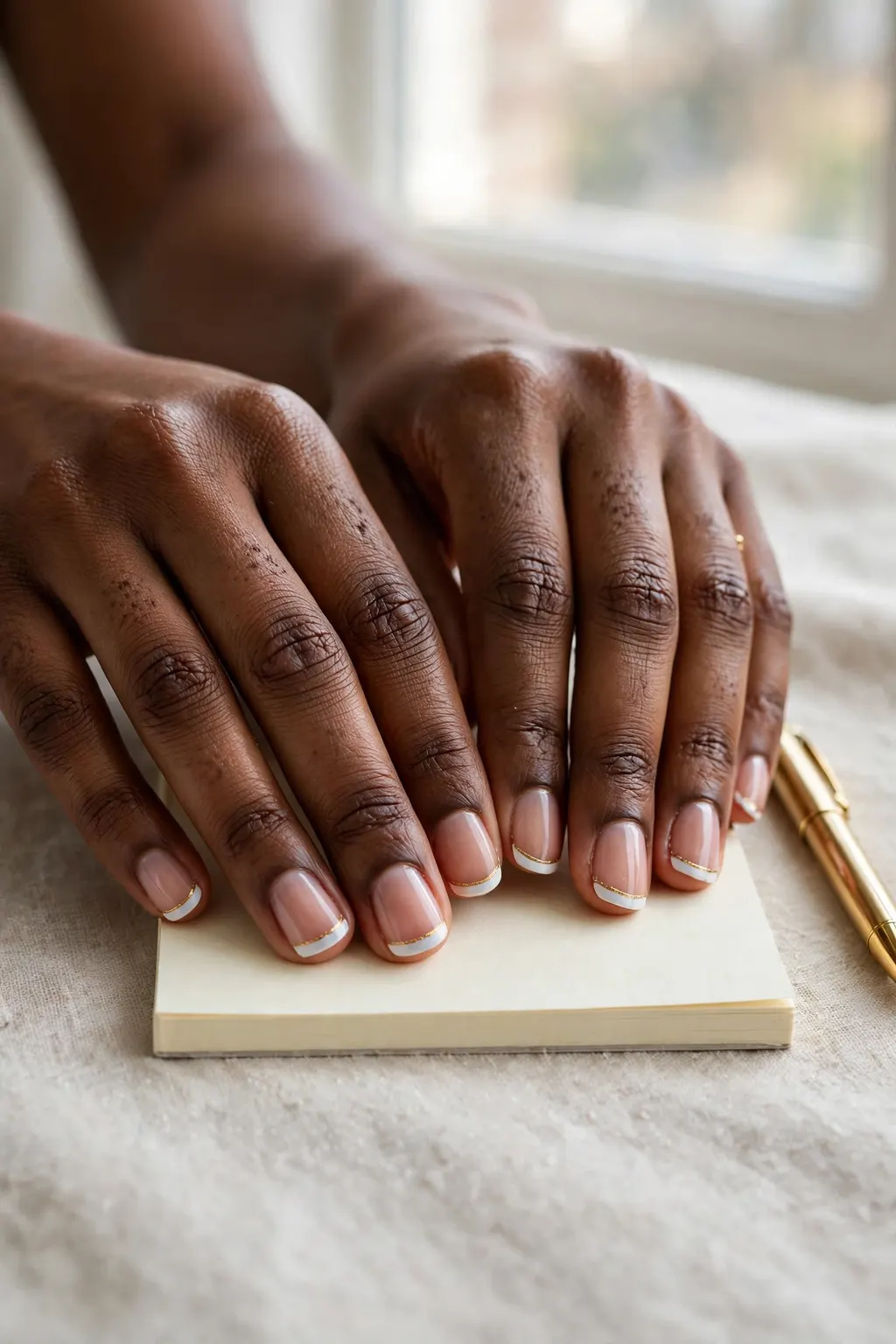
The salon brief for this set is different from a normal party brief, because the brief is not “make them festive” — it is “make them festive, make them desk-safe, and make them last two weeks and several parties.” That is three requirements, and the tech needs to hear all three, because a tech who hears only “festive” will build an evening set, and a tech who hears only “two weeks” will build a plain set, and neither is the set in this guide. The sentence to say is: “One set for two weeks of parties — Christmas French with a gold hairline, or a deep colour worn short, desk-safe in the day and festive at night, in gel so it lasts the fortnight.” Then add the two details that make it work: “Keep the tips thin and the glitter to the edge, and seal the foil with two coats of top coat” — because the thin tip is the desk safety, the edge glitter is the festive detail, and the double seal is what carries the set to day fourteen.
The second thing to ask is the schedule: “If I book this set on Saturday, will it still look neat for the party the following Friday?” — and the honest answer, for a gel set built as described, is yes, with the day-seven top coat applied at home. The third thing to ask is the removal plan: “How do I take this off without damaging the nail?” — because a two-week gel set removed badly is a damaged nail for January, and the removal is part of the service, not an afterthought. The tech who answers all three questions clearly is the tech to book with; the tech who waves the durability question away is the tech whose set will chip on day six.
📌 Save this brief before you book — one set, two weeks, several parties. Desk-safe by day, festive by night, gel so it lasts — and ask how it comes off, before it goes on.
Best for: nail shapes, lengths and skin tones
The salon brief works best when the reader brings a photograph — the French with the gold hairline, or the deep colour with the foil edge, saved from this guide or from a search — because a photograph is a brief the tech cannot misunderstand, and the words are the backup, not the brief itself. It works best on short to medium nails, because the brief’s desk-safety depends on the length, and a tech who is asked for a desk-safe set on long stiletto nails will rightly say the two do not go together. It works on every skin tone, with the base chosen for the skin as in the French section. And it works best when the reader books the appointment for the Saturday before the party week, not the day before the first party, because the set needs a day to settle — the top coat needs to cure fully, the foil needs to set, and the reader needs a day to live with the set before the first party judges it.
The exact wording to show your nail tech
Show the tech this sentence, written down: “One set, two weeks of parties. Christmas French — sheer nude base, thin white tips, hairline of gold at the smile line — or a deep colour (oxblood, emerald or midnight) worn short and glossy. Desk-safe at 3pm, festive at 8pm, gel, two coats of top coat, and please show me how the foil is sealed.” Then add the one question that prevents the most common error: “Will the gold hairline survive two weeks, or should we do the red accent tip on the ring finger instead?” — because the answer depends on the tech’s gold product, and a tech who is honest about their gold lasting ten days rather than fourteen is a tech worth trusting with the alternative. The wording matters because the set has three requirements and the tech needs to hear all three before the first coat goes on.
How long it lasts and what it costs
A gel desk-to-dinner set lasts the full two weeks, with the day-seven top coat applied at home; a regular-polish version lasts seven to ten days, and the reader who wants the full fortnight should book gel, not polish. The cost is a standard gel French or gel colour set, plus a small detail charge for the gold hairline or the foil accent — the bow, if painted, is usually included in the French price, and the 3D bow is the only element that adds a real charge, because it is a separate piece. No invented prices are quoted here, because prices vary by salon: ask for the set price, the detail price and the removal price separately, before the appointment, so the total is known and the removal is booked, not improvised. The value is the fortnight: one appointment, several parties, and no second booking in the busiest fortnight of the year.
The Morning-After Reset: Making Party Nails Last
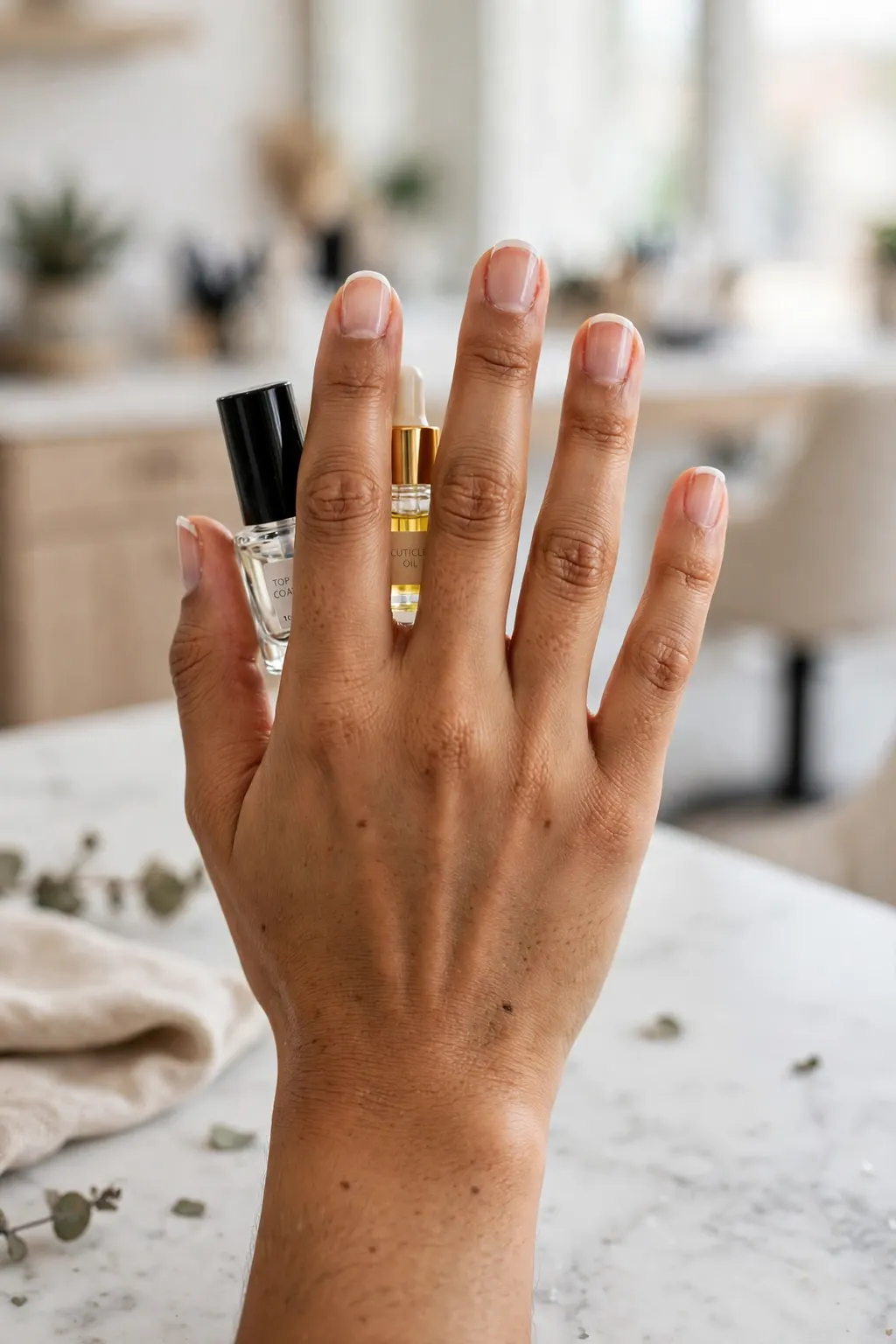
The morning after a party is when a manicure is decided — not at the appointment, but in the ten minutes after waking up, when the nails are checked in daylight and the damage, if any, is found. The reset is a small routine, and it is the routine that makes one set last two weeks of parties: check, seal, moisturise, and leave alone. Check the tips and the edges in daylight — the tip line, the foil edge, the bow — and look for the chip, the lift, the crack that the evening caused. Seal anything that has lifted with a single coat of clear top coat, applied thinly and left to dry fully, because a lifted foil edge sealed on the morning after will hold for another week, and a lifted foil edge left alone will peel by the next party. Moisturise the cuticles with oil, because the cuticle is the frame of the manicure, and a dry cuticle makes a neat set look neglected. And leave the set alone for the rest of the day — no picking, no filing, no re-painting a single nail, because the single re-painted nail never matches the set, and the picking is what turns a small chip into a peeled manicure.
The reset is also the moment to decide whether the set is still a party set or has become a plain set: if the gold hairline has worn off and the French underneath is still neat, the set is now a plain French, and it is still a good manicure — it has simply lost its festive detail, and the next party is the moment to add it back with a fine brush at home, or to accept the plain French for the remaining parties. The set does not fail when the decoration wears; it fails when the reader picks at it. The morning-after reset is ten minutes, once per party, and it is the cheapest maintenance in this guide — cheaper than a second appointment, cheaper than a repair, and the reason the one set lasts the fortnight.
📌 Save this reset — check, seal, moisturise, leave alone. Ten minutes the morning after, and the same set is ready for the next party.
Step by step
The morning-after reset, in order: wash the hands gently, with lukewarm water, and dry them fully — no hot water, because hot water softens the top coat and the gel underneath. Then check every nail in daylight, tip by tip, edge by edge, and note anything that has lifted or chipped. Then seal: one thin coat of clear top coat over the whole set, or over the single nail that needs it, and let it dry completely before doing anything else — do not touch the nails for ten minutes after the top coat, because a top coat touched while wet is a top coat ruined. Then cuticle oil, massaged into each cuticle, and hand cream. Then leave the nails alone for the rest of the day: no typing with the nails, no opening cans with the nails, no picking at the edge that lifted — the reset works because the top coat is given time to cure, and the cure is the protection.
Common mistakes to avoid
The first mistake is hot water on the morning after: a long hot shower softens gel and lifts foil, and the fix is lukewarm water and short showers for the fortnight. The second is picking at a lifted edge: a lifted foil edge picked at will take the top coat with it, and the fix is the seal — top coat over the lift, not a fingernail under it. The third is filing a chip: filing a chipped deep colour takes the colour with it and leaves a pale edge, and the fix is a drop of the same colour on the chip, sealed with top coat. The fourth is re-painting a single nail: a single re-painted nail never matches the set’s two-week wear, and the fix is to seal the chip and live with it, or to re-do the whole set — never one nail alone.
Products and tools that help
A clear top coat is the one product that matters for the reset — the same top coat the salon used, if possible, because matching top coats cure the same way. A cuticle oil is the second, because the cuticle is the frame and the oil is what keeps it neat. A bottle of the set’s colour, bought with the set, is the third, for the chip repair described above. And a pair of cotton gloves, worn for the first night after the appointment, is the quiet fourth product: the gloves protect the fresh top coat while it cures fully overnight, and the set that cures undisturbed for one night is the set that lasts the fortnight. The reset is ten minutes and four products, and the fortnight is the reward.
Frequently Asked Questions
What nails should I get for a work Christmas party?
A Christmas French tip with a gold hairline, a deep colour worn short, or a single painted bow on the ring fingers — any of the three passes the desk test and the evening test. The French is the safest choice, because it reads as a neat manicure at a metre and as Christmas up close; the deep colour is the boldest, because it reads as professional by day and party by night; the bow is the most festive, because it is the detail that says party without saying it loudly. Choose the one that matches your dress code and your comfort: if you are unsure, the French is the answer, and the gold hairline is the detail that makes it Christmas.
How do I make one manicure suit multiple holiday events?
Book one desk-to-dinner set in gel — a Christmas French, a deep colour, or a velvet finish — and let the outfit and the jewellery do the varying, not the nails. The set is chosen by the strictest party, the additions (a foil edge, a 3D bow) are added for a single black-tie night and removed the next morning, and the morning-after reset — check, seal, moisturise, leave alone — is run after every party. One appointment, two weeks, several parties: the set is the constant, and the parties are the variable.
Are bow nails appropriate for adults?
Yes — when the bow is small, painted, on one or two nails, and placed at the base of the nail where it reads as jewellery. A bow that is large, three-dimensional, on every nail, or placed in the centre of the nail reads as a costume, and that is the version that is not appropriate for an adult at work. The grown-up bow is a detail, not a theme: one small painted bow, deep red or gold, on the ring fingers, sealed with two coats of top coat. If the bow is the only festive detail in the set, it is enough — and if it is one of five festive details, it is too much.
Conclusion & Bottom Line
The work Christmas party asks a manicure to do two jobs, and the answer is not two manicures — it is one set, designed backwards from the evening and shrunk to pass the desk. Christmas French tips with a gold hairline, a grown-up painted bow, velvet and cat-eye finishes that wake up in evening light, gold foil and fine glitter as accents rather than coverage, deep oxblood, emerald and midnight for after dark, one set matched to the strictest dress code, and a ten-minute morning-after reset after every party. Book it once, on the Saturday before the party week, in gel, with the day-seven top coat at home — and the same ten nails will carry you from the desk at 3pm to the party at 8pm, and from the first party of the fortnight to the last, without a second appointment.
The bottom line: one set, two weeks, several parties — design it for 8pm, shrink it for the desk, and let the morning-after reset carry it through. For more Christmas and holiday nail ideas, start at AboutSuperstars.