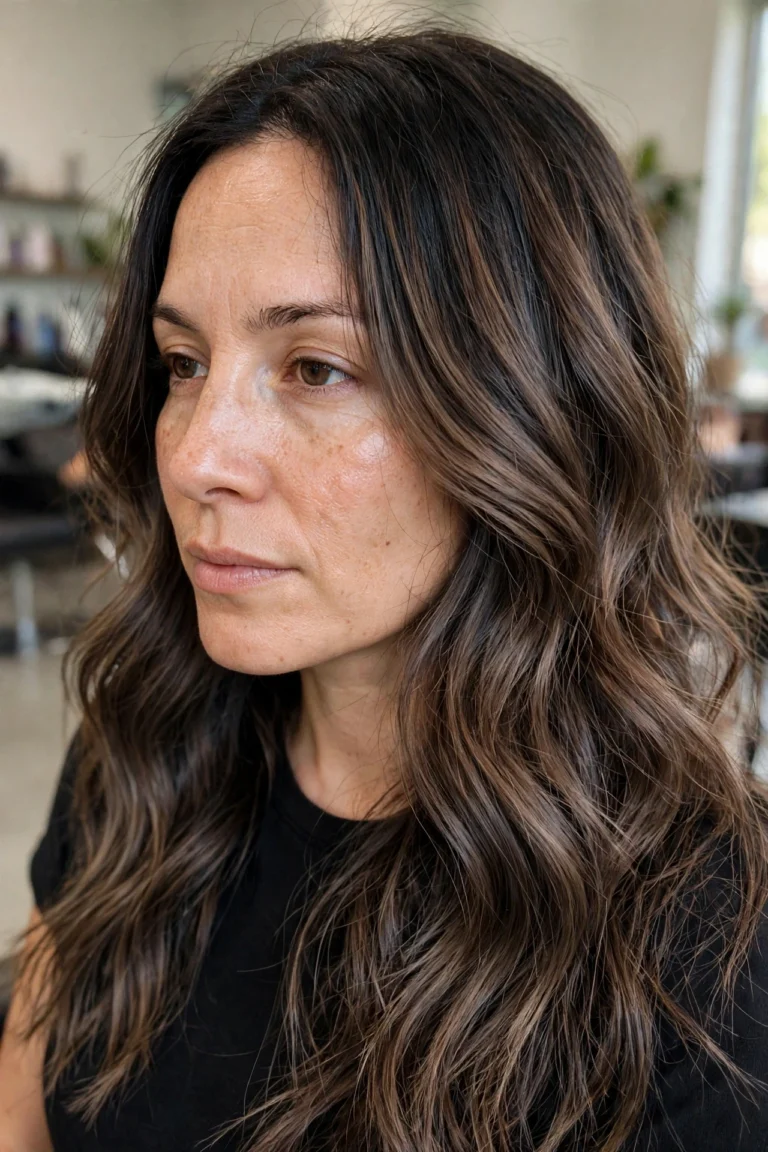
Dry Winter Scalp vs Dandruff: Routines, Scrubs and When Flakes Mean Something Else
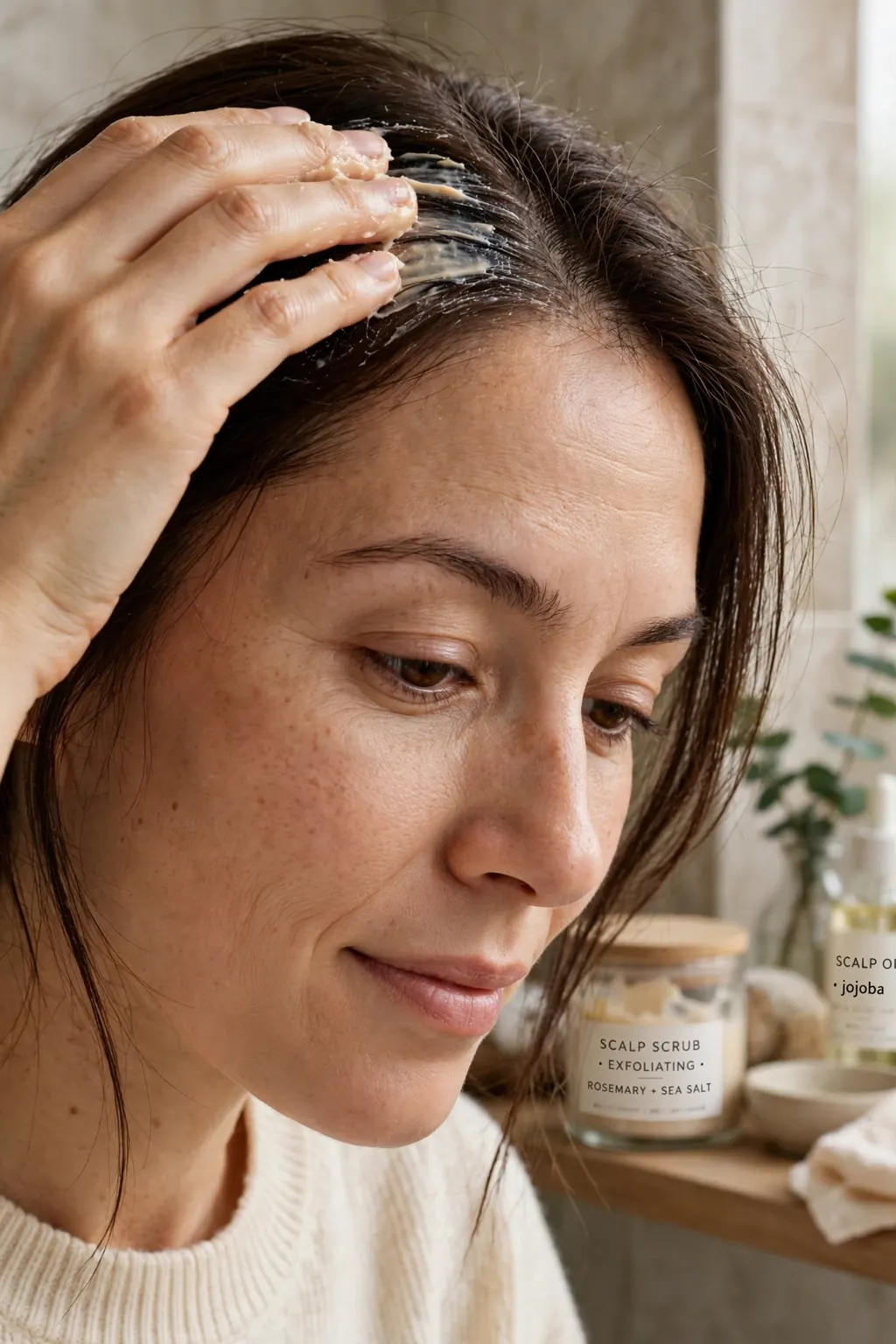
It starts the same way every winter. The air turns cold, the heating comes on, and a few weeks later there are white flakes on a dark jumper — and the first question is always the same one: is this dry scalp, or is it dandruff? The answer matters, because the two problems look alike and behave differently. Dry scalp is a moisture problem: the skin on the scalp is dry, tight and flaky, the same way the skin on your hands gets dry in winter, and it usually improves when you add moisture and stop stripping the scalp. Dandruff is a different problem: the scalp sheds faster than usual, the flakes are usually larger and oilier, and it usually needs a targeted shampoo rather than just more moisture. Treat one like the other and you waste weeks — moisturising dandruff does not calm it, and scrubbing a dry scalp raw does not moisturise it. This guide starts with how to tell them apart, then gives you the winter routine that fixes the dry-scalp side, the scrub comparison, the pre-wash oils, the shower fixes, the build-up check nobody mentions, and the red flags that mean it is time to ask a pharmacist or a doctor instead of trying another product.
Quick answer: Dry scalp flakes are usually small, dry and powdery, and the scalp feels tight and itchy — they improve with gentler washing, lukewarm water and moisture. Dandruff flakes are usually larger, yellowish and oily or sticky, often with redness, and they usually need an anti-dandruff shampoo used as directed. The winter routine is: cleanse gently, exfoliate once a week with the right scrub, soothe with a light serum or oil before washing, wash less often in lukewarm water, and check for product build-up before blaming the weather. If flakes come with spreading redness, soreness, broken skin, patches of hair loss or no improvement after a few weeks of the right care, see a pharmacist or doctor — this guide explains what to look for, it does not diagnose.
Reading Your Flakes: Powdery and Tight vs Oily and Sticky

The single most useful test is also the simplest: look at the flakes and feel the scalp. Dry-scalp flakes are small, white and powdery, like dust — they fall easily, they brush out of the hair, and they land on your shoulders without sticking. The scalp underneath usually feels tight, especially after washing, and it can itch in the dry, scratchy way that dry skin itches anywhere else on the body. Dandruff flakes are different in three ways at once: they are larger, they look slightly yellow or off-white rather than clean white, and they are oily or sticky, so they cling to the hair and the scalp instead of falling away. The scalp underneath often looks a little red or irritated, and the itch is usually stronger and more persistent. One more difference is where the flakes show up: dry scalp flakes tend to appear all over the scalp and often on the rest of the skin too — dry hands, dry shins, the same winter — while dandruff tends to concentrate where the scalp is oiliest, around the crown, the hairline and behind the ears.
Winter makes the confusion worse, because winter causes both problems at the same time. Cold air outside and heated air inside dry the scalp out, which pushes it towards dry-scalp flaking; at the same time, most people wash less often in winter and wear hats more, which lets oil and product build up, which pushes it towards dandruff. That is why the same person can have a powdery, tight scalp in December and an oily, sticky one in January, and why the right question is not “which one do I have forever” but “which one is this, right now”. Answer that by looking at the flakes today, not by remembering what the scalp did last year. If the flakes are small, dry and powdery and the scalp feels tight, start with the dry-scalp routine in the next section. If they are larger, yellowish and sticky, or the scalp looks red and sore, skip straight to an anti-dandruff shampoo used exactly as its label says, and read the red-flags section before buying anything else. And if you genuinely cannot tell — the flakes are somewhere in between, or the scalp is both tight and oily — treat it gently first: a mild shampoo, lukewarm water, one gentle scrub a week, and no new strong products all at once. Gentle care helps both problems a little, and it harms neither, which is the safe starting point while you watch what changes over two weeks.
Best for: hair types and face shapes
The flake-reading test works on every hair type, but what you see depends on the hair. On straight, fine hair the flakes are the most visible, because there is nothing to hide them — they sit on the strands and show up on dark clothing immediately. On wavy and curly hair the flakes are easier to miss, because they catch in the curl pattern and stay hidden until you part the hair or brush it out, which is why curly hair needs the part-and-look check: part the hair in a few places in good light and look at the scalp itself, not just the shoulders. On thick hair the scalp is harder to see at all, so the feel test matters more — tight and dry versus oily and irritated. On coily and very curly hair, flakes can be confused with product residue caught in the curls, so the distinguishing question is whether the scalp itself feels tight or sore, not just whether there is white stuff in the hair. Face shape does not change the test, but it changes where flakes land visibly: flakes on the hairline show most on a fringe or a centre part, and least on a deep side part where the hair covers the hairline. The test is the same for everyone — small and powdery versus larger and sticky — and the hair type only changes where you need to look.
The exact salon wording
Say: “My scalp has been flaking since the cold weather started, and I’m not sure whether it’s dry scalp or dandruff. The flakes look [small and powdery / larger and a bit yellow and sticky], and my scalp feels [tight and dry / itchy and a bit red]. Can you look at my scalp under good light and tell me which pattern you see, and whether I should be using a gentle moisturising routine or an anti-dandruff shampoo?” The two descriptions in brackets are the whole brief: they tell the stylist what you have already observed, and they ask for the one thing you cannot do yourself — a look at the scalp under salon light, parted in several places. A good stylist will also ask about your washing routine, your water temperature and what products you have been using, because the cause is often in the routine, not in the scalp itself. And if the stylist sees spreading redness, broken skin or patches, expect them to send you to a pharmacist or doctor rather than selling you a treatment — that is the right answer, and it is the same signpost this guide gives in the red-flags section.
Maintenance schedule
Reading your flakes is not a one-off test — it is a two-minute check, once a week, for the whole winter. Do it on wash day, before you wash: part the hair in three places — crown, side and nape — in good light, look at the flakes and feel the scalp, and note whether they are powdery or sticky, whether the scalp feels tight or irritated. Keep the routine steady for two weeks before changing anything, because a scalp needs about that long to show whether a change is working, and changing three products in one week tells you nothing about which one helped. Re-check after any change: if the flakes get smaller and drier, the moisturising routine is working; if they get larger and stickier, or the scalp gets redder, stop the new product and go back to the gentle baseline. In the deep-winter weeks, when the heating is on all day and the air is at its driest, check twice a week instead of once — the scalp changes faster when the air does. And keep one rule from this section for the whole season: never scratch flakes off with your nails. It breaks the skin, it makes the flaking worse, and it is the fastest route from a mild problem to a sore one.
📌 Save this before your next wash day — small, dry and powdery means dry scalp; larger, yellowish and sticky means dandruff. Two weeks on one routine before you judge it, and never scratch flakes off with your nails.
The Winter Scalp Routine: Cleanse, Exfoliate, Soothe
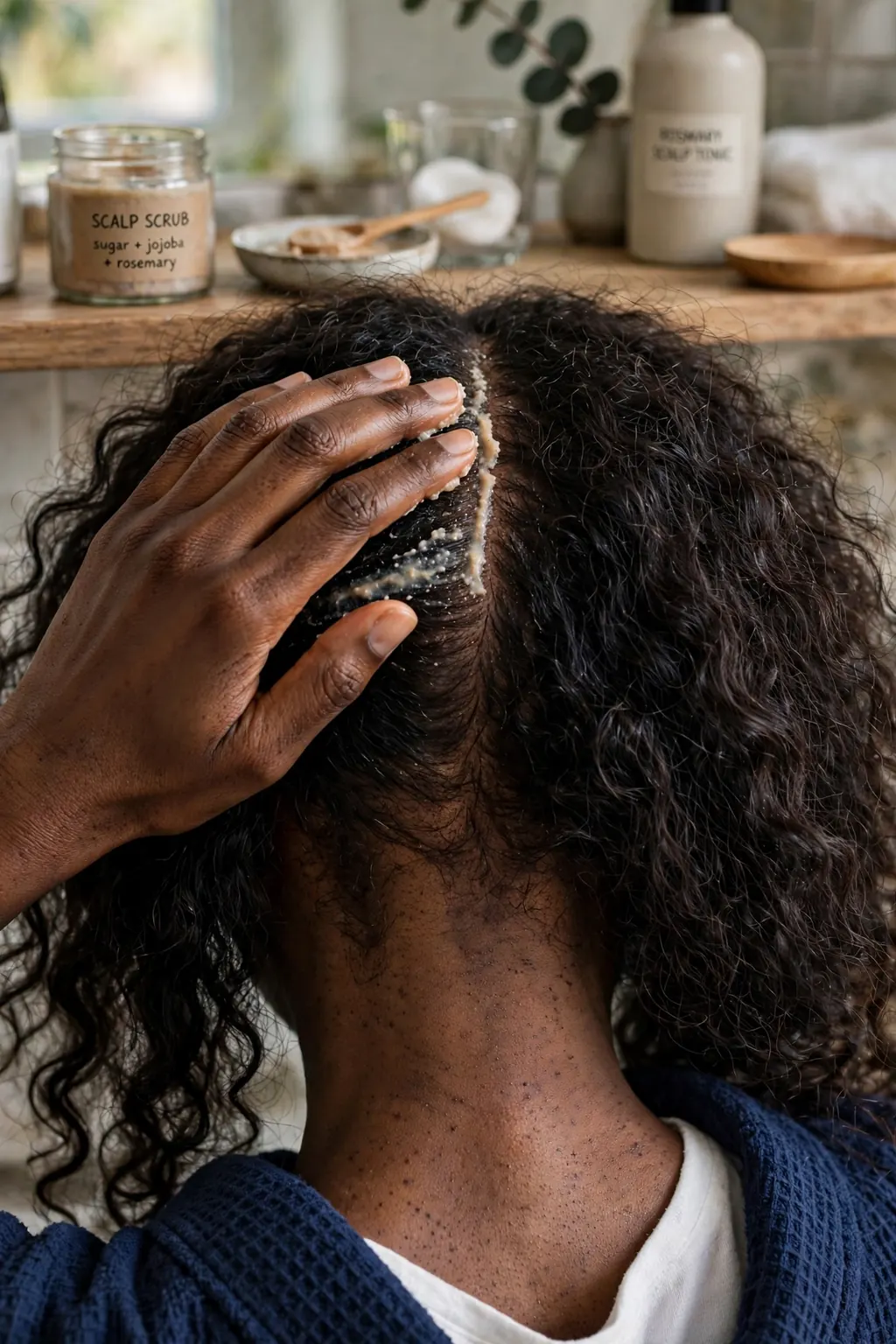
A winter scalp routine has three steps, in this order, and the order is the routine: cleanse, exfoliate, soothe. Cleanse means washing the scalp — not the lengths — with a mild shampoo, in lukewarm water, often enough to keep it clean and not so often that you strip it. For most people in winter that is two or three washes a week, not daily, and the shampoo should be massaged into the scalp with the fingertips, not the nails, for a full minute before rinsing. Exfoliate means a gentle scalp scrub once a week, which lifts the flakes and the build-up that shampoo alone leaves behind — the scrub comparison in the next section covers which kind to choose. Soothe means putting moisture back: a light scalp serum or a few drops of oil massaged into the scalp before washing, or a leave-in conditioner on the lengths after, so the scalp is not left bare and tight after the wash. Three steps, once or twice a week for the full routine, with the cleanse happening on every wash day and the scrub only on one of them. It is a short routine on purpose: a scalp that is flaking in winter is usually a scalp that is being over-treated, not under-treated, and the fix is a simpler routine done consistently, not a longer one done occasionally.
The mistake most people make is doing the three steps in the wrong order or all at once. Scrubbing before cleansing leaves the scrub residue on the scalp. Oiling after washing leaves the scalp greasy and the flakes stuck down instead of lifted. Scrubbing every day, because the flakes came back the next morning, strips the scalp raw and makes it flake more — the flakes that come back the day after a scrub are usually new flakes from irritation, not the old ones returning. The routine works when it is boring: the same mild shampoo, the same lukewarm water, the same once-a-week scrub, the same light serum, for two to three weeks, and then a judgement based on what the flakes look like, not on how the scalp feels on day two. If the routine is working, the flakes get smaller and fewer, the tight feeling after washing fades, and the itch settles. If it is not working — the flakes get bigger or stickier, or the scalp gets redder — the routine is not the problem to push harder; it is the signal to read the flakes again and, if the pattern now looks like dandruff, to switch to an anti-dandruff shampoo used as directed instead of adding more moisture.
What to ask your stylist: “I want a winter scalp routine I can do at home: cleanse, exfoliate once a week, soothe. Can you show me how much pressure to use when I massage the shampoo in, and how often I should be scrubbing for my hair type? I wash [two / three] times a week and my scalp feels [tight and dry / itchy and a bit oily] — is that the right frequency, or should I change it?” Bring the products you already use: a stylist who can see the shampoo and the scrub can tell you in thirty seconds whether either of them is too harsh for a flaking winter scalp, and that is a cheaper answer than buying a new shelf of products.
What it looks like in real life
In real life, the routine takes about ten minutes on a wash day and five minutes on a scrub day, and it looks unremarkable — which is the point. Wash day: lukewarm water, a coin-sized amount of mild shampoo massaged into the scalp with the fingertips for a minute, rinse, conditioner on the lengths only, rinse again with cooler water. Scrub day, once a week: before the wash, a small amount of scrub massaged into the damp scalp in slow circles for two minutes, then shampoo as normal, then a light serum or a few drops of oil on the scalp while it is still slightly damp. The scalp should feel clean and calm afterwards, not tight and not greasy — tight means the shampoo was too strong or the water was too hot, greasy means the oil or the serum was too much. On non-wash days, nothing: no dry shampoo on the scalp if it is already flaking, no extra product, no scratching. The routine is invisible to everyone else, and that is how you know it is working — the flakes stop showing up on your shoulders, the tight feeling stops arriving after every wash, and the scalp stops being something you think about all day.
Variations worth trying
If two or three washes a week leaves the scalp feeling dirty or the hair looking flat, try a co-wash — conditioner-only washing — on the middle day instead of adding a third shampoo: it cleans lightly without stripping, and it is the gentlest way to add a wash. The wider winter routine this sits inside — static control, dry ends and wash-day order — is in our winter hair care routine for dry, static-prone hair. If the scalp is very dry, try a pre-wash oil treatment once a week: warm a few drops of oil between your palms, massage it into the scalp, leave it for twenty minutes, then shampoo as normal — the oil protects the scalp from the shampoo instead of the shampoo stripping the scalp. If the hair is fine and oils weigh it down, skip the oil and use a scalp serum instead: serums are water-based, they absorb, and they do not leave the roots flat. If you swim or work out daily, rinse with lukewarm water on the non-shampoo days and shampoo only after the sweatiest sessions — sweat itself is not the enemy, but leaving it to dry on a flaking scalp is. And if the routine feels like too much to remember, write it on a card by the shower: cleanse, exfoliate once a week, soothe — three words, and the whole winter is covered.
When to skip it
Skip the scrub step — not the whole routine — if the scalp is broken, sore or bleeding anywhere, because scrubbing broken skin makes it worse and risks infection; go back to the gentle cleanse only, and see a pharmacist if it does not calm down in a few days. Skip the oil or serum step if the flakes are oily and sticky rather than dry and powdery, because adding oil to an oily, dandruff-pattern scalp feeds the problem instead of fixing it — in that case the anti-dandruff shampoo is the step to add, not the oil. Skip the whole routine’s new products, and keep only the gentle baseline, if you have just started a new medication or treatment that lists scalp changes as a side effect — tell your pharmacist or doctor about the flakes instead of treating them yourself. And skip any step that stings: a routine that stings is a routine that is irritating the scalp, and a stinging scalp flakes more, not less. Gentle, steady, two weeks before judging — and the skip rules above are the exceptions that keep a gentle routine safe.
Scalp Scrubs: Sugar, Salt and Chemical Options Compared
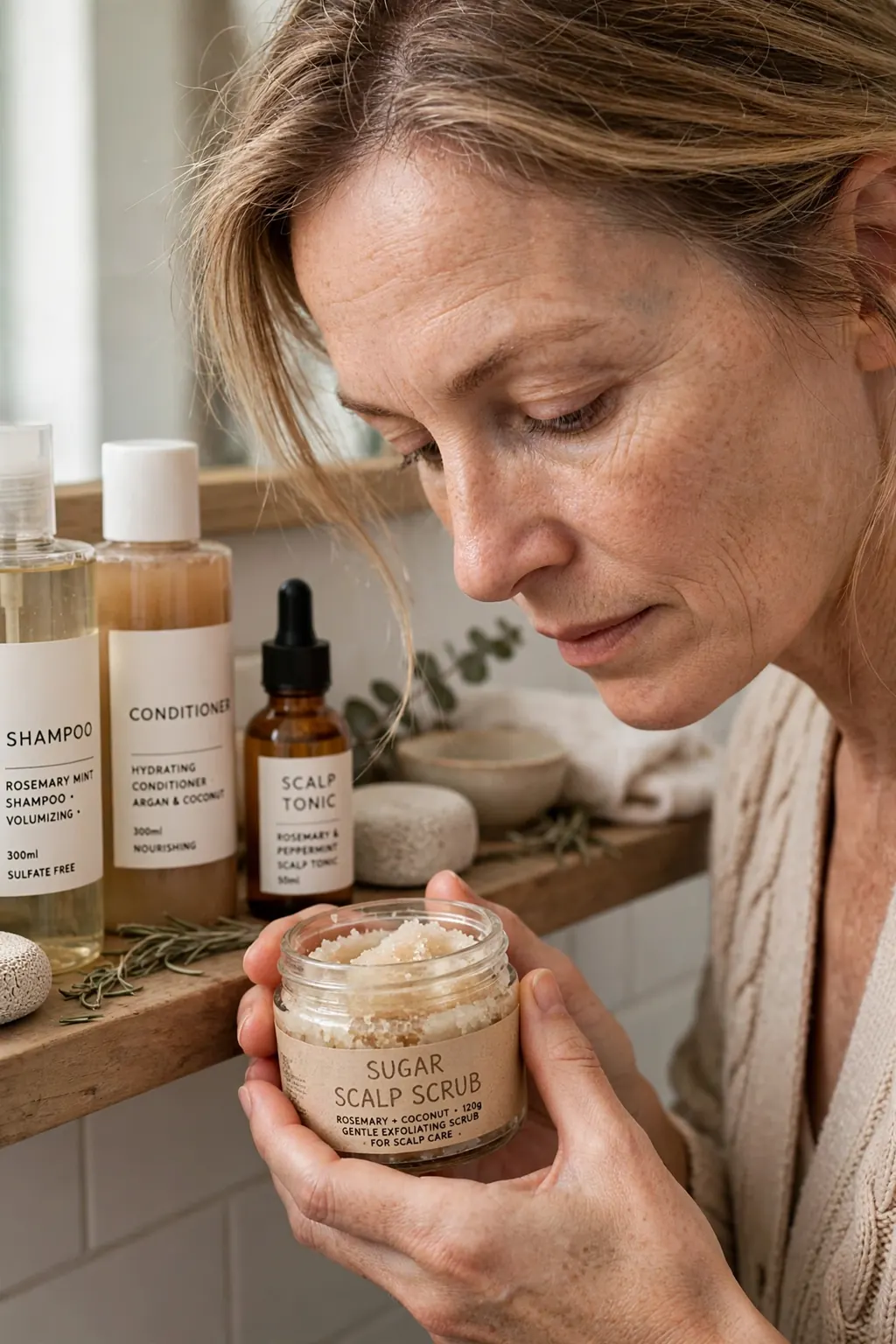
A scalp scrub does one job: it lifts the flakes and the build-up that shampoo leaves behind, so the shampoo can actually reach the scalp. There are three kinds, and they work differently enough that the choice matters. Sugar scrubs are physical exfoliants with fine, rounded grains that dissolve as you massage: they are the gentlest of the three, they suit a dry, tight scalp best, and they are the safest place to start if you have never scrubbed your scalp before. Salt scrubs are also physical, but the grains are sharper and they do not dissolve as fast: they exfoliate more strongly, they suit an oily scalp with build-up, and they should never be used on a scalp that is broken, sore or very sensitive — salt on broken skin stings, and stinging means stop. Chemical scrubs have no grains at all: they use gentle acids, usually salicylic acid or a fruit acid, to dissolve the bonds holding dead skin and flakes to the scalp, and they suit the person who finds physical scrubs too rough or too messy — but they need to be left on for the time the label says, and they should not be combined with other strong treatments on the same day.
The practical comparison is this. Sugar: gentlest, best for dry scalp, use once a week, massage for two minutes, rinse well. Salt: strongest physical option, best for oily build-up, use once a week at most and never on broken skin, massage lightly — the grains do the work, not the pressure. Chemical: no scrubbing needed, best for sensitive scalps that hate grains, use once a week exactly as the label says, and do not layer it with a physical scrub the same week until you know how your scalp reacts to each one alone. One more difference is the mess: sugar and salt scrubs need a good rinse, because grains left in the hair look exactly like the flakes you were trying to remove, which defeats the purpose. Whichever you choose, use it once a week, not more — a scalp scrubbed twice a week is a scalp being stripped, and a stripped scalp flakes more, not less. And buy one scrub, not three: try one kind for three weeks, judge it on the flakes, and only then consider switching.
Who it suits best
Sugar scrubs suit the dry, tight scalp best — the reader this article is mostly written for — and they suit fine hair too, because the fine grains rinse out easily and do not weigh the roots down. They suit curly and coily hair as well, because the grains dissolve and do not get trapped in the curl pattern the way a coarse scrub can. Salt scrubs suit the oily scalp with visible build-up: the person whose flakes are sticky, whose roots go flat a day after washing, and whose scalp feels coated rather than tight. They suit thick hair best, because the scalp is harder to reach and the stronger exfoliation is useful — but they do not suit fine hair, because the grains can be hard to rinse out of fine strands. Chemical scrubs suit the sensitive scalp that reacts to everything: the person who has tried physical scrubs and found them too rough, or whose scalp is easily irritated by fragrance and grains. They suit all hair types, because there is nothing to rinse out of the hair itself. The rule for all three is the same: the scrub that suits you is the one your scalp feels calm after, not the one that feels strongest while you use it.
How to ask for it (or do it at home)
At home, the method is the same for sugar and salt: wet the hair, part it in sections, apply a small amount of scrub directly to the scalp — not to the lengths — and massage in slow circles with the fingertips for about two minutes, then shampoo as normal and rinse thoroughly. Do not use your nails, do not press hard, and do not scrub the same spot twice — the grains and the time do the work, not the force. For a chemical scrub, the method is different: apply it to the scalp as the label says, leave it for the stated time, then shampoo and rinse — do not massage it like a physical scrub, because there is nothing to massage, and do not leave it on longer than the label says in the hope of a stronger result. At the salon, the ask is: “Can you recommend a scalp scrub for a [dry and tight / oily and built-up] scalp, and show me how much to use? I wash [two / three] times a week and I want to exfoliate once a week at home.” If the stylist suggests a scrub that stings, feels gritty in a painful way, or is meant for daily use, that is the wrong scrub — a scalp scrub is a weekly product, and a good one feels like a gentle massage, not a punishment.
Styling and upkeep
A scrub does not change how you style your hair, but it changes what the hair looks like once it is styled: with the flakes and build-up lifted, the roots sit cleaner, the part looks cleaner, and the hair holds its shape better because it is not weighed down by residue. Upkeep is the weekly rhythm: scrub once a week, on the same wash day each week, so it becomes a habit rather than a rescue — the same day, the same amount, the same two minutes. Between scrubs, do nothing extra to the scalp: no dry shampoo on the scalp if it is flaking, no extra oils, no scratching. If the scrub leaves grains in the hair, rinse longer next time and use less product — the amount is a teaspoon-sized dollop per section, not a handful. And replace the scrub when it changes: a sugar scrub that has gone hard or a salt scrub that has clumped will not spread evenly, and uneven spreading means some parts of the scalp get scrubbed raw while others get nothing. One scrub, once a week, two minutes, rinse well — and the scalp does the rest.
📌 Save this before you buy a scrub — sugar is gentlest and best for dry scalps, salt is strongest and never on broken skin, chemical has no grains and suits sensitive scalps. One kind, once a week, three weeks before you judge it.
Oils and Serums: Pre-Wash Treatments That Help
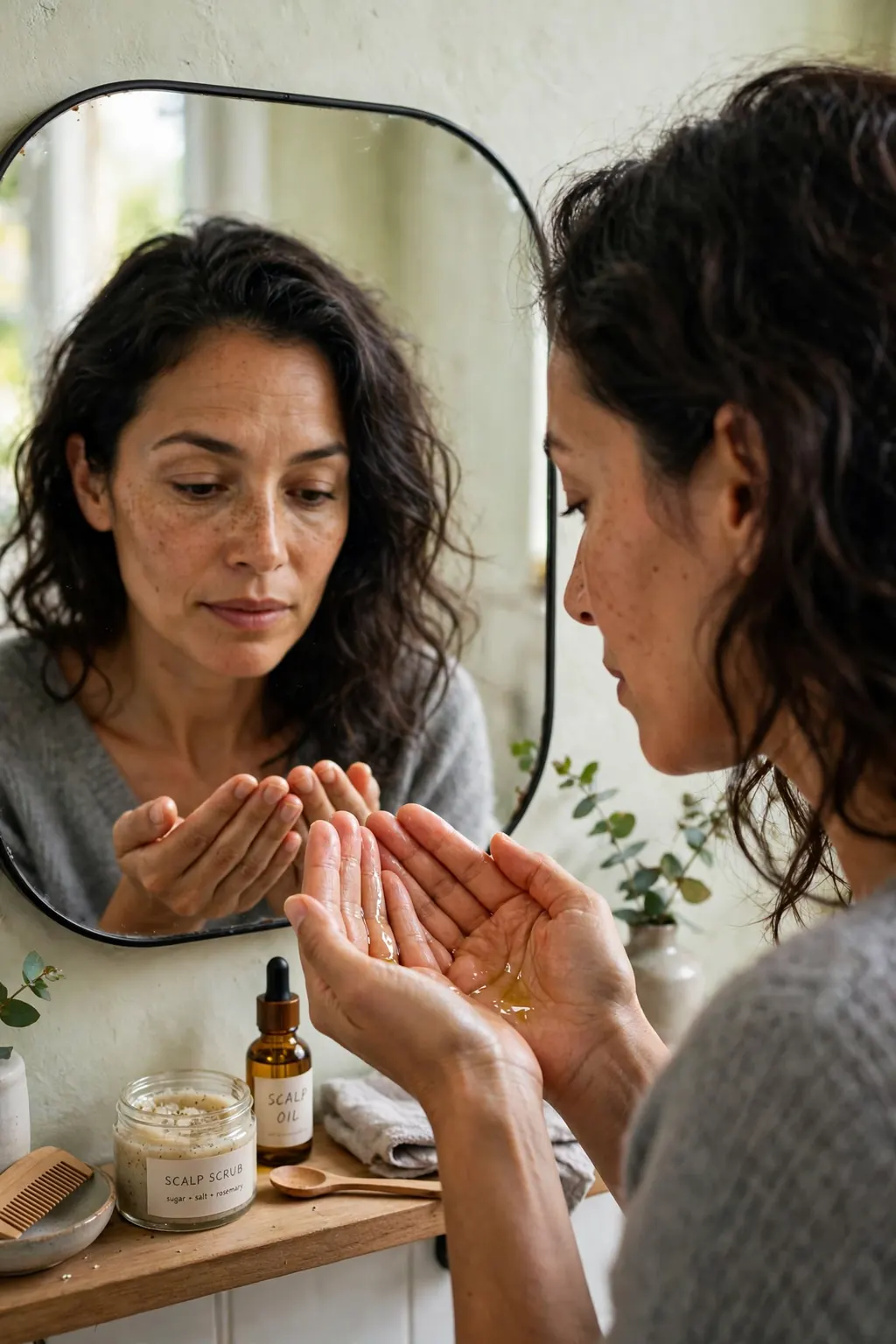
Pre-wash treatments are the “soothe” step done before the wash instead of after it, and for a dry winter scalp they are often the most noticeable change in the whole routine. The idea is simple: the scalp is dry, the shampoo is going to strip it further, so you put a thin layer of moisture on first and let the shampoo wash the excess away instead of washing the scalp bare. A few drops of a light oil — jojoba, argan or a dedicated scalp oil — warmed between the palms and massaged into the scalp twenty minutes before washing, does exactly that: it softens the flakes so they lift off easily, it protects the scalp from the shampoo, and it leaves the scalp feeling calm instead of tight after the rinse. A scalp serum does the same job in a lighter form: serums are usually water-based, they absorb rather than sit on the surface, and they suit fine hair and oily-leaning scalps that cannot take oil without going flat. The choice between oil and serum is a hair-type choice, not a quality choice — oil for dry, thick or curly hair that drinks moisture, serum for fine hair or any scalp that goes greasy easily.
The technique matters more than the product. Warm the oil between your palms first — cold oil sits on the scalp, warm oil spreads. Part the hair in sections and apply to the scalp, not the lengths; the lengths get conditioner after the wash, they do not need the pre-wash oil. Massage with the fingertips in slow circles for two or three minutes, which also lifts loose flakes and brings blood to the scalp, and then leave it for fifteen to twenty minutes — long enough to soften, not so long that it soaks in and becomes hard to wash out. Then shampoo as normal, and shampoo twice if the first wash does not remove the oil: a second, lighter shampoo is better than leaving oil residue on the scalp, because residue traps flakes and looks exactly like the problem you were treating. Use the treatment once a week, on the same day as the scrub or on a different wash day — not both on the same day at first, until you know how your scalp reacts to each one alone. And keep the amount small: five to eight drops for the whole scalp is enough, and more oil does not mean more moisture — it means a greasier wash and a flatter root.
The technique, step by step
Step one is the parting: dry hair, parted in four or five sections, so the oil reaches the scalp instead of sitting on the top layer of hair. Step two is the warming: five to eight drops of oil, or a pea-sized amount of serum, warmed between the palms until it feels barely warm. Step three is the application: fingertips to the scalp, section by section, massaging in slow circles for two to three minutes total — fingertips, never nails, and no pressing hard enough to hurt. Step four is the wait: fifteen to twenty minutes, with the hair loosely clipped up, not tied tight. Step five is the wash: shampoo as normal, rinse, and shampoo a second time lightly if the hair still feels oily at the roots. Step six is the check: after the hair is dry, look at the scalp in the partings — it should look calm and the flakes should be fewer and smaller, not gone entirely on the first try. If the scalp feels tight after the wash, the shampoo was too strong or the water was too hot, not the oil too little; if the roots look flat and greasy, the oil amount was too much, and halving it next time is the fix.
Common mistakes to avoid
The most common mistake is using too much oil, because the logic feels right — a dry scalp must need a lot of oil — and the result is roots that go flat within hours and a scalp that looks oily, which is then mistaken for dandruff. The second is leaving the oil on overnight: it does not moisturise more, it just migrates onto the pillow and leaves a residue that is hard to wash out, and on a flaking scalp an overnight oil treatment can trap flakes against the skin. The third is putting the oil on the lengths instead of the scalp: the lengths do not need it, the scalp does, and oil on the lengths just weighs the hair down. The fourth is using a heavy oil — castor oil or coconut oil straight — on fine hair, where it sits on the surface and never absorbs; a light oil or a serum is the right choice for fine hair, and the heavy oils belong on thick, curly or coily hair that can absorb them. And the fifth is combining the oil with the scrub on the same day, the first time: if the scalp reacts, you will not know which step caused it. One new step at a time, two weeks each, is the pace that actually tells you what works.
Products and tools that help
You need very little, and the list is deliberately short. A light scalp oil — jojoba or argan, or a dedicated scalp oil with a dropper so you can measure five to eight drops — is the first option. A water-based scalp serum is the second, for fine hair or anyone who hates the feeling of oil. A wide-tooth comb is the third, for parting the hair into sections before you apply, so the product reaches the scalp. A soft, clean towel or a shower cap is the fourth, for the fifteen-minute wait, to keep the oil off your clothes. Everything else is optional: a scalp massager with soft silicone bristles can replace the fingertips if you find the massage tiring, but it is a convenience, not a necessity, and a hard-bristled brush is never a substitute — it scratches the scalp and makes flaking worse. Buy one oil or one serum, not both, and use it once a week for three weeks before deciding whether it helps.
Shower Temperature and Wash Frequency Fixes
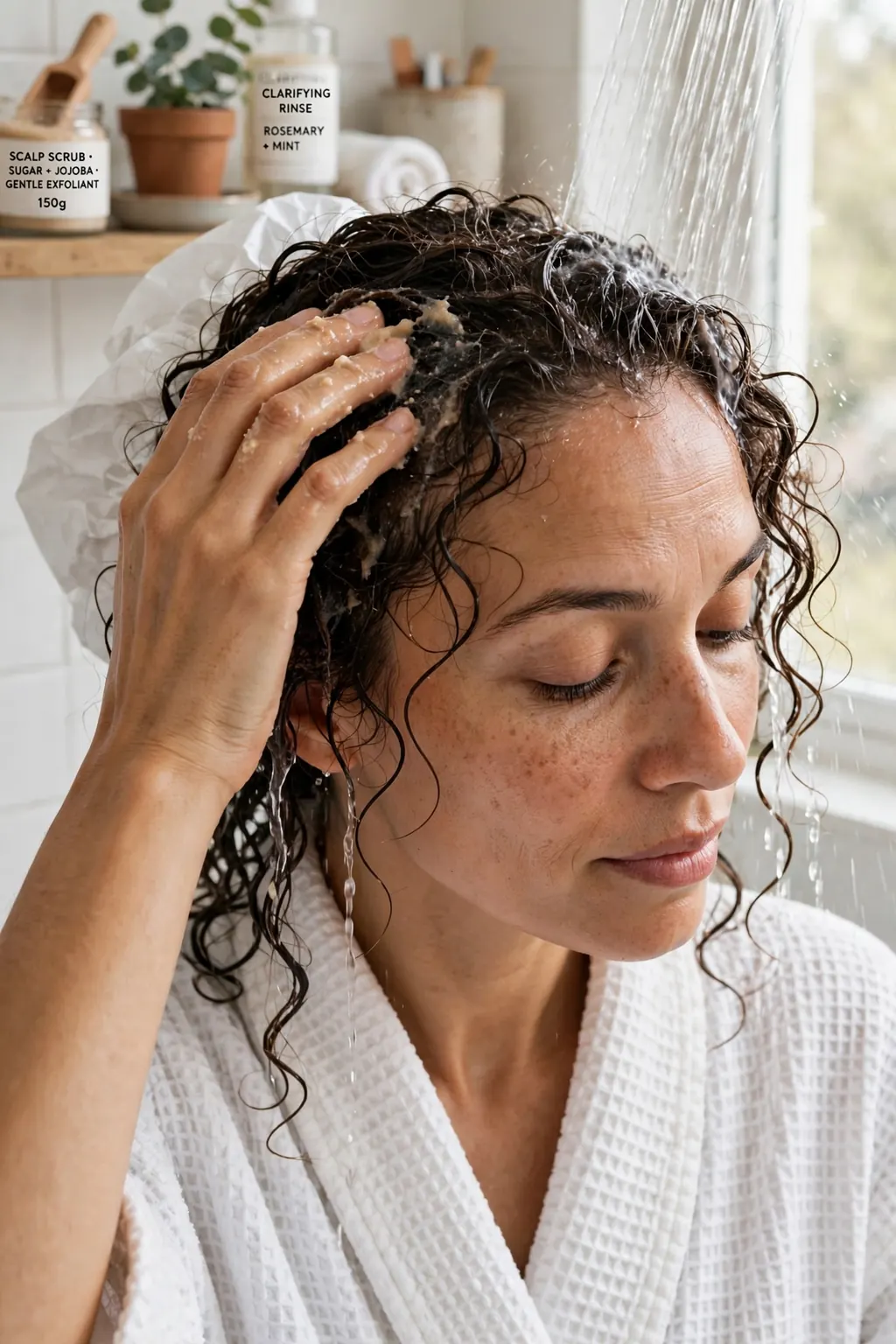
The shower is where a winter scalp is won or lost, and the two decisions that matter are the water temperature and how often you wash. Hot water feels good on a cold morning and it is the worst thing you can do to a flaking scalp: it strips the natural oils from the skin, it leaves the scalp tight and dry, and it makes the itch worse within minutes of getting out. Lukewarm water — comfortable, not hot, the temperature you would wash your face with — cleans just as well and leaves the scalp calm. The test is the skin on the inside of your wrist: if the water feels hot there, it is too hot for the scalp. A final rinse with cooler water is a useful extra: it closes the cuticle on the hair, it calms the scalp after the wash, and it costs nothing. The temperature change alone, with no new product at all, is often enough to reduce the tight feeling after washing within a week — which is why it is the first fix to try, before buying anything.
Wash frequency is the second decision, and the right answer is less often than you think, but not so rarely that the scalp gets dirty. For most people in winter, two or three washes a week is the range: daily washing strips the scalp and makes dry flaking worse, while going a full week without washing lets oil, sweat and product build up, which pushes the scalp towards the oily, sticky pattern. The exact number depends on the hair: fine, straight hair gets oily faster and may need three washes; thick, curly or coily hair holds moisture longer and may need only two, or one wash plus a co-wash in between. The signal to watch is the scalp, not the calendar: if the scalp feels tight and itchy the day after washing, you are washing too often or the water is too hot; if the scalp feels coated and the roots go flat, you are washing too rarely or the shampoo is too mild for the build-up. Change one thing at a time — temperature first, then frequency — and give each change two weeks before judging it, because a scalp takes that long to settle into a new rhythm.
Best for: hair types and face shapes
Lukewarm water suits every hair type and every scalp, without exception — there is no hair type that benefits from hot water on the scalp. Wash frequency is where the hair type matters. Fine, straight hair usually needs three washes a week in winter, because the oil travels down the straight shaft quickly and the roots go flat; the fix for fine hair is a mild shampoo used more often, not a strong shampoo used rarely. Wavy hair usually needs two or three washes, depending on how much product is used — the wave pattern hides oil better than straight hair, so it can go a day longer. Curly and coily hair usually needs one or two washes a week plus a co-wash, because the curl pattern slows the oil’s journey down the shaft and the hair itself is drier; overwashing curly hair is the fastest route to a tight, flaking scalp. Face shape does not change the shower, but it changes what you notice: a fringe shows a greasy root line faster than a swept-back style, and a centre part shows flakes at the parting sooner than a deep side part. The shower rules are the same for everyone — lukewarm, two to three washes, cooler final rinse — and the hair type only sets where you sit inside that range.
The exact salon wording
Say: “My scalp has been flaking since winter started and it feels tight after I wash. I currently wash [every day / every other day / twice a week] with [hot / warm] water. Should I be washing less often, and is my water too hot? Can you show me how the shampoo should be massaged in, and how long I should leave the conditioner on the lengths?” The washing frequency and the water temperature are the two facts the stylist needs, and the question about the massage is the useful extra: most people shampoo the lengths and barely touch the scalp, when the scalp is the part that needs the shampoo and the lengths are the part that needs the conditioner. A good stylist will also ask what shampoo you use, because a strong clarifying shampoo used daily is the most common cause of a tight winter scalp — and the fix, in that case, is a milder shampoo, not a new treatment. If the stylist suggests washing less often and the idea worries you because the roots go flat, ask about dry shampoo on the lengths only, never on the scalp, as the bridge between washes.
Maintenance schedule
The shower routine needs no schedule beyond the wash days themselves — two or three a week, lukewarm water, cooler final rinse, every time. The maintenance is in the noticing: once a week, on wash day, check whether the scalp still feels tight after washing. If it does, the water is still too hot or the shampoo is still too strong — change one of those before adding any new product. If the scalp feels calm after washing but tight by the next morning, the air is the problem, not the shower — indoor heating dries the scalp overnight, and the fix is the pre-wash oil or the serum from the previous section, not a hotter or more frequent wash. In the coldest weeks, when the heating runs all day, consider a humidifier in the bedroom: it is not a hair product, but it is the only fix that addresses the air itself, and a scalp that sleeps in humidified air flakes less the next morning. And keep one rule for the whole winter: never wash with hot water because the bathroom is cold. Warm the bathroom, not the water — the scalp will thank you for it.
Product Build-Up: The Third Cause Nobody Mentions

When flakes do not improve with a gentler routine and a weekly scrub, the cause is often not the scalp at all — it is what is sitting on top of it. Product build-up is the layer of dry shampoo, styling cream, hairspray, oil and serum that accumulates on the scalp and the roots over days of styling, especially in winter, when people wash less often and use more product to fight static and frizz. It looks like flakes, because the dried product breaks into white or greyish pieces that sit on the scalp and fall onto the shoulders; it feels like flakes, because the scalp under the layer itches; and it is routinely mistaken for dandruff, which is why people buy anti-dandruff shampoo for a problem that is actually a residue problem. The test is simple: the flakes of build-up sit on the hair and the scalp surface and brush away easily, the scalp underneath looks normal rather than red or irritated, and the flakes get worse as the days since the last wash increase — while true dandruff persists regardless of wash day. If that pattern matches, the fix is not a new treatment but a proper clean: one clarifying wash, used once, followed by a return to the gentle routine, and a change in how much product goes on the scalp.
The clarifying wash is the one time a strong shampoo is the right tool, and it should be used exactly once, not as a new daily shampoo. Wet the hair, apply a clarifying shampoo to the scalp, massage with the fingertips for a minute, rinse thoroughly, and follow with conditioner on the lengths only. The scalp should feel clean and light afterwards, not stripped — if it feels tight, the clarifying wash did its job and the gentle routine should resume immediately, because a second clarifying wash the next day would strip the scalp raw. After the reset, the prevention is in the habits: apply styling products to the lengths, not the scalp; use dry shampoo on the roots only on the days you truly need it, and brush it out properly rather than letting it accumulate; and wash the hair properly after a day of heavy styling, instead of adding another layer of product on top of yesterday’s. Build-up is a habit problem with a one-wash fix, and once the habit changes, it rarely comes back — which is why it is worth checking for build-up before concluding that the scalp itself is the problem.
What it looks like in real life
In real life, build-up looks like a scalp that is fine on wash day and flaky by day three, with white or greyish pieces that brush out easily and a scalp that itches more as the week goes on. The hair itself gives the game away: the roots look dull and coated rather than shiny, the hair feels heavy at the roots even when it was clean two days ago, and the parting looks greyish or whitish where the product has collected. After a clarifying wash, the change is immediate and obvious: the roots feel light again, the hair moves freely, the parting looks clean, and the “flakes” are gone — because they were product, not skin. The contrast is the diagnosis: if a single clarifying wash removes the flakes entirely, it was build-up; if the flakes come back within a day or two of a proper wash, it is the scalp, and the earlier sections are the ones to follow. In a busy winter week — hats, scarves, dry shampoo between washes, a little extra cream for the static — build-up can arrive in three or four days, which is why the check belongs in every winter routine, not just in the ones that are already struggling.
Variations worth trying
If a full clarifying shampoo feels too strong, try a diluted version: mix a small amount of clarifying shampoo with water in your palm and apply it to the scalp only, or use a gentle shampoo twice in one wash — the first wash lifts the surface product, the second cleans the scalp. If the build-up is mostly dry shampoo, try brushing the hair thoroughly with a clean brush before washing: dry shampoo is designed to be brushed out, and much of it leaves with the brush, which means the wash has less to do. If the build-up is mostly oil or serum, try a pre-wash rinse with lukewarm water alone, massaging the scalp with the fingertips for a minute before the shampoo goes on — the water loosens the oil and the shampoo removes it, instead of the shampoo fighting through a layer of oil. If you use a lot of styling product, try a “scalp-free” week: products on the lengths only, nothing on the roots or the scalp, and see whether the flakes fade on their own — if they do, the products were the cause, and the habit, not the scalp, is what needs changing. And if the build-up keeps returning every week, look at the dry shampoo first: it is the single biggest contributor, and using it less often, or switching to a lighter formula, is usually enough.
When to skip it
Skip the clarifying wash if the scalp is broken, sore or red anywhere, because a strong shampoo on broken skin stings and makes the problem worse — use the gentle routine only, and see a pharmacist if the soreness does not calm down. Skip it if the flakes are clearly the dry, powdery kind and the scalp feels tight, because a clarifying wash strips a dry scalp further and the flakes will get worse, not better — the gentle routine and the pre-wash oil are the fixes for that pattern, not a stronger wash. Skip it if you have already used a clarifying shampoo in the last two weeks: one reset is enough, and repeating it turns a reset into a stripping habit. And skip the idea of clarifying as a regular step entirely: a clarifying shampoo is a reset button, not a routine, and a scalp that needs resetting every week has a product habit to fix, not a scalp that needs stronger shampoo. One clarifying wash, then back to gentle — and if the flakes return within days of the reset, read the flakes again and check the red flags, because the cause is in the scalp, not on it.
Itch Without Flakes: Sensitivity and Heating Air
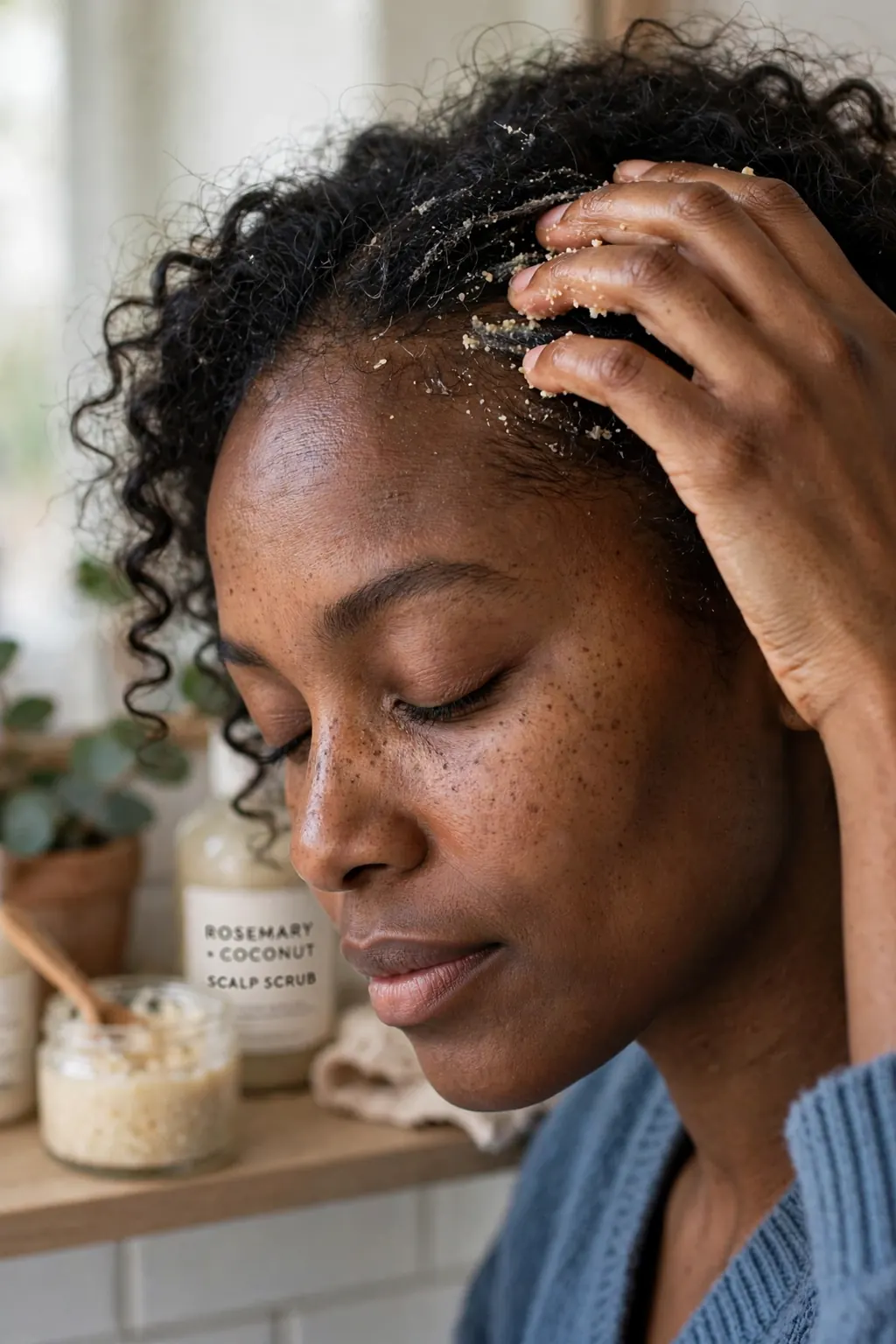
Not every winter scalp problem comes with flakes. Some scalps itch without flaking at all — a dry, prickly itch that arrives when the heating comes on, gets worse in the evening, and does not produce a single visible flake. The cause is usually sensitivity, not shedding: cold air outside and dry, heated air inside pull moisture out of the scalp’s surface, the skin barrier weakens, and the nerve endings in the scalp become more reactive, so normal things — a hat, a scarf, a change in temperature when you come indoors — register as an itch. It is the same mechanism as winter skin on the hands and shins, applied to the scalp, and it responds to the same fixes: moisture, gentleness, and less of everything that strips or irritates. The first step is to stop the things that make a sensitive scalp worse: hot water, strong shampoo, scratching, and new products introduced all at once. The second is to add the things that calm it: lukewarm water, a mild fragrance-free shampoo, a light serum or oil before washing, and a hat that is not too tight.
Heating air deserves its own mention, because it is the winter factor nobody blames. Central heating drops indoor humidity sharply, and the scalp spends all day — and all night — in that dry air. The signs that heating air is the culprit are the timing: the itch is worst in the evening after a day indoors, and worst in the morning after a night in a heated bedroom, and it improves on the days you spend more time outside or the heating is off. The fixes are environmental as well as cosmetic: a humidifier in the bedroom is the most effective single change, because it treats the air rather than the scalp; keeping the bedroom a degree or two cooler at night helps for the same reason; and a silk or satin pillowcase reduces the friction that turns a dry scalp into an itchy one overnight. None of these is a hair product, and all of them matter more than a new shampoo — because an itch caused by dry air will not be fixed by a product applied to the hair, however good the product is. If the itch persists despite gentle care and humidified air, or if it comes with redness, soreness or flaking that was not there before, the red-flags section is the next read, not another product.
Who it suits best
The sensitivity fixes suit everyone with a winter itch, but they matter most for the people whose scalps react to everything: the person who has tried three shampoos this winter and itched with all of them, the person whose scalp itches when a new product touches it, the person with eczema or sensitive skin elsewhere on the body. They suit fine hair particularly well, because fine hair needs the lightest products and the gentlest handling, and a heavy product on fine hair creates its own itch as it sits on the scalp. They suit curly and coily hair too, because the scalp under a curl pattern is harder to reach and easier to irritate with a product that is not rinsed out properly. They suit anyone who wears a hat daily, because a tight hat band is a constant low-level irritation on a sensitive scalp, and a looser hat or a silk liner under it removes that irritation without any product at all. And they suit the person whose itch has no flakes: if there is nothing to see, there is nothing to scrub, and the answer is gentleness and moisture, not exfoliation — scrubbing an itchy, flake-free scalp is the fastest way to turn an itch into a sore.
How to ask for it (or do it at home)
At home, the routine for an itchy, flake-free scalp is the gentle baseline and nothing else: lukewarm water, a mild fragrance-free shampoo massaged in with the fingertips, conditioner on the lengths only, and a light serum or a few drops of oil on the scalp before washing if the itch is dry. Change nothing else for two weeks — no new styling products, no dry shampoo on the scalp, no scrub — and watch whether the itch fades. If it does, add things back one at a time, a week apart, so you learn which one the scalp objected to. At the salon, the ask is: “My scalp itches in winter but it doesn’t flake, and it gets worse when the heating is on. Can you check whether the scalp looks dry or irritated, and tell me whether I should be using a fragrance-free shampoo? I don’t want a scrub or a treatment — I want to know what to stop using.” The words “what to stop using” are the point: for a sensitive scalp, the treatment is often subtraction, not addition, and a stylist who understands that will not sell you a shelf of products for a problem that a simpler routine would fix.
Styling and upkeep
Style an itchy scalp the way you would style a dry one: loosely, gently, and with as little product on the scalp as possible. Low, loose styles — a low braid, a low twist, hair worn down and free — put no tension on the scalp and no product near it. Tight ponytails and topknots pull on the scalp all day and make an itch worse, and they are the first style to drop when the scalp is sensitive. For the days between washes, when flakes are not the issue but the itch is, the styles that keep the hair contained without touching the scalp are the useful ones — and the 50 Powerful Hairstyles for Women guide covers the low, loose styles that hide a bad scalp day and keep their shape under winter layers. Upkeep is the gentle baseline, every wash, all winter: lukewarm water, mild shampoo, conditioner on the lengths, nothing new without a reason. And keep the hat rule: a hat that is too tight itches a sensitive scalp all day, a looser hat or a silk liner under it does not — the liner that fixed hat hair in Day 13 fixes the itch for the same reason, by stopping the friction at the source.
📌 Save this for the heating season — an itch with no flakes is usually sensitivity, not shedding. Lukewarm water, fragrance-free shampoo, humidified air at night — and no scrub on a scalp that has nothing to scrub off.
Red Flags: When to See a Pharmacist or Doctor

Most winter scalp flaking is a routine problem with a routine fix, and this guide has covered it. A few patterns are not routine, and they are the reason this section exists. See a pharmacist or doctor if the scalp is red and sore across a wide area, or the redness is spreading rather than settling; if the skin is broken, bleeding, weeping or crusted anywhere on the scalp; if there are thick, silvery or yellowish scales that do not lift with gentle care; if there are patches where hair is thinning or coming out; if the itch is severe enough to disturb sleep or daily life; or if the flakes have not improved at all after three to four weeks of the right care — gentle washing, the correct shampoo for the pattern you see, and no new irritants. A pharmacist is the right first step for most of these: they can look at the scalp, suggest an appropriate medicated shampoo, and tell you whether a doctor’s visit is needed. A doctor is the right step if the pharmacist suggests it, or if any of the patterns above are severe, spreading quickly, or come with pain, swelling or fever. This is general information, not a diagnosis — only a clinician who can see your scalp can say what is causing it, and this guide does not try to do that job.
There are also two situations that are not emergencies but still belong with a clinician rather than with a new product. The first is flakes that start at the same time as a new medication or treatment: some medicines list scalp changes among their effects, and the right response is to tell the pharmacist or the prescribing doctor, not to treat the scalp yourself. The second is a scalp problem in a child, or in someone whose immune system is weakened: the gentle routine in this guide is written for a healthy adult scalp, and a child’s scalp or an immunocompromised person’s scalp deserves a clinician’s judgement before any scrub, oil or medicated shampoo is used. In both cases the guide’s advice is the same — stop adding products, keep the gentle baseline, and ask. And one final rule for the whole winter: if a product stings, burns, or makes the scalp worse within a day or two, stop using it immediately, rinse the scalp with lukewarm water, and do not try to push through the reaction in the hope that it settles. A scalp that is getting worse on a product is telling you something, and the correct response is to listen, not to persist.
The technique, step by step
The technique for the red flags is not a hair technique — it is a decision routine, and it takes two minutes. Step one: look, in good light, parting the hair in three places, and note exactly what you see — redness, broken skin, thick scales, patches — in plain words, so you can describe it accurately. Step two: check the timeline — when did it start, what changed just before it started, and has it improved, stayed the same, or got worse over the last two weeks. Step three: stop the newest products first, keeping only the gentle baseline of lukewarm water and a mild shampoo, so the pharmacist or doctor sees the scalp as it is, not as the latest product made it. Step four: see a pharmacist first, describe what you saw and when it started, and ask whether an over-the-counter medicated shampoo is appropriate or whether a doctor’s visit is needed. Step five: follow what they say, and if they say to see a doctor, see a doctor — do not substitute a stronger product for the appointment. Five steps, and the scalp gets a professional judgement instead of another guess from a shelf.
Common mistakes to avoid
The most common mistake is treating a red-flag pattern with a stronger product instead of getting it looked at: a medicated shampoo bought without advice can mask the pattern, irritate the scalp further, or treat the wrong problem, and the weeks spent on it are weeks the real cause went unexamined. The second is scratching: a sore, broken scalp that is scratched gets infected more easily, and an infected scalp takes far longer to heal than a sore one. The third is covering the scalp with oils and heavy creams in the hope of “soothing” it: on broken or inflamed skin, heavy products trap moisture and bacteria against the skin and make it worse. The fourth is waiting too long — months of worsening flakes, spreading redness or hair loss — because the problem felt embarrassing or minor; scalp conditions are common, pharmacists see them every day, and the earlier they are looked at, the simpler the fix usually is. And the fifth is assuming that because a product worked for someone else, it will work for you: scalps differ, causes differ, and the product that fixed a friend’s dry scalp can irritate a scalp whose problem was never dryness in the first place.
Products and tools that help
For the red flags, the helpful “products” are not hair products at all: a good light and a mirror, so you can actually see the scalp you are describing; a short written note of when the problem started and what changed before it, so the pharmacist or doctor gets the timeline straight; and a gentle, fragrance-free shampoo to use while you wait for the appointment, so the scalp is clean without being irritated. If a pharmacist recommends a medicated shampoo, use it exactly as its label says — the stated contact time, the stated frequency, the stated duration — because medicated shampoos work by being left on the scalp for long enough, and rinsing them off immediately is the most common reason they appear not to work. Do not buy a medicated shampoo for someone else’s pattern, do not use a leftover medicated product from a previous problem, and do not combine two medicated products without a pharmacist’s advice. The shelf is not the clinician, and for the patterns in this section, the clinician is the product that matters.
Frequently Asked Questions
How can you tell dry scalp from dandruff?
Look at the flakes and feel the scalp. Dry scalp flakes are small, white and powdery, they fall away easily, and the scalp feels tight and dry — they usually improve with gentler washing, lukewarm water and moisture. Dandruff flakes are larger, slightly yellowish and oily or sticky, they cling to the hair and scalp, and the scalp often looks a little red and itches more persistently — they usually need an anti-dandruff shampoo used as directed. Winter complicates the picture, because cold air dries the scalp while hats and less frequent washing let oil and product build up, so check the flakes as they are today, not as they were last year. If you cannot tell, start gently — mild shampoo, lukewarm water, one gentle scrub a week — and watch what changes over two weeks before adding anything stronger.
How often should you use a scalp scrub?
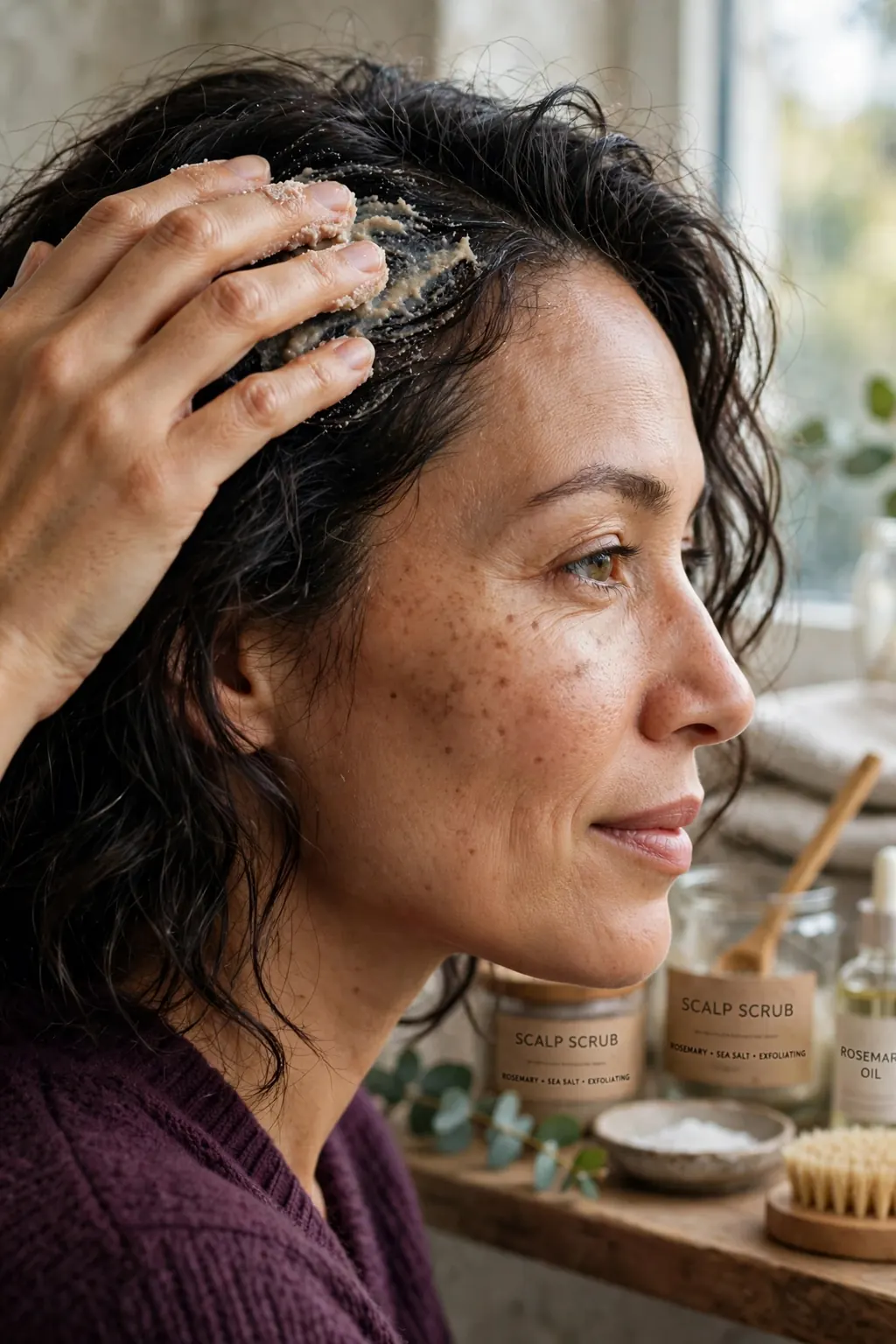
Once a week is enough for most scalps, and more often usually makes flaking worse rather than better. Use a sugar scrub for a dry, tight scalp, a salt scrub for an oily scalp with build-up (never on broken or sore skin), or a chemical scrub if your scalp dislikes grains — massage a physical scrub in with the fingertips for about two minutes, or leave a chemical scrub on for exactly the time its label states, then shampoo as normal and rinse thoroughly. Give one kind of scrub three weeks before judging it, and skip the scrub entirely if the scalp is broken, sore or bleeding. A scalp scrubbed twice a week is a scalp being stripped, and a stripped scalp flakes more, not less.
When should scalp flakes be checked by a doctor?
See a pharmacist first — and a doctor if they advise it — if the scalp is red and sore across a wide area or the redness is spreading, if the skin is broken, bleeding, weeping or crusted, if there are thick silvery or yellowish scales, patches of hair loss, or an itch severe enough to disturb sleep, or if the flakes have not improved after three to four weeks of the right care. Also seek advice if flakes start at the same time as a new medication, or if the scalp problem is in a child or someone with a weakened immune system. This guide is general information, not a diagnosis — only a clinician who can see your scalp can say what is causing it.
Conclusion: Dry Winter Scalp vs Dandruff — Your Next Step
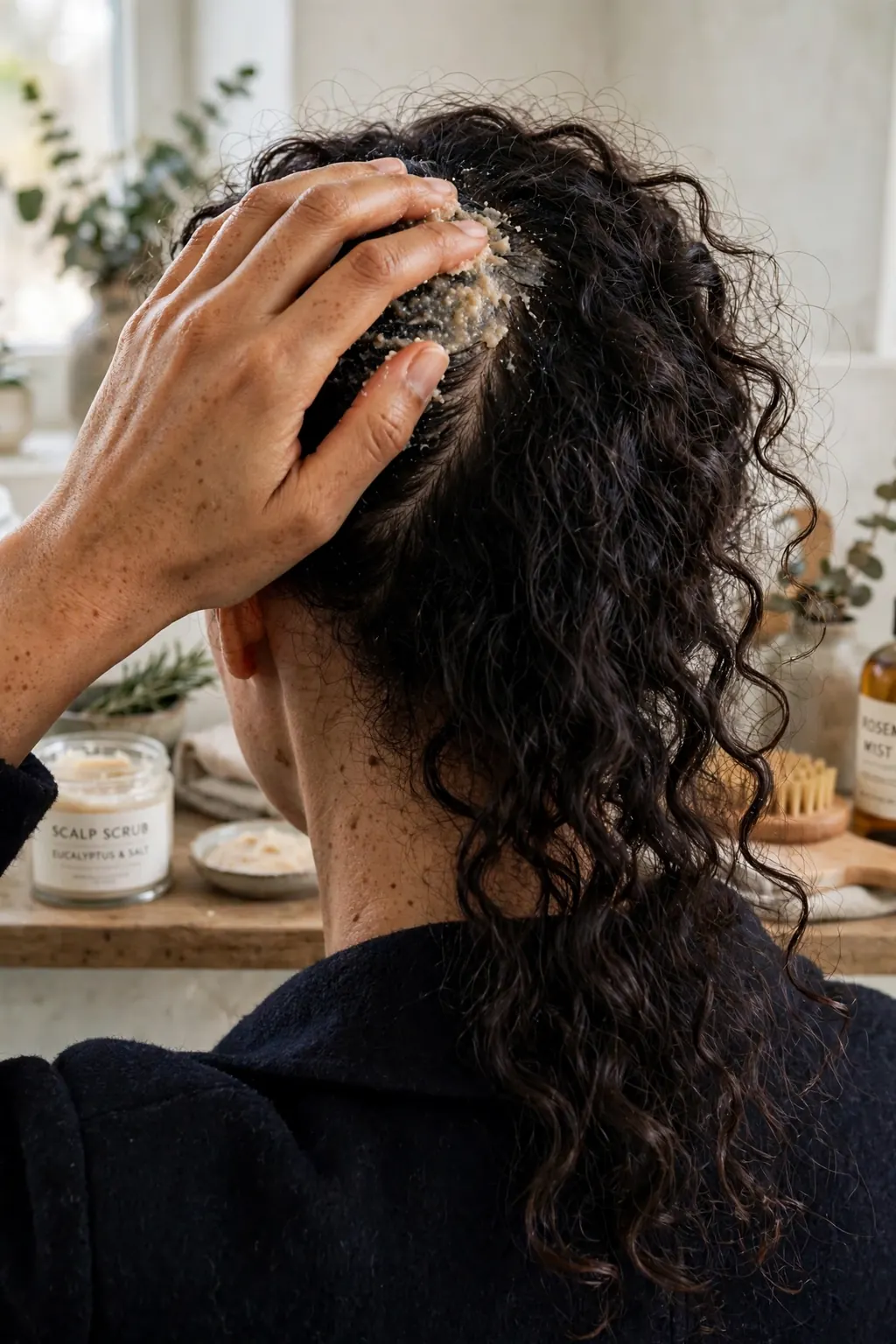
Winter flakes come down to one question and one routine. The question is which pattern you are looking at: small, dry and powdery means a dry scalp that wants moisture and gentleness; larger, yellowish and sticky means dandruff that wants a targeted shampoo used as directed. The routine is the same either way at the start — cleanse gently, exfoliate once a week with the right scrub, soothe with a light oil or serum before washing, lukewarm water, two or three washes a week — and the differences are in the details: sugar for dry, salt for oily build-up, chemical for sensitive, no scrub at all on broken skin. Around those choices, the checks do the work: read the flakes once a week, check for product build-up before blaming the weather, keep the shower lukewarm, and remember that heating air dries the scalp overnight just as surely as cold air dries it outside.
Start with the smallest step that helps most: look at your flakes in good light tonight, and change one thing — the water temperature. Lukewarm water costs nothing, it takes no new product, and it is the single change most likely to calm a tight winter scalp within a week. Then add the weekly scrub, then the pre-wash oil if the scalp still feels dry, and judge each change over two weeks, not two days. And if the pattern ever crosses into the red flags — spreading redness, broken skin, thick scales, hair loss, or no improvement after a few weeks of the right care — stop adding products and ask a pharmacist. That is the whole guide: read the flakes, run the routine, and know when the answer is a professional, not a product.
📌 Save this before winter sets in — powdery means dry, sticky means dandruff. Lukewarm water, one scrub a week, soothe before you wash — and a pharmacist, not another product, for the red flags.