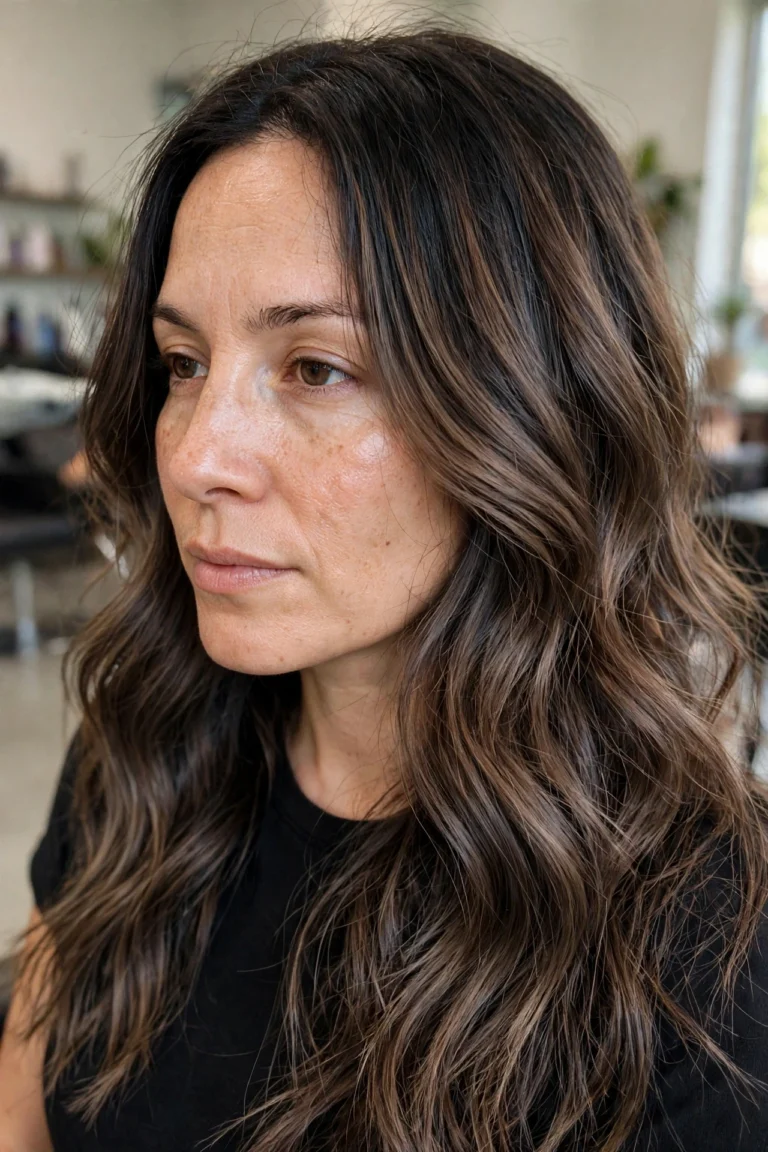
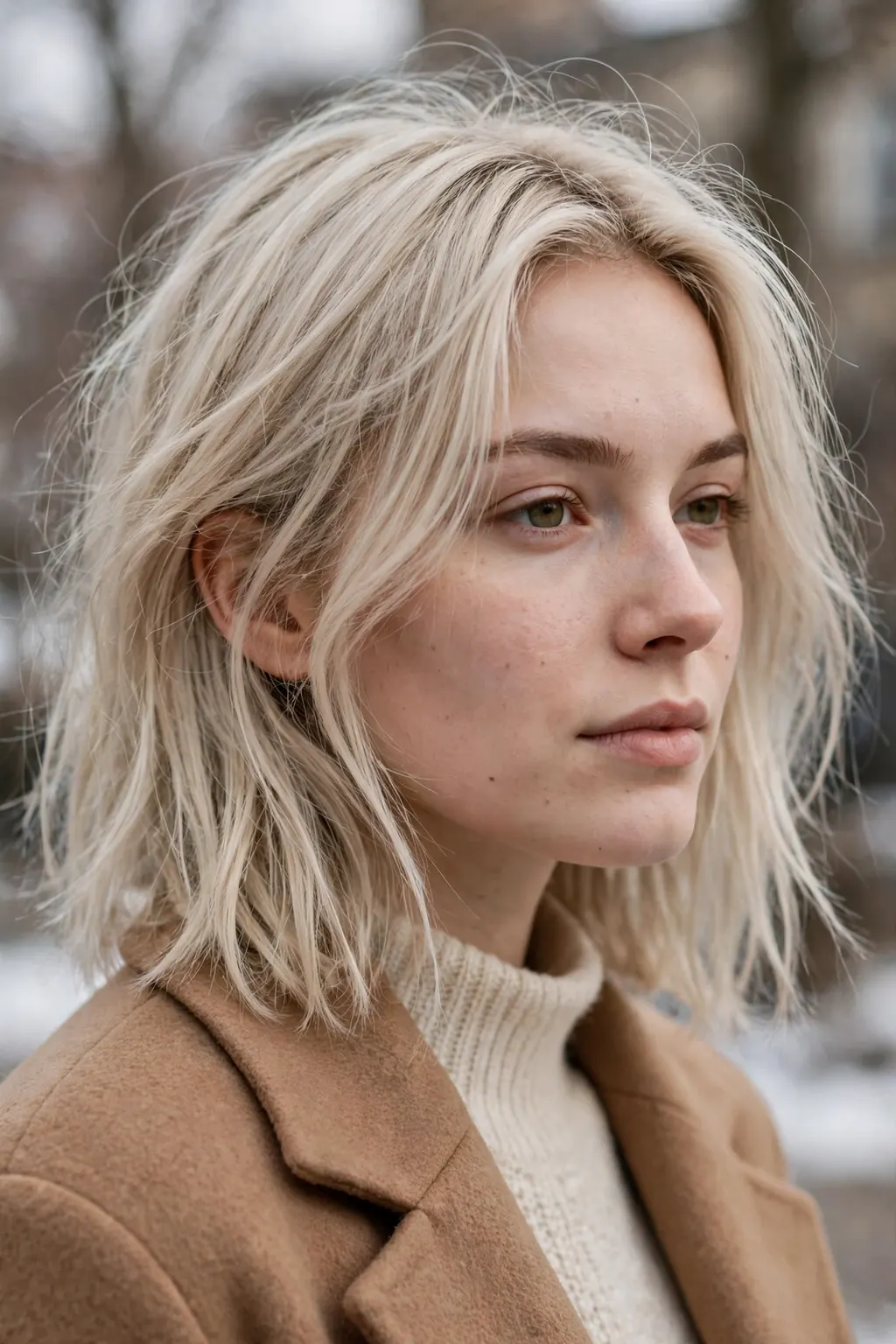
Stone Blond: The Cool Matte Blonde That Replaces Icy Platinum This Winter

Icy platinum had a long run, and it is ending the way bright trends always end: not because it looks bad, but because it looks like everyone. Stone blonde hair colour is what replaces it — a cool, matte blonde the colour of pale stone in winter light, with no shine, no yellow and no blue-grey cast. It reads as expensive because it reads as quiet: the hair looks like hair, only lighter, cooler and deliberately undone of warmth. This guide is the honesty check before you book it — the difference between stone and ice, the level your hair actually needs to reach, the full-head route for light bases, the balayage route for darker ones, the toning schedule that keeps it matte without tipping it grey, the winter light and makeup that keep a cool blonde looking alive, the breakage watch that every bleached blonde owes itself, and the exact salon script that gets you matte, not grey, not lavender. ‘Stone blond’ is a featured shade in Perfect Corp’s AW26–27 roundup, and winter 2027 colour roundups show silver-edged, matte blondes on the rise (plan fresh check, 7 Nov 2026) — the shade is arriving, and this guide is about arriving at it honestly. For more colour inspiration, start at AboutSuperstars (https://aboutsuperstars.com/).
Quick answer: Stone blond is a cool, matte blonde — pale, flat and stone-coloured, with no yellow and no shine. You need level 9–10 underneath it, a violet or blue toner kept on schedule, and a salon script that says “matte, not grey, not lavender”. It suits cool and neutral skin best.
Stone Blonde Hair Colour vs Ice: Why Matte Reads More Expensive Than Shiny-Pale

The difference between stone blond and icy platinum is not the lightness — both sit at level 9–10, the palest blonde there is. The difference is the finish. Icy platinum is shiny-pale: the hair reflects light, the tone is bright, and the overall read is polished and deliberate. Stone blond is matte: the hair absorbs light, the tone is flat and cool, and the overall read is quiet and expensive. Matte reads as more expensive for the same reason matte lipstick reads as more expensive than glossy lipstick — shine announces itself, matte does not, and the eye trusts what does not try to impress it. That is the whole argument for stone blond, and it is also the whole risk: a matte blonde with the wrong undertone reads as grey, and grey reads as dull, not expensive.
The practical difference is in the toner. Platinum is toned to bright — a violet toner that kills yellow and leaves a clean, bright pale. Stone blond is toned to flat — a toner with a touch of ash and a touch of beige, balanced so the yellow is gone but the brightness is gone too, and the result is a pale blonde that looks like stone in winter light: cool, quiet, with depth rather than shine. The mistake is asking for stone and getting platinum with a matte top coat, or asking for platinum and getting stone because the toner was left on too long — both are toner errors, and both are fixed by the salon script in the last section of this guide. The Soft Copper Blonde After Platinum guide (https://aboutsuperstars.com/soft-copper-blonde-after-platinum/) covers the other direction of this same decision — leaving platinum behind — and its transition logic applies here too: the shade you leave matters as much as the shade you arrive at.
📌 Save this distinction before you book — stone is matte, platinum is shiny-pale. Same level, different finish. If your blonde reflects light, it is not stone.
Who it suits best
Stone blond suits cool and neutral skin best, because its flat coolness matches a cool undertone — fair skin with pink or blue undertones, light olive skin, and the reader whose veins read blue at the wrist. It suits warm skin less naturally, because a cool matte blonde against warm skin can read as grey rather than stone, and the fix is a warmer base or a balayage route that leaves warmth at the roots. It suits straight and wavy hair best, because the matte finish shows on smooth lengths, and curly hair well, because the flat tone gives curls a stone-like depth — but very curly hair can read as dull in stone blond if the curls are not defined, so definition matters. It suits the reader who wears minimal makeup and quiet clothes, because the shade is a quiet-luxury blonde, and it suits the reader who is tired of platinum’s brightness more than any other — stone blond is, above all, the blonde for the reader who wants to be less bright.
How to ask for it (or do it at home)
At the salon, the sentence is: “Stone blond — a cool, matte blonde, level 9–10, toned flat, not bright. Matte, not grey, not lavender.” Then add the two details that make it stone rather than platinum: “An ash-beige toner, not a straight violet — I want the yellow gone and the shine gone too.” If you are doing it at home, the honest answer is not to: stone blond is a two-step colour — lift to level 9–10, then tone to flat — and the lift is the part that goes wrong at home, because an uneven lift shows through a matte toner in a way it never shows through a shiny one. If you must do it at home, lift in two sessions, tone with a violet-blue toner left on for half the recommended time, and check the result in daylight before deciding whether to tone again — matte is a toner decision, and it is reversible, where a bad lift is not.
Styling and upkeep
A stone blond needs almost no styling to look right, which is the point — but it needs the right care. The matte finish shows damage more honestly than a shiny finish does, so the hair must be conditioned well, with a weekly mask, because dry stone blond reads as straw and conditioned stone blond reads as stone. Style it smooth and straight for the full matte effect, or with soft waves for a lived-in version — the waves should be brushed out, not defined, because definition adds shine and shine is what stone blond is not. Refresh the toner every 2–3 weeks, not once, because a matte blonde warms up faster than a bright one — the yellow returns first at the roots, and the fix is a toner refresh, not a full recolour.
The Level You Need for Stone Blonde Hair Colour: An Honesty Check
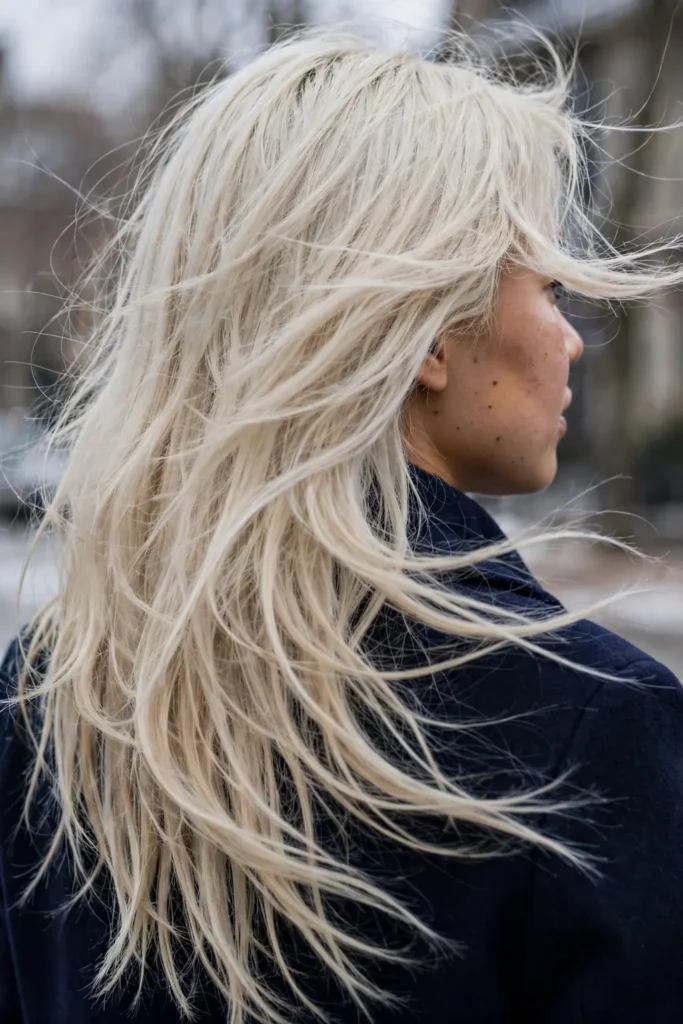
The honesty check is the level, and the level is non-negotiable: stone blond needs level 9–10 underneath it, the palest blonde there is, with the yellow lifted out before the toner goes on. Level 8 is not enough — at level 8, the hair is still gold, and no toner can make gold read as stone; the toner will sit on top of the gold and the result will be a warm blonde with a grey cast, which is the worst of both worlds. Level 9 is the minimum, level 10 is the ideal, and the difference between them is the difference between a stone blond that holds for three weeks and one that warms up in one. The check is simple: lift a strand in daylight, and if you can see yellow, you are not there yet — lift again, or choose the balayage route, which leaves the darker base alone and only lifts the lengths.
The second honesty check is the hair’s condition, because level 9–10 is a heavy lift for most hair, and a heavy lift on compromised hair is how breakage happens. If your hair has been bleached before, or coloured dark, or heat-styled daily, the lift to level 10 may cost more in condition than the shade is worth — and the honest answer is then the balayage route, or a darker stone, or no stone at all. A good colourist will tell you this before they start, and a colourist who will not is a colourist to leave. The third check is your own maintenance: stone blond needs toning every 2–3 weeks, a purple or blue shampoo once a week, and a mask once a week, and if that schedule sounds like too much, the shade is too much — there is no low-maintenance version of a level-10 blonde, matte or otherwise.
📌 Save this check before you book — level 9 minimum, level 10 ideal, and if you can see yellow in daylight, you are not there yet. A toner cannot fix a level it was never given.
The technique, step by step
The technique is lift, then tone, in that order, never together. First, the lift: bleach with a low developer, in sections, starting at the mid-lengths and ends, then the roots last, because the roots lift faster with scalp heat. Check the lift every ten minutes, and stop at pale yellow — the colour of the inside of a banana skin — because that is level 9–10, and lifting past it costs condition for no gain. Second, the tone: a violet-blue toner with an ash-beige balance, applied to damp hair, left on for the time your colourist judges by eye — usually less than the packet says, because stone wants flat, not grey, and over-toning is the error this shade is built around. Rinse, condition, and check the result in daylight before deciding whether a second, shorter tone is needed.
Common mistakes to avoid
The first mistake is lifting to level 8 and toning anyway: the result is a warm blonde with a grey cast, and the fix is to lift again, not to tone harder — more toner on a level-8 base only makes it greyer, not stonier. The second mistake is over-toning: leaving the toner on too long, or using a straight violet with no beige balance, so the blonde goes lavender or grey, and the fix is a clarifying wash or a warm gloss, not more toner. The third mistake is lifting in one session from dark hair: a dark base needs two lifts, spaced a week apart, and one aggressive lift is how breakage happens. The fourth is toning on dry hair, which takes the toner unevenly — tone on damp hair, always, and check the result in daylight, not salon light.
Products and tools that help
A low-volume developer (20 vol, not 30 or 40) is the lift’s most important product, because a slow lift is an even lift, and an even lift is what a matte toner needs. A violet-blue toner with an ash-beige balance is the tone’s most important product, and the balance is the point — straight violet goes lavender, straight ash goes grey, and the beige is what makes it stone. A purple shampoo, used once a week, is the maintenance product, and a weekly mask is the condition product, because a level-10 blonde without a mask is a blonde on a countdown to breakage. None of these is expensive; the cost of stone blond is in the salon time, not the product.
Full-Head Stone Blond for Light Bases
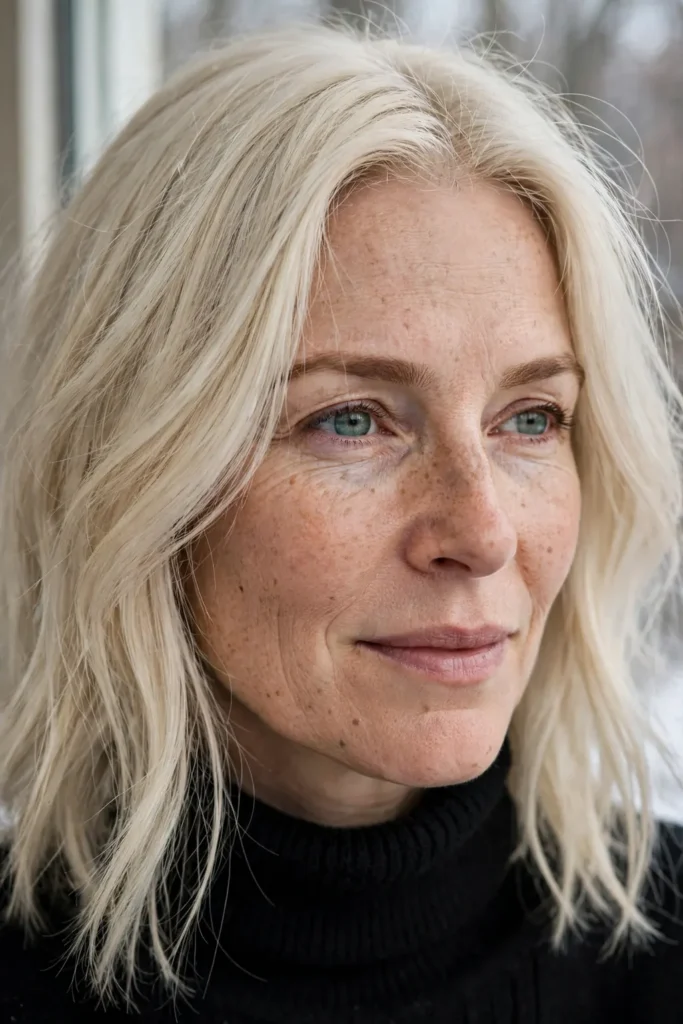
Full-head stone blond is the route for the reader whose base is already light — natural level 7–8, or previously lightened hair that has grown out to a light base. The whole head is lifted to level 9–10, then toned flat, and the result is a single, even, matte blonde from root to tip. It is the most dramatic version of stone blond, and the most honest: there is nowhere for an uneven lift to hide, and nowhere for warmth to hide either, so the lift must be even and the tone must be right. It suits the reader who wants the full stone effect — the pale, flat, quiet blonde — and who has the base and the condition to carry it. It does not suit the reader whose base is dark, because the lift from dark to level 10 in one session is the lift that breaks hair, and the balayage route is the honest answer there.
The routine is the same as the honesty check’s technique, done on the whole head: lift in sections, roots last, check every ten minutes, stop at pale yellow, tone to flat on damp hair, check in daylight. The difference is the scale: a full head takes two to three hours, and the regrowth shows in three to four weeks, because a level-10 root against a level-7 base is a visible line, and the maintenance is a root lift every four to six weeks, not a full recolour. The cost is a full-head colour service, and the time is the price of the shade — there is no shortcut to an even level-10 blonde, and a shortcut is how it goes wrong.
📌 Save this before you choose full-head — light base only, even lift, roots every 4–6 weeks. If your base is dark, this is not your route — balayage is.
Best for: hair types and face shapes
Full-head stone blond is best on fine to medium hair, because fine hair lifts evenly and the matte finish gives it a presence it would not otherwise have — fine hair in a shiny blonde can read as thin, and in a matte blonde it reads as deliberate. It suits straight and wavy hair best, because the even tone shows on smooth lengths, and it suits oval and long faces most, because the pale, flat colour frames the face without adding width. It suits thick hair well too, because the matte finish calms the volume, and it suits the reader with a light natural base best of all, because the lift is short and the condition cost is low. It is the best choice for anyone who wants the full stone effect and has the base to carry it without a heavy lift.
The exact salon wording
At the salon, the sentence is: “Full-head stone blond — lift to level 9–10, even, roots last, then tone flat with an ash-beige toner. Matte, not grey, not lavender.” Then add the two details that protect the result: “Low developer, check every ten minutes, and tone on damp hair.” If the colourist suggests a single aggressive lift from a dark base, say no — a dark base needs two lifts, spaced a week apart, and a colourist who will not space them is a colourist to leave. The wording matters because the lift is the part that goes wrong, and a colourist who hears “even” and “low developer” knows you are asking for the careful version, not the fast one.
Maintenance schedule
A full-head stone blond needs a root lift every four to six weeks, a toner refresh every two to three weeks, a purple shampoo once a week, and a mask once a week. The roots are the schedule’s driver: a level-10 root against a darker base shows in three weeks, and the fix is a root lift, not a full recolour, because re-lifting the lengths costs condition for no gain. The toner refresh is the schedule’s second driver: the matte fades first, the yellow returns second, and a toner refresh at two weeks keeps the stone flat where a toner refresh at four weeks is already a correction. The mask is the schedule’s insurance: a level-10 blonde without a weekly mask is a blonde on a countdown, and the countdown is measured in breakage, not in weeks.
Stone-Toned Balayage for Darker Bases (The Realistic Route)
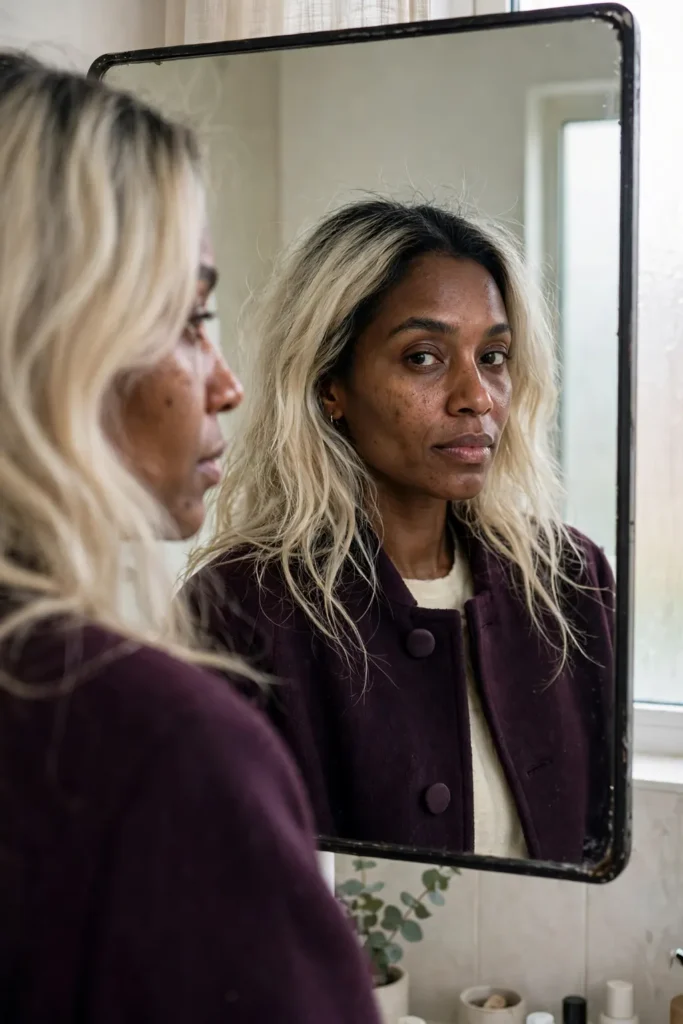
Stone-toned balayage is the realistic route, and it is the route most readers should take. The base stays dark — its natural level, or a darker colour — and only the lengths and ends are lifted, then toned to stone, so the result is a dark root melting into a cool matte blonde, with no harsh line and no full-head lift. It is realistic for three reasons: the lift is smaller, so the condition cost is lower; the regrowth is softer, so the maintenance is lighter; and the warmth that lives at the root is not a problem, because the root is not stone — only the ends are, and the ends are where stone blond looks best. In real life, a stone balayage reads as a lived-in blonde with a cool, matte finish, and it is the version of stone blond that survives a real winter, a real job and a real budget.
The technique is a freehand or foiled balayage, painted onto the lengths and ends, with the lightest pieces framing the face and the darkest pieces left at the nape, so the blonde reads as sun on stone rather than as a block. The lift goes to level 9 on the lightest pieces, level 8 on the mid-lengths, and the toner is the same ash-beige balance as the full-head route, applied to the lifted pieces only. The result is not a single flat colour — it is a dimension, a range from dark root to stone end — and that dimension is what makes the balayage forgiving: an uneven lift hides in the blend, a warm piece hides among the cool ones, and the regrowth is a softening, not a line. The 30 Hairstyles Ideas for Fine Hair guide (https://aboutsuperstars.com/30-hairstyles-ideas-for-fine-hair/) covers the fine-hair half of this decision — balayage is the blonde that gives fine hair its dimension without the full-head lift, and its layering logic applies here too.
📌 Save this before you choose balayage — dark root, stone ends, no harsh line. The balayage is the realistic route: smaller lift, softer regrowth, same matte finish where it shows.
What it looks like in real life
In real life, a stone balayage looks less like a colour and more like a light effect: the roots are your own, the mid-lengths are a cool brown-blonde, and the ends are stone — pale, flat, matte — and the three blend into each other without a line. It photographs beautifully, because the dimension gives the camera something to read, and it grows out beautifully, because there is no line to grow out — the root simply gets longer and the blend gets softer. The women whose stone balayage still looks good at eight weeks are the ones whose colourist left the root alone and painted the light where the sun would hit it: around the face, at the ends, and in a few pieces through the crown. The version to avoid is the balayage that is really a full-head blonde with a dark root painted on top — a hard line at the crown, and a blonde that starts all at once, which is a full-head colour with a root shadow, not a balayage.
Variations worth trying
If the full stone balayage feels like too much, scale it down without changing the logic: a face-frame only — the pieces around the face lifted to stone, the rest left dark — is the lightest version, and it gives the stone effect where the camera sees it, for half the time and half the cost. A money-piece plus ends — the face frame and the last two inches — is the middle version, and it is the one that photographs best. A full balayage with a root melt — the root blended down into the mid-lengths — is the most complete version, and it is the one that grows out best. The variation to avoid is the one that lifts the whole head to level 8 and calls it a balayage: a level-8 base toned stone is not stone blond, it is a warm blonde with a grey cast, and the honesty check in the second section is what catches it.
When to skip it
Skip the stone balayage when your hair is very dark and very thick, because the lift to level 9 on thick dark hair is a heavy lift even in balayage form, and the result can be patchy where the bleach did not penetrate evenly — a full-head lift in two sessions, or a darker stone, is the better call. Skip it if your hair is already compromised — bleached, coloured dark, heat-damaged — because even a partial lift costs condition, and a compromised base plus a level-9 lift is how breakage happens. And skip it if you want a single, even colour: balayage is dimension, not uniformity, and the reader who wants one flat stone from root to tip wants the full-head route, not this one.
Toning Schedules: Purple, Blue and the Over-Toning Trap
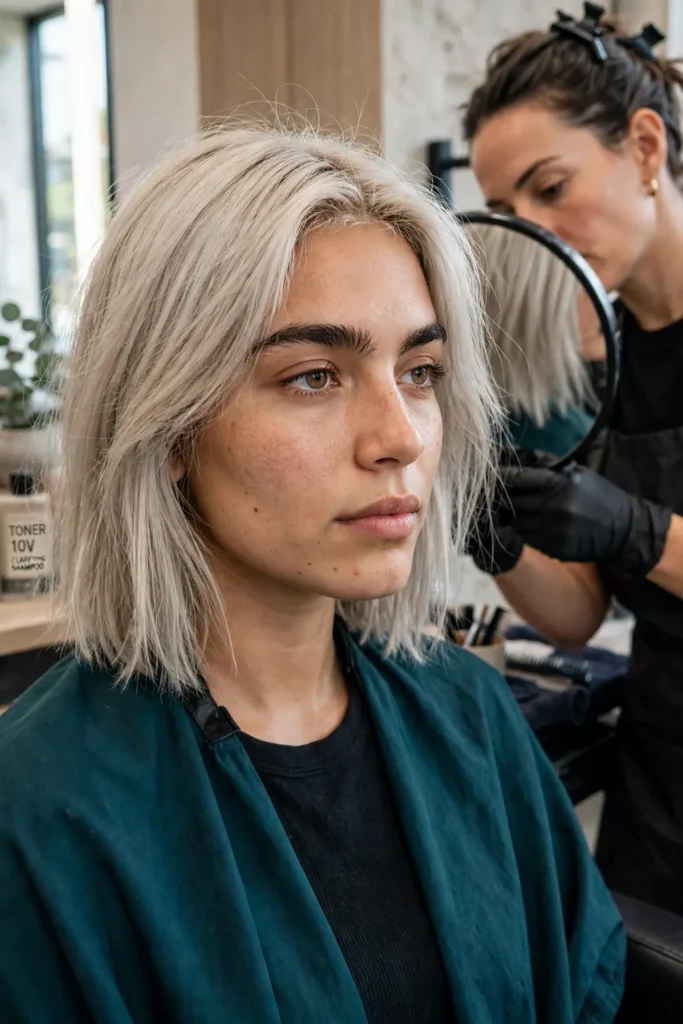
Toning is the schedule that makes stone blond, and it is also the trap that breaks it. The schedule is simple: a purple shampoo once a week, a blue shampoo once a fortnight if the yellow is stubborn, and a salon toner refresh every two to three weeks. Purple kills yellow, blue kills orange, and stone blond needs both killed — but not too much, because the over-toning trap is the other side of the same coin: too much purple, and the blonde goes lavender; too much blue, and it goes grey; too much of either, left on too long, and the matte becomes a cast. The trap is that over-toning feels like care — you are toning more because you care more — and the result is the opposite of what you wanted: a blonde that is cool, yes, but also grey, flat in the wrong way, and dull rather than stone.
The way out of the trap is to tone by eye, in daylight, and to stop before you think you should. A purple shampoo left on for two minutes is a maintenance dose; left on for ten, it is a colour. A salon toner is judged by the colourist watching the hair change, not by the clock, and the right moment to rinse is when the yellow is gone, not when the packet says so. If you have over-toned — lavender or grey, and the hair looks dull — the fix is a clarifying wash, or a warm gloss, or simply time: a few washes will lift the excess tone, and the stone will come back. The rule is: tone less often than you think, rinse sooner than you think, and check in daylight, always, because salon light hides the grey that daylight shows.
📌 Save this schedule before you buy the shampoo — purple once a week, blue once a fortnight, salon toner every 2–3 weeks. Tone by eye, rinse early, check in daylight. More toner is not more care.
Who it suits best
A toning schedule suits the reader who washes their hair two to three times a week, because the schedule is built around washes — a purple shampoo once a week is one wash in three, and a reader who washes daily will over-tone without meaning to. It suits cool and neutral skin best, for the same reason the shade does: the toner’s coolness matches a cool undertone, and on warm skin the same schedule can tip the blonde grey. It suits the reader who is willing to watch their hair — to check the tone in daylight, to notice the yellow returning, to rinse early — because toning is a judgement, not a routine, and the reader who tones on autopilot is the reader who over-tones. It suits, above all, the reader who understands that stone blond is a maintained colour, not a one-time colour, and that the maintenance is the shade.
How to ask for it (or do it at home)
At the salon, the sentence is: “Tone it flat, not grey — ash-beige, not straight violet. Rinse when the yellow is gone, not when the clock says so.” Then add the maintenance ask: “And show me the purple shampoo — how long do I leave it on, and how often?” If you are toning at home, the rule is half the recommended time, once a week, and check in daylight after every wash: a purple shampoo left on for two minutes is a maintenance dose, and a purple mask left on for ten is a colour, and the difference between them is the difference between stone and lavender. If the hair goes grey or lavender, do not tone again to fix it — wash it with a clarifying shampoo, or wait three washes, and the excess tone will lift.
Styling and upkeep
A toned stone blond needs the same upkeep as any level-10 blonde: a weekly mask, a heat protectant before styling, and a purple shampoo once a week, not more. The styling should be smooth and straight for the full matte effect, or softly waved and brushed out for the lived-in version — and the waves should be set with a cool shot, not a hot iron, because heat warms the tone and warmth is what the toner is fighting. The upkeep’s real discipline is the daylight check: once a week, look at your hair in daylight, and ask whether it is stone, grey or yellow — stone means the schedule is working, grey means tone less, yellow means tone more, and the answer is always in the mirror, not in the bottle.
Winter Light and Makeup: Making Cool Blonde Look Alive
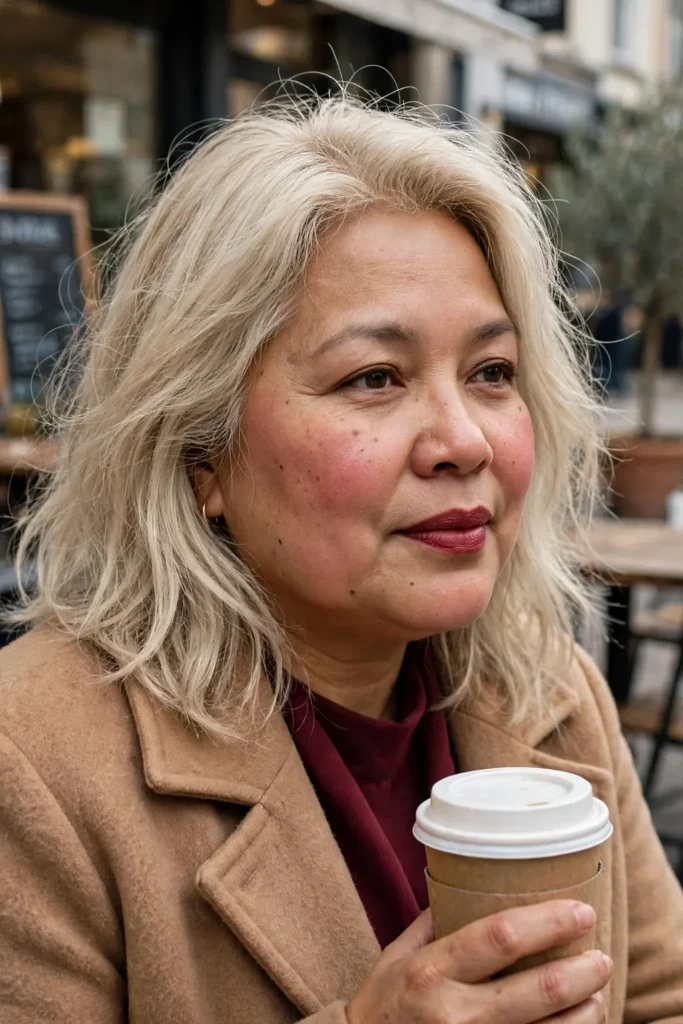
The risk of a cool matte blonde in winter is that it can look washed out, because winter light is already cool and flat, and a cool flat blonde in cool flat light can disappear into the background. The fix is not to warm the blonde — that would undo the shade — but to give the face something the blonde does not have: warmth in the makeup, definition at the eyes, and colour at the lips. A warm blush, a defined brow, a soft brown liner and a lip with some life in it — a rose, a berry, a warm nude — are what make a cool blonde look alive, because the face carries the warmth the hair does not. The reader who wears no makeup with a stone blond will look paler than she is; the reader who wears a little warmth will look deliberate, and the blonde will read as a choice rather than a wash-out.
The same logic applies to clothes: a stone blond against a grey coat in grey light is a lot of grey, and the fix is a colour somewhere in the outfit — a camel coat, a burgundy scarf, a deep green dress — something warm that the blonde can sit against. Winter light is the other half of the problem: it is low, flat and cool, and it flatters a matte blonde in a way summer light does not, because summer light is warm and bright and fights the matte. The stone blond’s best light is a winter morning — soft, cool, even — and its worst is a heated room at night, where the warm light turns the matte yellow. Check the colour in daylight, always, and trust the morning mirror more than the evening one.
📌 Save this before winter — warm blush, defined brow, a lip with life. The face carries the warmth the hair does not, and a camel coat beats a grey one against stone.
The technique, step by step
The technique is a five-minute face: a warm blush on the apples of the cheeks, blended up, not across; a brow filled in softly, because a stone blond can wash the brows out; a soft brown liner at the lash line, not black, because black against a matte blonde reads as harsh; a mascara that defines without clumping; and a lip — rose, berry or warm nude — with enough colour to anchor the face. The steps are in that order, because the blush is the warmth, the brow is the definition, and the lip is the anchor, and skipping any one of them leaves the face unfinished. The technique’s discipline is the mirror: check the face in daylight, with the hair down, and ask whether the blonde reads as a choice — if it does, the makeup is right, and if it does not, add warmth, not colour.
Common mistakes to avoid
The first mistake is no makeup at all: a stone blond with a bare face reads as washed out, because the blonde takes the colour from the face and gives nothing back. The second is cool makeup with a cool blonde — a grey eyeshadow, a mauve lip, a cool blush — which doubles the coolness and turns the whole face grey. The third is a black liner and a black mascara with no blush, which reads as harsh against a matte blonde, because the contrast is all at the eyes and nowhere else. The fourth is trusting the evening mirror: heated rooms and warm light turn a stone blond yellow, and a colour judged at night is a colour misjudged — check it in the morning, in daylight, and trust that mirror.
Products and tools that help
A warm cream blush is the most important product, because a cream blush sits on the skin like warmth rather than sitting on top of it like powder, and warmth is what the face needs. A soft brown liner is the second, because brown defines without harshness, and a brow pencil one shade warmer than the blonde is the third, because the brows are the frame the blonde sits in. A lip colour with life — a rose, a berry, a warm nude — is the fourth, and a camel or burgundy scarf is the fifth, because the outfit is part of the face’s frame. None of these is expensive; the technique is in the balance, not the product, and the balance is warmth against cool, not warmth instead of cool.
Breakage Watch: Cool Blondes Are Still Bleached Blondes
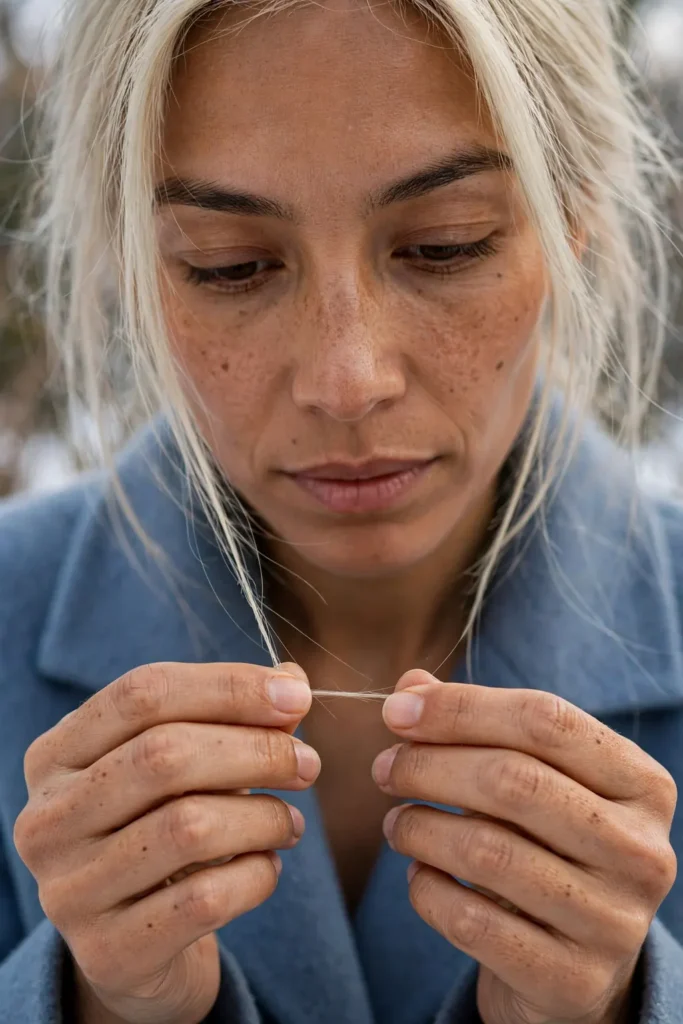
The warning in this section is the one the whole article depends on: cool blondes are still bleached blondes, and a level-10 lift is a level-10 lift whatever the toner on top of it. Stone blond is not a gentler blonde because it is matte — the matte is a toner, and the toner sits on top of a lift, and the lift is what costs condition. The breakage watch is therefore the same as for any platinum: the hair is porous, the ends are fragile, the elasticity is reduced, and the signs of trouble are the same — hair that stretches and does not spring back, ends that feel like cotton wool, breakage at the crown where the heat and the bleach meet, and a texture that goes from smooth to rough in a week. If you see those signs, the shade is not the problem and the toner is not the problem — the lift is, and the fix is to stop lifting, to cut the ends, and to rebuild with protein and moisture before any more colour.
The prevention is the routine: a low developer, a spaced lift, a weekly mask, a protein treatment once a fortnight, a heat protectant before every hot tool, and a bond-builder in the salon if your colourist offers one. The routine’s discipline is the elastic test: once a week, take a single strand, wet it, stretch it gently, and watch — if it springs back, the hair is healthy; if it stretches and stays stretched, the hair needs protein; if it snaps, the hair needs a cut and a rest, not more colour. The test takes ten seconds, and it is the most honest measurement in this whole guide, because the mirror shows the colour and the strand shows the condition, and the condition is what decides whether the colour can continue.
📌 Save this before you lift — do the elastic test weekly. If the strand stretches and stays stretched, the hair needs protein; if it snaps, it needs a cut, not more colour.
Best for: hair types and face shapes
The breakage watch suits every hair type, because every level-10 blonde is a bleached blonde, and the watch is the price of the shade. It suits fine hair most urgently, because fine hair has less to lose — a fine strand that breaks is a visible gap, where a thick strand that breaks is a hidden one — and it suits thick hair too, because thick hair hides damage until the damage is severe. It suits straight hair most visibly, because breakage shows as flyaways on a smooth surface, and curly hair most quietly, because breakage hides in the curl — which is why curly-haired readers should do the elastic test even more faithfully, because the mirror will not warn them. It suits, above all, the reader who has been blonde before and knows the cost, because that reader will not be surprised by the watch — and the reader who has never been blonde should read this section twice.
The exact salon wording
At the salon, the sentence is: “I want stone blond, but I want my hair afterwards too — low developer, bond-builder if you have it, and tell me honestly if my hair can take the lift.” Then add the condition ask: “And after the colour, what is the protein schedule — how often, and what do I use at home?” If the colourist says the hair cannot take it, believe them — a colourist who turns work away is a colourist who cares about the hair, and the shade will still be there in three months, when the hair is stronger. The wording matters because the lift is the part that costs condition, and a colourist who hears “tell me honestly” knows you are asking for the truth, not the sale.
Maintenance schedule
A stone blond’s maintenance schedule is a condition schedule first and a colour schedule second: a weekly mask, a protein treatment once a fortnight, a heat protectant before every hot tool, a purple shampoo once a week, and a salon toner every two to three weeks. The mask is the schedule’s foundation, because moisture is what a bleached blonde loses first; the protein is the schedule’s structure, because protein is what rebuilds the strand; and the heat protectant is the schedule’s insurance, because heat on a level-10 blonde is the fastest route to breakage. The ends should be trimmed every eight weeks, not twelve, because a level-10 end splits faster than a virgin end, and a split end left alone travels up the strand. The schedule is the shade’s real cost, and it is measured in time, not money.
Salon Script: ‘Matte, Not Grey, Not Lavender’
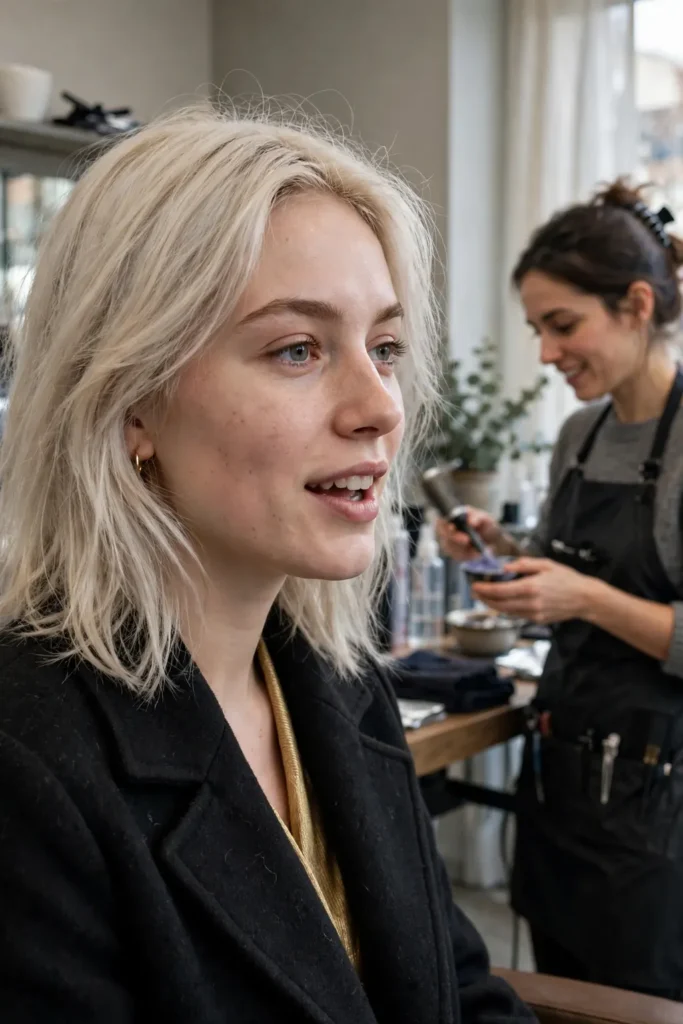
The salon script is the whole article in one paragraph, and it is the paragraph to carry into the appointment. Say: “Stone blond — a cool, matte blonde, level 9–10, toned flat. Matte, not grey, not lavender. An ash-beige toner, not a straight violet — I want the yellow gone and the shine gone too. Low developer, lift in sections, roots last, check every ten minutes, tone on damp hair, rinse when the yellow is gone.” Then add the maintenance line: “And show me the purple shampoo — how long, how often — and the mask I should use at home.” That is the script, and it is the difference between a stone blond and a grey one, a lavender one, a warm one, or a broken one — because every error in this guide is a toner error or a lift error, and the script names both before they happen.
The script works because it gives the colourist the three decisions that matter — the level, the toner balance, and the rinse moment — and it gives them in the colourist’s own language, not the client’s. A colourist who hears “ash-beige, not straight violet” knows the tone you want; a colourist who hears “matte, not grey, not lavender” knows the two errors to avoid; and a colourist who hears “rinse when the yellow is gone” knows you are asking them to judge by eye, not by the clock. If the colourist disagrees — if they say your base needs two lifts, or your hair needs a rest, or the shade will not suit your skin — listen, because the script is a starting point, not a demand, and a colourist who corrects the script is a colourist who is doing their job.
📌 Save this script before your appointment — “Matte, not grey, not lavender. Ash-beige, not straight violet. Rinse when the yellow is gone.” Say it before the colour starts, not after.
What it looks like in real life
In real life, a good salon script sounds like a conversation, not a demand: the client says the shade, the colourist asks about the base, the client says the level, the colourist checks the condition, and together they decide whether the lift happens today or in two sessions. The women whose stone blond looks best are the ones whose appointment started with that conversation, because the colourist knew the target and the limits before the bleach was mixed. The appointment that goes wrong is the one that starts with a photograph and no words — a picture of a stone blond on a model with a level-10 base, shown to a colourist who has not checked yours — and the fix is always the same: say the script, listen to the answer, and let the colourist’s honesty shape the plan.
Variations worth trying
If the full script feels like too much for a first appointment, scale it down without changing the logic: say the shade and the toner balance — “stone blond, ash-beige toner, matte not grey” — and let the colourist ask the rest. If you are a regular at the salon, add the history — “last time we lifted to level 9, this time I want the tone flatter” — because the colourist’s memory is the best record of your hair. If you are trying a new salon, bring a photograph and the script together, because the photograph shows the target and the script shows the limits, and a new colourist needs both. The variation to avoid is the one that drops the toner balance: “stone blond” on its own is a shade, not a recipe, and without “ash-beige, not straight violet” the colourist will guess — and the guess is usually lavender.
When to skip it
Skip the script — and the appointment — when the colourist will not discuss the level, the toner or the condition, because a colourist who will not talk is a colourist who will not listen, and a level-10 lift deserves a conversation. Skip it when your hair fails the elastic test, because a strand that snaps is a strand that needs a rest, not a colour, and the shade will still be there in three months. And skip it when you cannot commit to the maintenance — the toner every two to three weeks, the mask every week, the purple shampoo once a week — because stone blond without maintenance is a blonde that warms up, greys out or breaks, and the script is only the beginning of the shade, not the whole of it.
Frequently Asked Questions
What is stone blond hair colour?
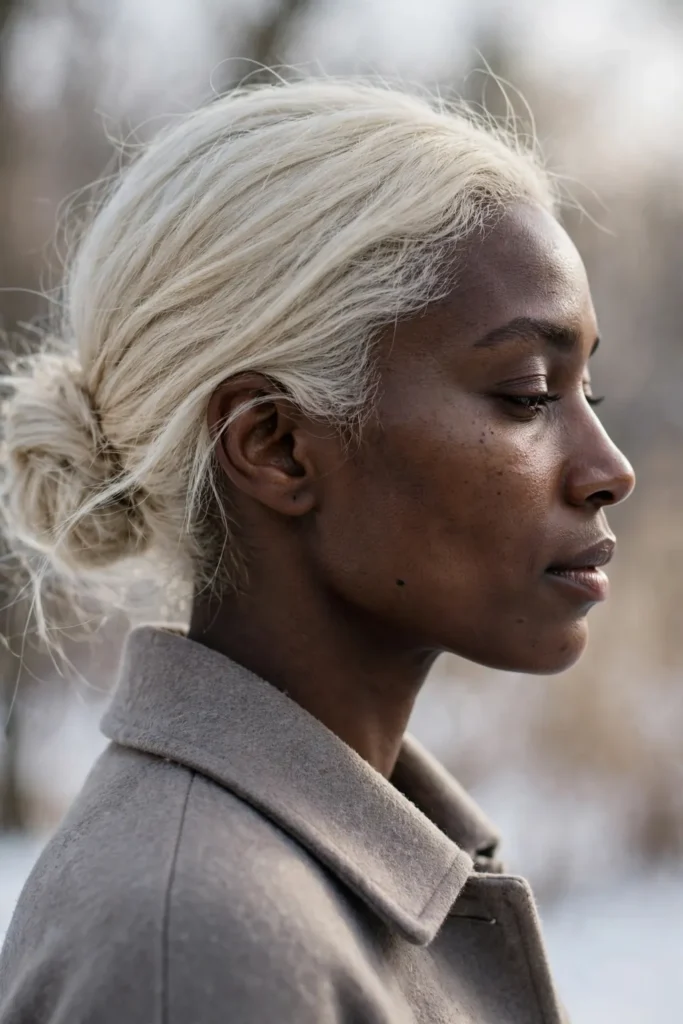
Stone blond hair colour is a cool, matte blonde — pale, flat and stone-coloured, with no yellow and no shine. It sits at level 9–10, the palest blonde there is, and it is toned flat with an ash-beige toner, not bright like icy platinum. It is a featured shade in Perfect Corp’s AW26–27 roundup, and winter 2027 colour roundups show silver-edged, matte blondes on the rise. It suits cool and neutral skin best, and it is high maintenance by nature: toning every 2–3 weeks, not once.
Is stone blond high maintenance?
Yes — by nature, not by accident. A level-10 blonde needs a root lift every four to six weeks for a full head, a toner refresh every two to three weeks, a purple shampoo once a week, and a weekly mask, because the matte fades first, the yellow returns second, and the condition is what decides whether the colour can continue. The balayage route is lighter — softer regrowth, no root line — but it still needs the toner schedule, because a matte blonde warms up faster than a bright one.
Who suits a cool matte blonde?
A cool matte blonde suits cool and neutral skin best — fair skin with pink or blue undertones, light olive skin, and the reader whose veins read blue at the wrist. It suits warm skin less naturally, because a cool matte blonde against warm skin can read as grey rather than stone, and the fix is a warmer base or a balayage route that leaves warmth at the roots. It suits straight and wavy hair best, because the matte finish shows on smooth lengths, and the reader who wears minimal makeup and quiet clothes, because the shade is a quiet-luxury blonde.
Conclusion: Stone Blond — Your Next Step

Stone blond is not a lighter platinum, and it is not a safer blonde — it is a different blonde, and it asks for a different honesty. The level must be 9–10, the toner must be ash-beige, the rinse must be by eye, and the maintenance must be every two to three weeks, not once. If your base, your skin and your schedule can carry that, the shade is the quietest, most expensive-looking blonde of the winter — pale, flat, stone-coloured, and deliberate. If any of the three cannot, the balayage route is the honest answer, and a darker stone is the honest compromise. Either way, the next step is the same: do the elastic test, check the level in daylight, and carry the script into the salon.
The bottom line: stone blond is matte, not grey, not lavender — level 9–10, an ash-beige toner, rinsed by eye, and the shade is only as good as the maintenance behind it.